BABY COLLECTION
BABY COLLECTION
Couldn't load pickup availability
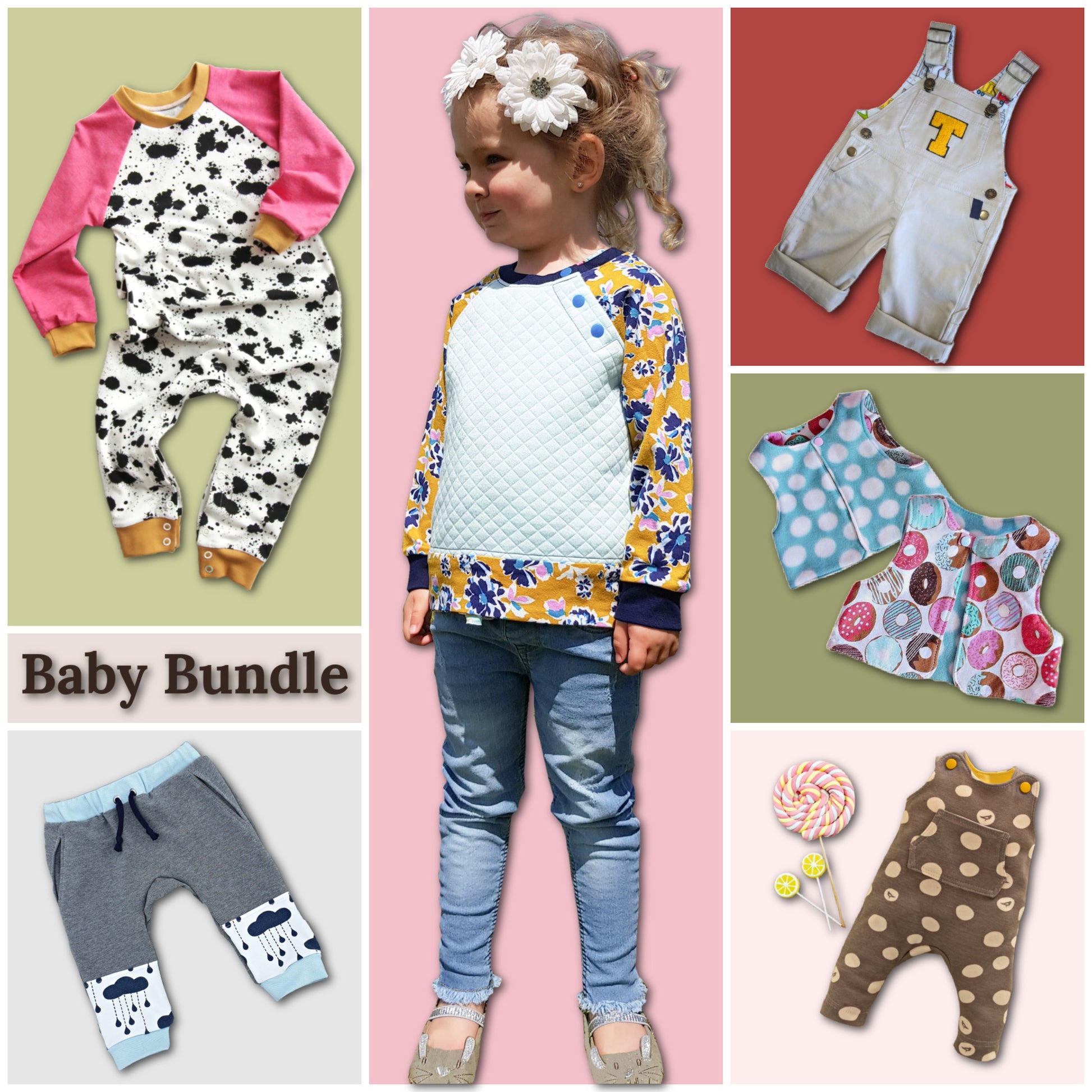
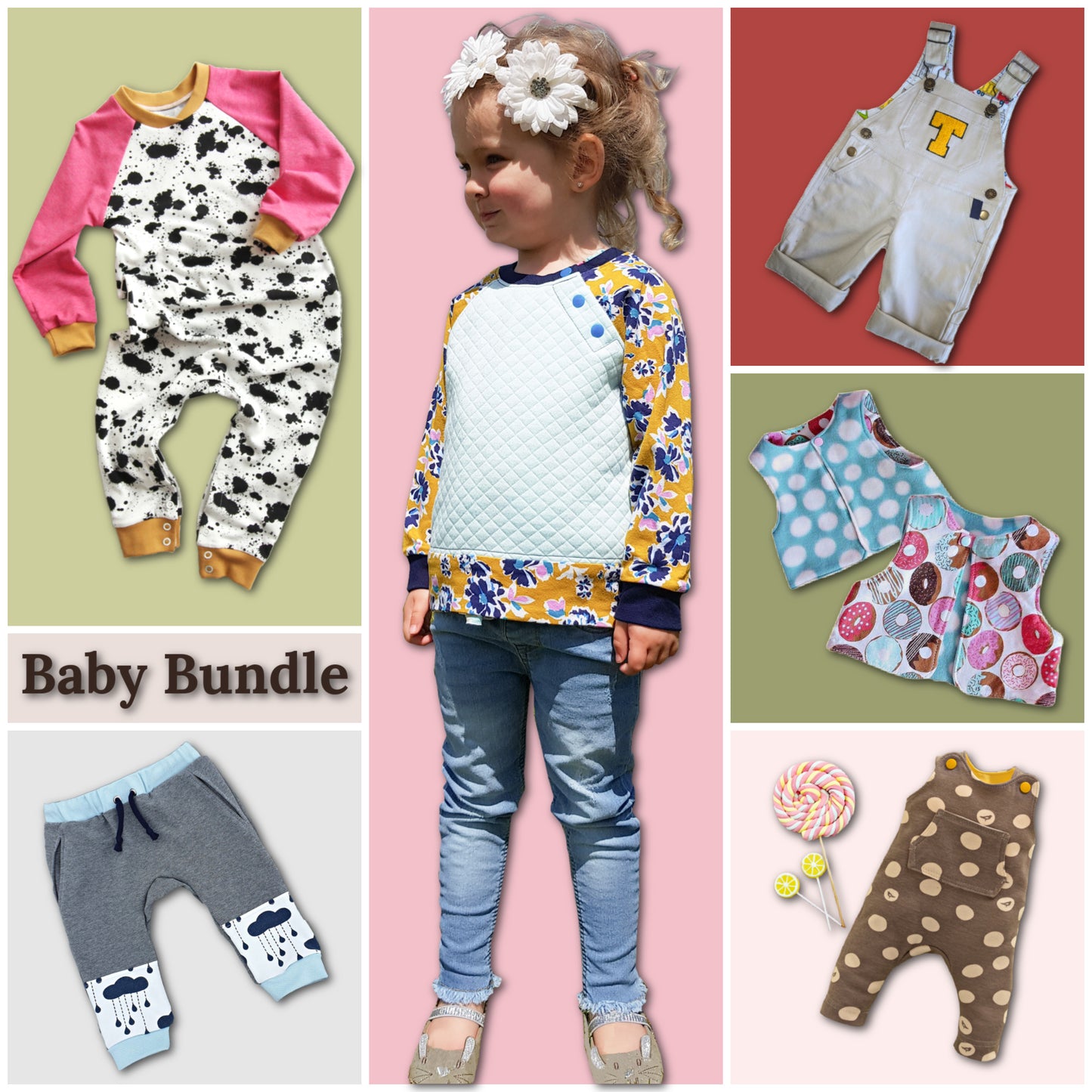
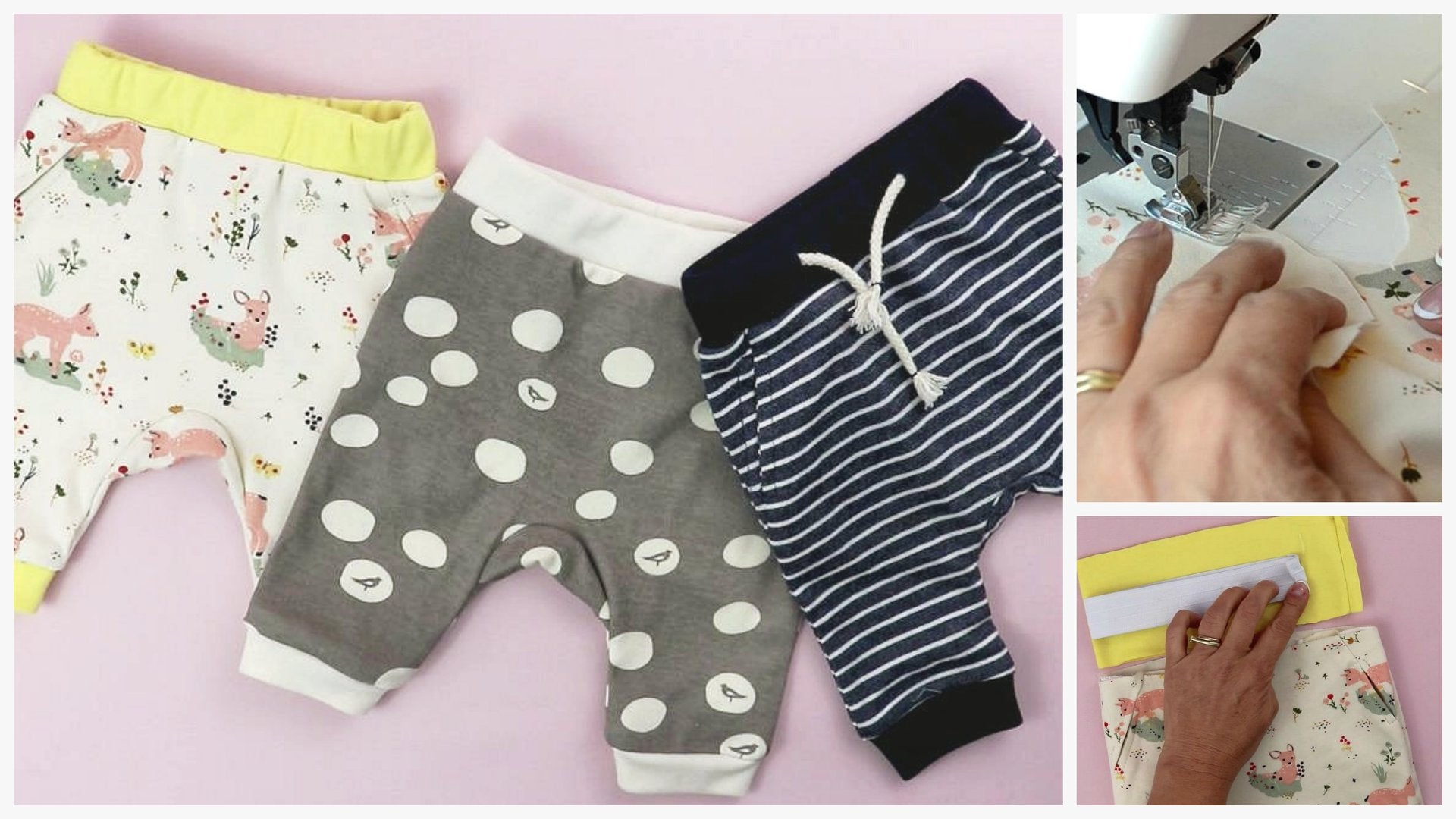
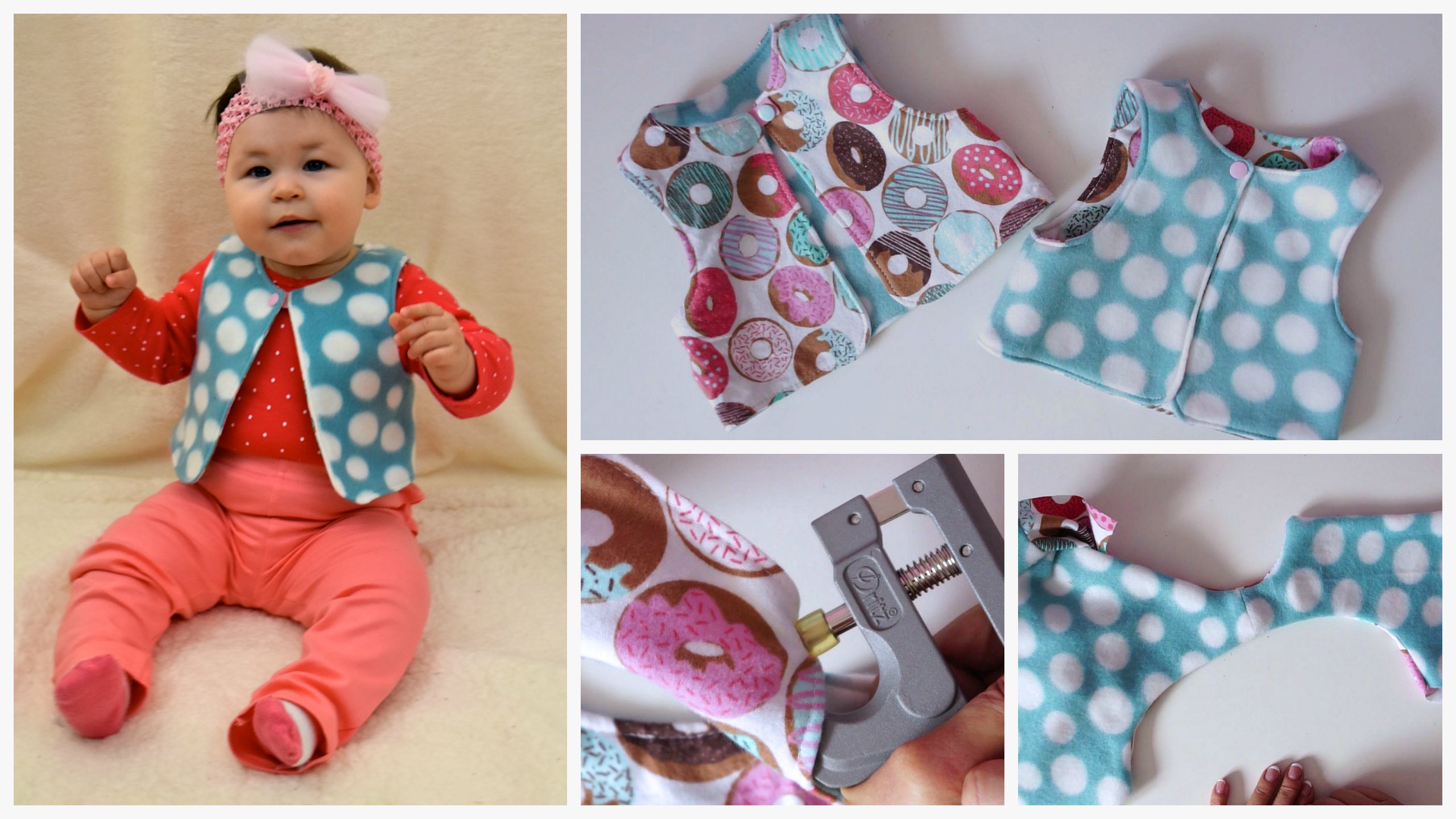
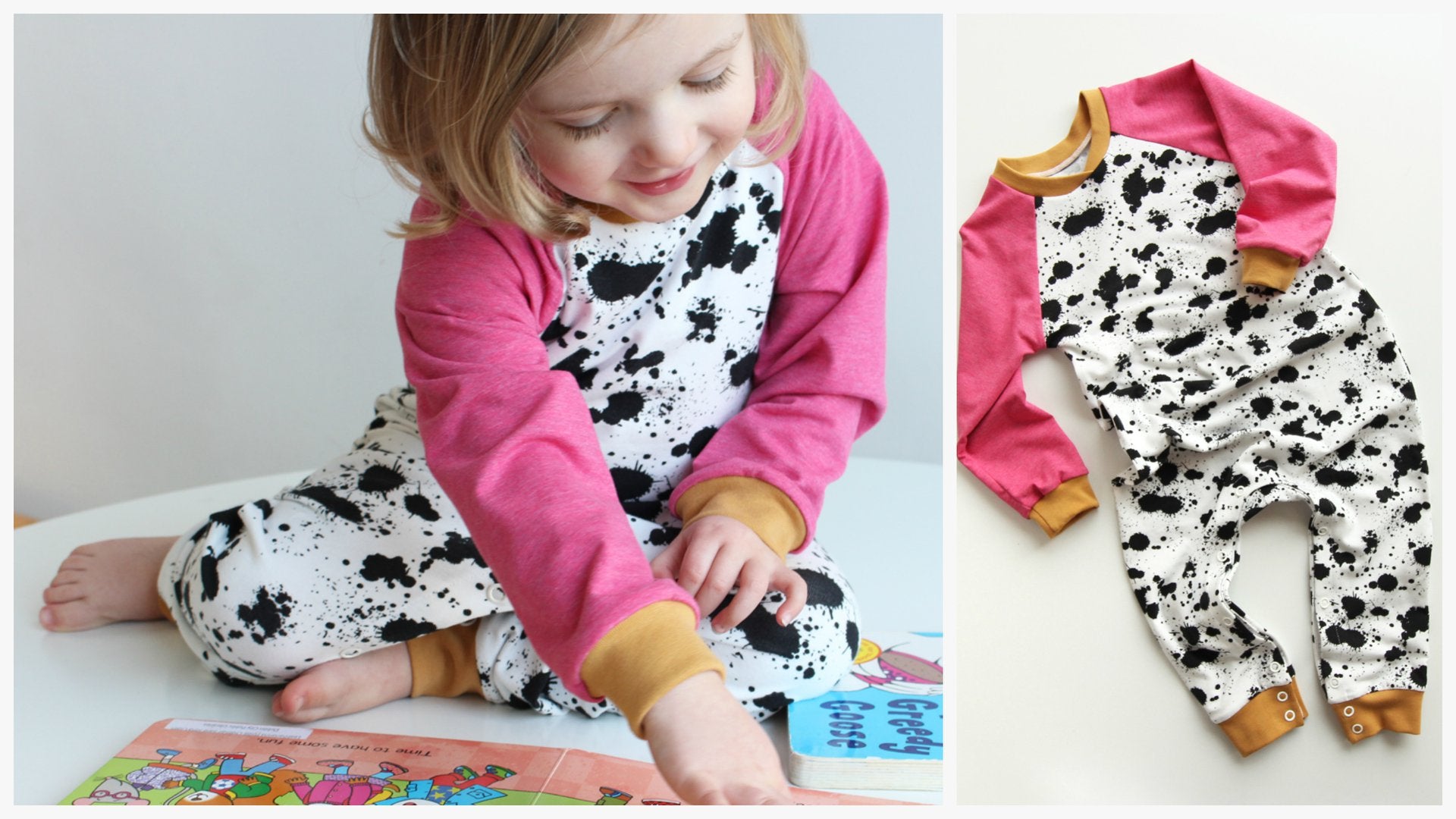
Aww, look at this adorable sewing bundle! All your favourite baby patterns gathered into one sweet package — and all at a tiny price. Comfy pants, a sweater, vest, dungarees and romper await!
Each pattern comes with step‑by‑step video tutorials, guiding you through every stitch. The dropdown menu below links to each individual pattern, where you’ll find all the video tutorials waiting for you.
Pattern Download Includes
- Instant Download
- DIN A4 & US Letter Size
- Individual PDF files for every Size
- All Sizes included
- Detailed eBook
- Video Tutorials
Design Options
Design Options
Please refer to the individual listings:
Fabric Requirements
Fabric Requirements
Please refer to the individual listings:
Available Sizes
Available Sizes
Size: Newborn - 3 Years
Classic Vest: 6 Months - 12 Years
Please Read
Please Read
- This is a digital pattern or PDF file, not a physical product. It will be delivered electronically via a download link delivered to the email used for the purchase.
- To ensure the pattern prints at its actual size, it's recommended that you use Adobe Acrobat Reader.
- The pattern creator, Frocks & Frolics, welcomes small-scale production using their patterns.
Customers are encouraged to tag Frocks & Frolics when sharing projects made using their patterns on social media.
@frocksandfrolics #frocksandfrolics
Share

STEP-BY-STEP VIDEO TUTORIALS
VIDEO TEXT
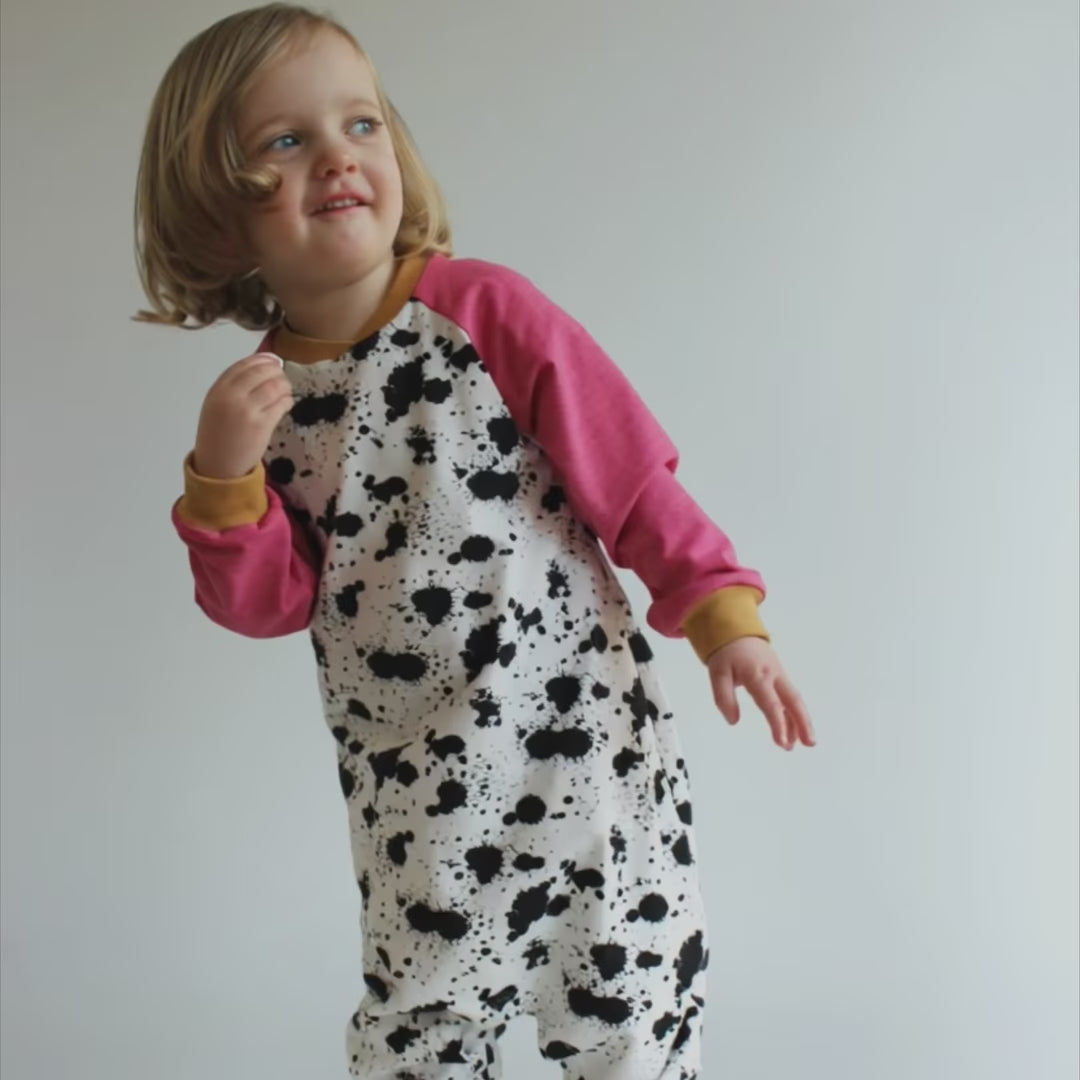
How to sew a Baby Romper
Transcript for the Video: Dungies - All-in-One-Video
Hello YouTube, I have a new project for you, my sewing friends.
We’re going to sew this Romper together in just a moment.
This is so cute.
We have a little pocket down here, and I’ll show you exactly how that works.
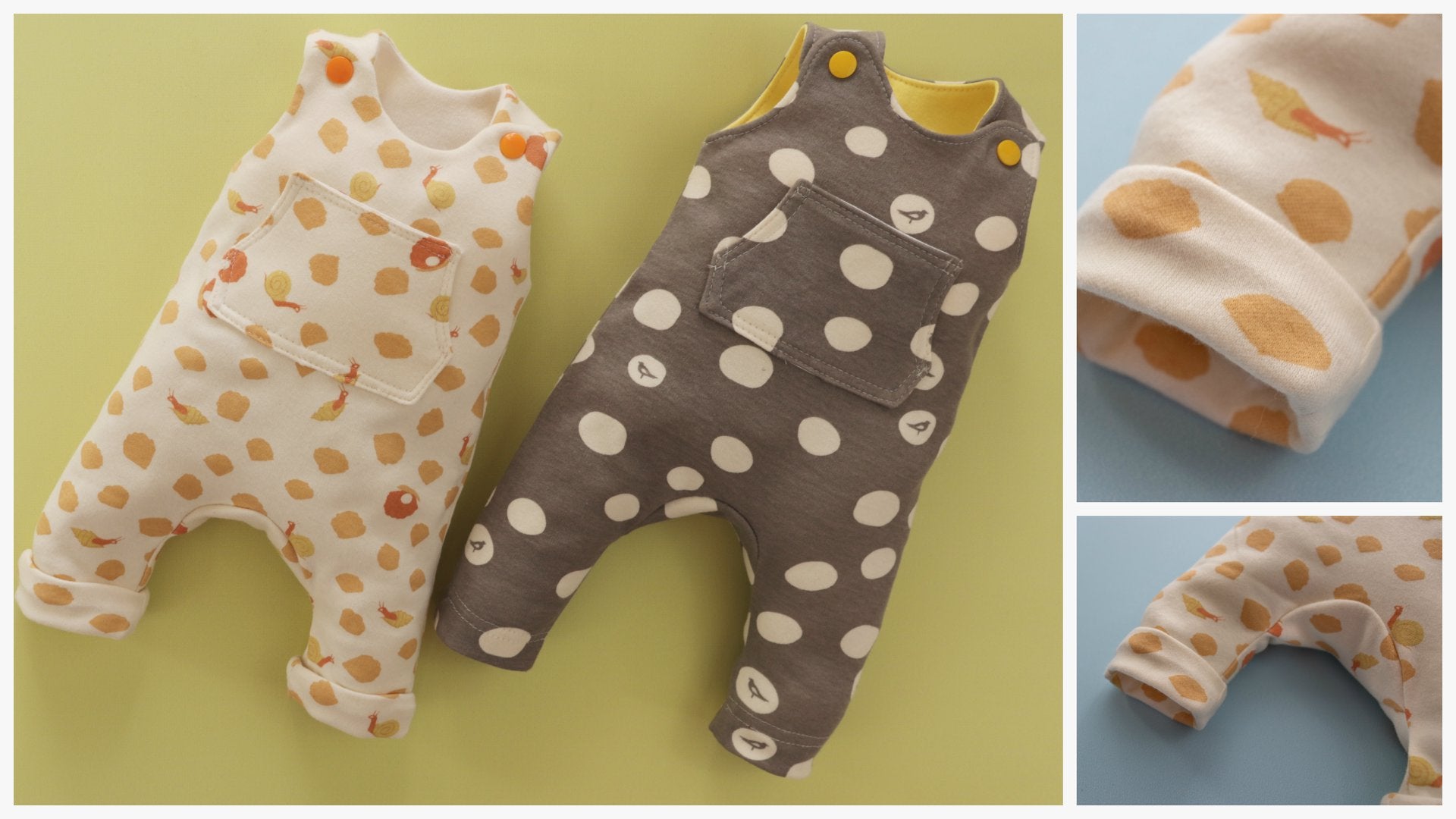
Then we have a wonderful cuff at the bottom — normally it looks like this — but here I’ve made a fake turn‑up, which isn’t a real turn‑up at all.
I’ll show you exactly how that works.
It’s a fantastic technique you might want to remember.
More Pieces from the Collection
I’ve sewn another one, with a striped fabric, and added a little fire engine motif on the front — super cute.
And here’s a little preview of the other pieces in this collection:
- a simple little pair of pants with elastic at the top
- very simple little cuffs at the bottom
- and a matching top in the same fabric
I’m using a wonderful organic fabric — it’s hard to describe how it feels, but organic fabric is just softer, denser, and simply lovely.
The Dungarees
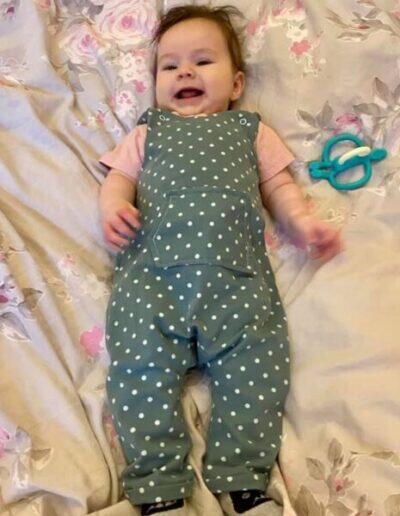
The highlight is this adorable pair of dungarees — really stylish.
They also have a fake turn‑up.
Another variation I want to show you:
there’s a seam at the back, so we don’t need a gusset — also nice.
I made one with polka dots and another with checks — both super cute.
I hope you enjoy all of this.
These techniques — like how to create an opening — are really fun to learn, and of course I’ll show you everything.
A Little Bremen Story
I also wanted to tell you something:
I’m from Bremen, as many of you know.
I started this collection with these little fabrics, and my husband said:
“Marina, that’s blue and white stripes again!”
And I thought — oh dear, he’s right.
I almost added red buttons — blue, white, red, like most people from Bremen.
I didn’t even notice until he said it.
But I added red KamSnaps at the top — so it fits again, right?
Start Sewing
If you want to get started right away with the ponies and our super cute little romper, you can — the patterns are already available on frocksandfrolics.com and in the Academy with the video.
Now we can begin with the pattern and cutting.
Pattern Overview
We have a beautiful pattern: front piece, back piece.
Each size has its own pattern — great for beginners because I can write more on it without confusing you.
For example, “attach here” — that tells you where the gusset goes.
At the top you have the button positions.
I can add more information without overwhelming you with lines everywhere.
Here it also says how many pieces to cut:
once in contrast or main fabric, on the fold.
Down here you can see the gusset — every good baby pattern should have one, unless it’s a normal trouser shape with a shaped back.
If not, always look for a gusset — in patterns you buy and in baby clothes you buy in shops.
Cutting the Fabric
I’m using a wonderful organic fabric from Birch in America — really great, stretches both ways.
My facing is also knit fabric.
I need stretchable fusible interfacing this time.
I have my pattern and a small piece of cotton for the pocket.
Here’s a tip:
I don’t cut the interfacing and facing separately — I do it in one go.
Cut the amount you need, place the interfacing underneath, and fuse it to the wrong side of the fabric.
Stretch interfacing is annoying to cut — it sticks to the scissors — so this method is much easier.
Then fold the fabric, place the facing on the fold, and cut.
Do the same with the front piece — and you’re done.
Always mark front and back center.
Sewing the Pocket
Place the pocket pieces right sides together — very simple — and sew all the way around.
Keep the needle in the fabric when sewing curves.
Important: leave a bigger turning gap than I did.
I left a tiny one — lazy me — and it makes it hard to get nice edges.
I recommend a 5 cm turning gap.
Clip only the curves — do not cut off the corners.
They sit better when left intact.
Use a pin to push out the edges.
Here’s the trick:
Lay the seam allowances on top of each other, press with your thumb, push to the other side, hold with a pin — perfect edge.
Topstitching the Pocket
Topstitch the curve on both sides — one or two lines, as you like.
Now attach the pocket:
- place the pattern on the front
- fold the pocket
- see the exact position
- pin
You can place it higher or lower — personal preference.
Sew across the top and along the curve — once or twice.
If you have striped fabric, you can add a motif or even embroider something.
Attaching the Gusset
We have a little corner sticking out — that’s where the gusset goes.
Simply sew around — without pins is easier.
Bring the edges together, sew around.
With a bit of practice it’s very easy.
The sticking‑out corner shows you exactly where to start and stop.
Knit fabric stretches, so it’s even easier.
Now serge and press the seam allowance into the gusset.
Attaching the Facings
Pin the facings at the underarm seam and at the top.
Sew from underarm to underarm.
When sewing curves:
- lift the presser foot
- keep the needle in
- push the fabric inward, never pull
Knit fabric stretches — pushing inward keeps the shape correct.
Shaping the Curves
After turning, push out the curves.
If you see little bumps, use a pin to push them back into the seam — after pressing, no one will ever see them.
Inner Leg Seam
Place front and back together.
Match the markings.
Pin from the gusset outward.
It feels like inserting a sleeve — but easier because knit stretches.
It looks like too much fabric — but it’s just the curve.
The gusset gives the baby enough room for the diaper.
Now serge and press into the back.
Side Seams
Topstitch both sides and the lower edge of the facings.
Place right sides together, pin the underarm, and sew.
You don’t need many pins.
I press the seam allowances open — flatter and nicer.
Fake Turn‑Up Hem
Now I’ll show you how to sew a fake turn‑up.
You can serge all around and fold up 2.5 cm, or fold up without serging — but 2.5 cm looks best.
Sew from the inside — much easier.
Sew very close to the edge.
Then roll up 0.5–1 cm — both legs the same.
Do not press the edge beforehand — makes it harder.
After sewing, press well — looks perfect.
Final Steps
These adorable dungarees take 20–40 minutes depending on your speed.
The turn‑ups look super cute and very professional.
You can also topstitch around the top — I didn’t here, but you can.
Jelly Bean Sweater: From Start to Finish
Transcript for Video: Jelly Bean Sweater - From Start to Finish
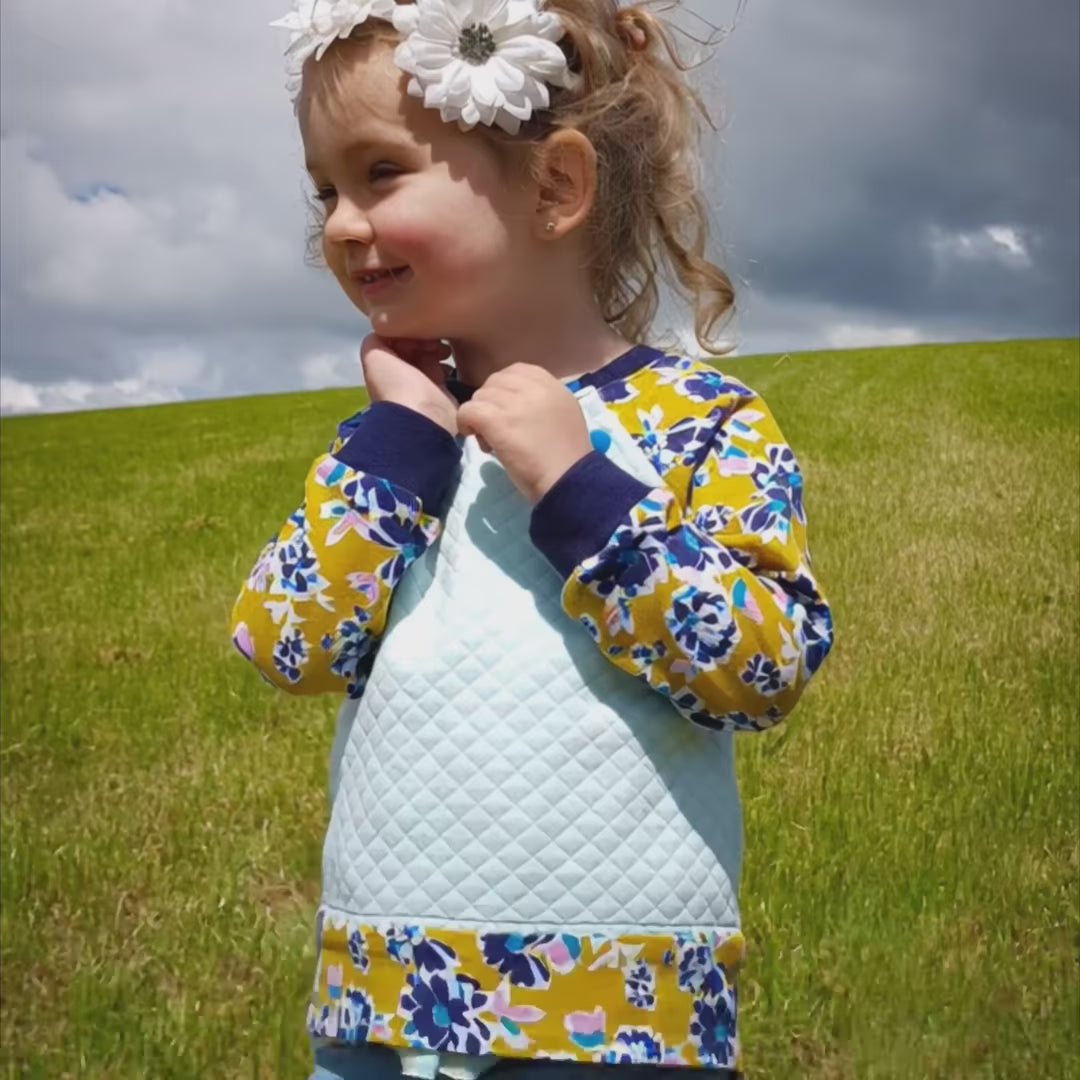
And it's a really nice pattern because it has got a closure, which means that if your kid has a problem with something going over their head, then it's no issue either because you've got the closure which you can open up. And I think it's a great technique to put into your little box of things that you know how to do. It's very, very simple to do. It's actually not complicated — we're just working with two facings here really, and they just go on top of each other and that's it.
The problem doing this was to do the pattern for you — now that wasn't easy. But now you've got the pattern, it's awfully easy.
About My Patterns
All my patterns, as some of you might already know, come in single files.
So for all the children's patterns you've got one file per size, and of course you get all the sizes that are included with the pattern.
That means:
- you can cut it out in any type of space
- you don't need much room
- you don't waste paper
- smaller sizes fit on fewer sheets
- you keep your sanity
For example:
A size 3 might have 6–7 pages, while a size 8 might have 12 pages.
Matching Jogger Bottoms
What goes with this gorgeous little sweater are these Java bottoms.
They have some really ingenious pockets which were pretty difficult to do — but they're not proper welt pockets. They’re practiced seams, and well… there's a trick to it.
There is a video here on YouTube for that as well.
I’m going to put the link in the top right-hand corner of this video, and it's also in the info box so you can find everything you need down there.
I think they make a really, really super pair together.
Suitable Fabrics
Let’s begin and have a look at what fabrics are suitable.
Here I've used some sweatshirt fabric, which is really cool.
It only has two-way stretch, and not even that much. You don't need a lot of stretch because the sweatshirt is quite roomy.
But you should not use:
- woven fabric with no stretch
- very lightweight fabrics
That will not work.
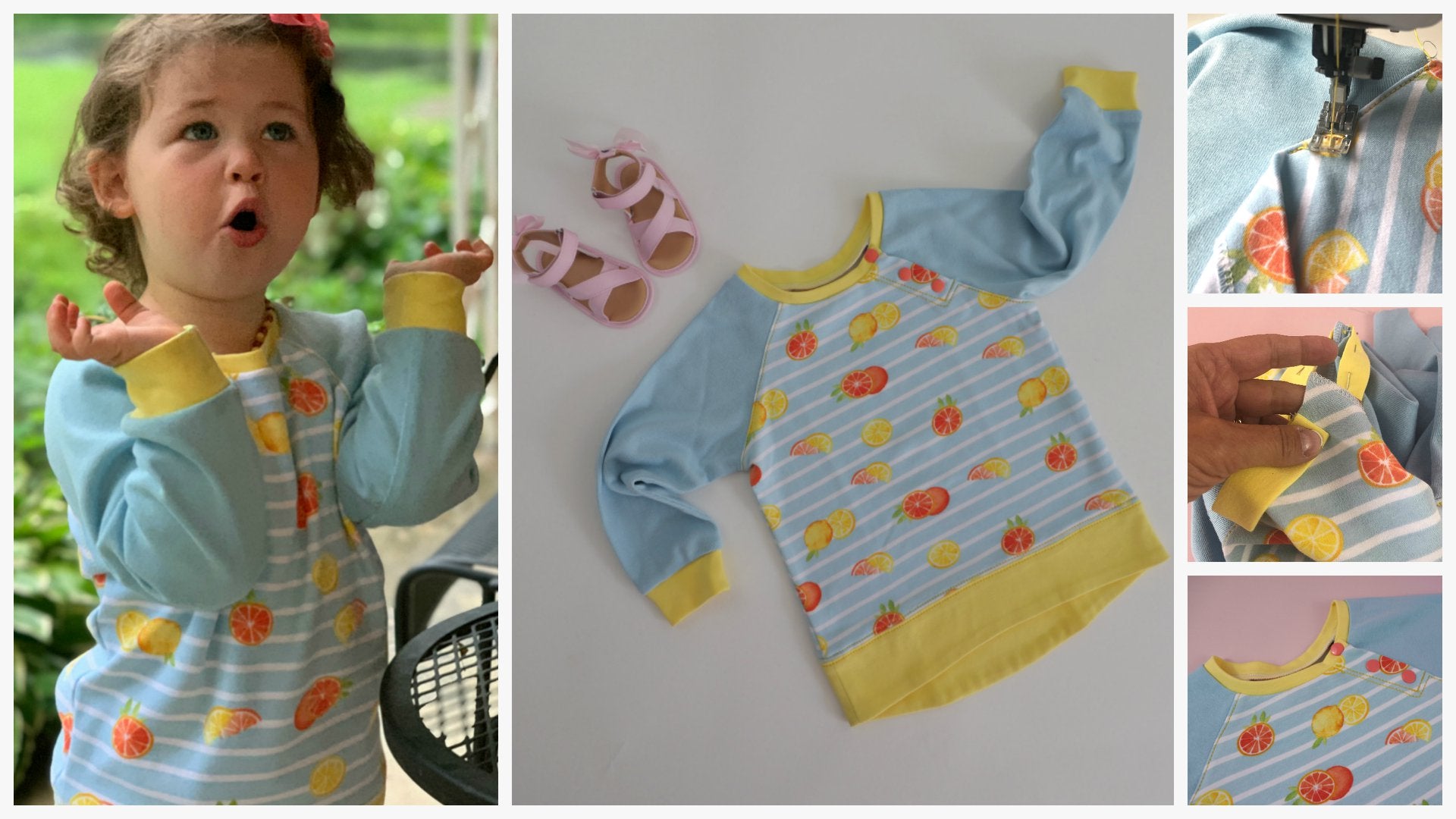
It is a Raglan sweatshirt, and as you can see blended in here on the side, we've made loads of different ones and we absolutely love this little sweatshirt.
You can go wild:
- heavier sweat fabrics
- heavier knit fabrics
Just no wovens.
Closure Options
As the closure I've used KamSnaps, which are always very good.
You could also use metal snaps if you already know KamSnaps and want a challenge.
But for beginners, I would stick with KamSnaps.
Cutting the Sleeves
Because we've got a closure, we've got a right sleeve and a left sleeve, and you need to cut them out so that they're facing absolutely correctly to get the right and left sleeve.
In the academy I also have a chapter showing you how to adapt the pattern quickly to make the standard version without the closure.
You don't necessarily need it — the head will go through — but I think it's a really nice design feature.
Hem Options
We’ve got two different ways of finishing the hem trim:
- a plain hem trim
- a high‑low hem trim
The high‑low version is shown in the little picture blended in on the side.
In this video I'm going to show you what to do if the fabric is really thick and you want it to be nice and flat.
With lighter fabrics you don’t need this method.
Materials Used
I've used:
- interfacing to reinforce the placket
- yellow topstitching thread
- light blue standard cotton thread
Here you can see the interfacing that I'm going to put onto the placket, and I'm just quickly going to cut that.
Interfacing the Placket
Let’s get started.
The first thing we're going to do is iron on those interfacing bits.
You don't need any steam for that — my iron is one of these miraculous American irons that never turns off the steam. It's a really cheap one.
Do the other side as well.
Then I need to overlock that little edge at the top — or “serge” if you're in America.
Sewing the Sleeves
Now I'm going to sew the sleeves to the front.
On the other side we are only closing it up to where the placket is — we’re going 1 cm higher than where the placket starts.
Then I'm going to place the back on as well like this.
Flip the back over, put it on, and pin the other sleeve seams.
Now I'm going to sew those in.
As always, we have a 1 cm seam allowance.
Overlocking and Preparing the Placket
With all my seams now closed, I need to overlock them.
Now I fold over my placket so that I can clearly see the overlocking, and then we're just overlocking this edge.
Pull it around a bit, make sure you don't cut into it — that is a real risk.
You might want to turn off your knife if you're not sure.
Pressing and Overlapping the Placket
Now we can proceed to iron all our sleeves into the front.
Here where I've got my opening, I can now fold it over where it needs to be so that it overlaps, leaving a little bit standing on the front piece.
Now I'm going to sew this down.
Lengthen your stitch length — 3.5 or even 4.
On your presser foot you need to find a fixed point to go down.
Use the same fixed point on all three seams and leave out the opening.
Neckband
Now we're going to do the neckband.
Close the short sides first with a 1 cm seam allowance.
Cut off your seam allowances so it's nice and small — because we are going to put a KamSnap in there, and if it's really thick, the KamSnap won’t go in.
Iron the whole thing lengthways in half.
Attaching the Neckband
The first thing to do is to half your sweatshirt.
You will see that it's exactly on the seam there.
Here I'm putting my back onto the center back — which is not the actual center back, but the folded center.
Here you can see it goes just where the placket starts.
Then I stretch the neckband and work my fingers to the middle, putting pins all the way around.
Once we've sewn it in, we're going to sew across here to stitch in the placket as well.
If you did that in one go and just folded it over, it would give an ugly nose.
Trust me — it will always move.
Sewing the Neckband
Make sure everything is even and then sew it in.
I'm using a foot‑width seam allowance here.
Make sure nothing slips out at the front — it always wants to do that.
Folding and Stitching the Placket
Now the next step is to fold over the placket really tightly.
Pin it, then turn it over to the other side.
Do it from the underside so you can see the stitching line.
Hit the same stitching line — it gives you a beautiful result.
Overlocking the Neckline
Now I can go back to the overlocker.
I'm lining it up with a point on my machine — it's the Brother Lock 1034D.
It's a very cheap machine but it's done me for years.
Now I'm going to press this over my ironing board — lots of steam.
Topstitching the Opening
Next step: topstitching the opening.
Because the front placket is a little wider than the back one, you should have no issue doing this.
Start on the underarm seam.
Stitch length 3.5 to 4 (or even 4.5 depending on your machine).
Use the same fixed point as before.
Turn at the top and stitch across.
If you're unsure, mark the line with a textile pen first.
Adding a Second Stitch Line (Optional)
I'm adding a second line just to see what it looks like.
It's not really necessary.
You could also add two stitching lines where you topstitch onto the sleeve — up to you.
Adding the KamSnaps
Now we're going to put the KamSnaps on.
Press down hard to make an indent.
Use the awl to push through all layers.
KamSnap parts:
- flat cap
- cap with thicker rim
- cap with sharp rim
First:
Put the flat cap through from the underside.
Add the thicker rim on top.
Press with the tool.
Second:
Push the prong through from the top side.
Add the sharp rim.
Press again.
Done.
Closing the Side Seams
Now we can move on to the next bit — closing the side seams.
Do it in one go.
It gives us another look at our placket — isn’t it fantastic?
Sew from the lower end all the way up.
1 cm seam allowance.
Make sure nothing folds over.
Then overlock the seam.
Pressing the Seams
Iron the seams towards the center back.
Do this on both sides.
Cut off overlapping threads.
Hem Trim and Cuffs
Now we're going to do the cuffs and the hem trim.
The hem trim has the front and back twice each.
Sew front and back together at the side seam.
Do the wrist cuffs now as well — no point going back later.
Iron all seam allowances apart.
Hem Trim Technique
Now we continue with the hem trim.
Put the two hem trim pieces inside each other, right sides facing.
Close the lower curved edge — not the straight edge.
Cut back the seam allowances.
Iron the seam apart.
Turn and roll the edge out.
Press all the way around.
Attaching the Hem Trim
Put the trim over the sweatshirt.
Attach only one side — this is why it will lie flat.
The top part will be overlocked later.
Pin and sew the lower edge.
Then overlock the top edge.
Topstitching the Hem Trim
Fold the hem trim so the seam sits neatly.
Pin vertically.
Topstitch above and below the seam.
This gives a very commercial look.
Press everything well.
Cuffs
We have arrived at the last part — the cuffs.
Place the ends on top of each other and press.
Turn the top inside out.
Place the cuff inside — never outside.
Match the seam to the underarm seam.
Stretch to the other side.
Sew in place.
Overlock the seam.
Final Press
Give the cuffs a gentle press — and we are done.
Thank you everyone for watching to the end, and I hope to see you soon again with another project from Frocks & Frolics. Bye for now.
A quick Runthrough of the entire Project
Transcript for the Video: Bubble Gum - All-in-One-Video
Hi everyone, I'm Marina.
Welcome to another project with Frocks and Frolics.
These are my Bottom Joggers and I'm going to show you exactly how to make them.
Before we go off and sew them together in about ten minutes, let's have a look at the super‑duper little joggers in a bit more detail.
Waistband Construction
One of the things that's different from other jogger bottoms you might have made is that the waistband is constructed first and then sewn in.
This means that you can change the elastic afterwards.
Of course, you could do the traditional method if you'd like and put the elastic in after.
I think it looks nicer this way — it gives you a little bit more firmness around here, and so we're getting a really fantastic little pair of joggers.
The Pocket Technique
The other thing is my little technique here:
how to put in these gorgeous pockets.
They are so simple to put in and they look so nice.
If you're an absolute beginner who doesn't know how to put pockets in, then this is the method for you.
The Importance of the Gusset
One of the things that a lot of these little patterns don't have is a gusset.
When I first started the baby collection — which is not so long ago — I realized that you just can't do without it.
I've done a few without, and there's always that massive tension because the gusset has to wrap around the nappy.
It's a very simple thing to do.
You can also make the joggers without pockets.
Buttonhole Tie Option
I also want to show you the other method here:
simply put two little buttonholes in and then put through a tie.
I didn't even stitch down for a tunnel — of course you could do that before you put it in.
If you want to know how to do it with eyelets, I've already done that in the Maisie Short, and that video is linked in the description.
Getting Started
So without further ado, let's start sewing.
The first thing to do is to put your pattern together.
Make sure it's printed correctly — 5 cm or 1 inch should be the measurement.
Then join your pattern pieces together in alphabetical order.
It's really dead simple.
Cutting the Fabric
Here I've cut everything out.
It's so simple.
We're cutting:
- the front on the fold
- the back on the fold
- the waistband
- the funny‑looking shapes for the pocket
- the gusset
- the cuffs (which will magically change into yellow later on)
Preparing the Pocket Side Piece
Now we're going to take that special triangular piece.
You can put some interfacing on it if it's a really lightweight fabric, or leave it as it is.
To make the pattern match:
- Place the front piece on your fabric so that it's a perfect match.
- Put the triangle on with a 1 cm seam allowance.
- Move the front piece away.
- Pin the triangle.
- Cut it out.
It will fit absolutely perfectly.
Sewing the Pocket
Place your pocket with the slanted side right sides facing onto the front and sew it in with a 1 cm seam allowance.
That little jagged action isn't in the pattern anymore — it didn’t make any sense.
Iron the seams apart.
Creating the Pocket Opening
Now we're going to create this lovely opening.
With the seams lying open:
- put the triangle on top
- make sure it matches nicely
- put a pin at the top and bottom
- flip the whole thing to the underside
- measure down either what's on the pattern or 3 cm from the top and bottom
- sew in the ditch from the top to the marking
- then again from the marking to the end
Really simple.
Don't forget to lock your stitches at the top and bottom.
You have now fixed the side part of your pocket.
Folding and Topstitching the Pocket
Fold the pocket back forward.
All we have to do now is topstitch it.
If you've already done one side, the other side needs to be the same height — you might want to mark it.
Stitch all the way around.
Tip:
Start right on the seam so you can count your stitches:
- one, two, three down
- one, two, three across
- one, two, three up
Dead simple.
Adding the Pocket Lining
Next step: put the pocket lining under.
You can:
- overlock it together and topstitch through all layers
- or pin it and sew the pocket in, then overlock
Both are possible.
The pocket is now done.
Securing the Pocket
Where the little weird‑looking triangle is, it's a bit loose.
To secure it:
- stitch right next to the topstitching line
- from the very top down
Stitch length 2.5.
Overlock it — your pocket is inserted.
Inserting the Gusset
Next we're going to put in our gusset to the back.
You've got this protrusion there, so it's really easy to work your way around.
Do not pin this — just stitch it in.
Make sure you've marked:
- the center back
- the center of your gusset
Work your way around.
Overlock it.
Sewing the Inseam
Bring together the legs, right sides inside.
Bring it in flat in the leg area.
It will feel like you have to hold the gusset in, but it's only because it's a curve.
Sew it in.
Some of you might not need to pin this — beginners should.
Beautiful seam — overlock it.
Sewing the Side Seams
Sew the side seams together with a 1 cm seam allowance on both sides.
Overlock.
Make sure the pocket doesn't fold over.
Iron the seam towards the back with lots of steam.
Preparing the Cuffs and Waistband
Sew together the seams of the cuffs and the waistband.
Feed in the next piece right away so you don't waste expensive Gütermann thread.
Iron the seams apart.
Iron the cuffs lengthwise.
Attaching the Cuffs
Turn your joggers inside out.
Insert the cuff inside.
Line up:
- cuff seam
- inner leg seam
Stretch to fit and pin.
Sew from the inside so you can move the fabric easily.
Remove all pins before overlocking — pins ruin knives.
Steam the seam back in.
Turn flat.
Steam again.
Beautiful cuff.
Preparing the Waist Elastic
Next we're going to do the sports elastic for the waist.
It's 1.25 inches wide.
Use the measurement in your instructions for the length.
Sew down either side with a 1 cm overlap.
Press to create a crease.
If you're sewing for a child far away, use the traditional method:
- sew waistband
- leave a gap
- thread elastic later
Inserting the Elastic into the Waistband
Here we're inserting it straight into the waistband:
- stretch it on
- pin all the way around
- sew along the edge (not catching the elastic)
Turn joggers inside out.
Insert waistband.
Line up waistband seam with center back.
Pin.
Stretch to find opposite side and quarters.
Sew all the way around.
Stretch as you go.
Hold at the end.
Overlock — remove all pins.
Finished Joggers
And you are done with your beautiful little pair of joggers.
This is such a good pattern for a beginner.
If you want to make your own go to:
- frocksandfrolics.com
You’ll have full access to all videos for FREE.
I cannot wait to see you there.
And for everyone watching on YouTube — the next project is a little sweatshirt.
How to sew a Baby Vest
Transcript for the video: Classic Vest - Step by Step Tutorial
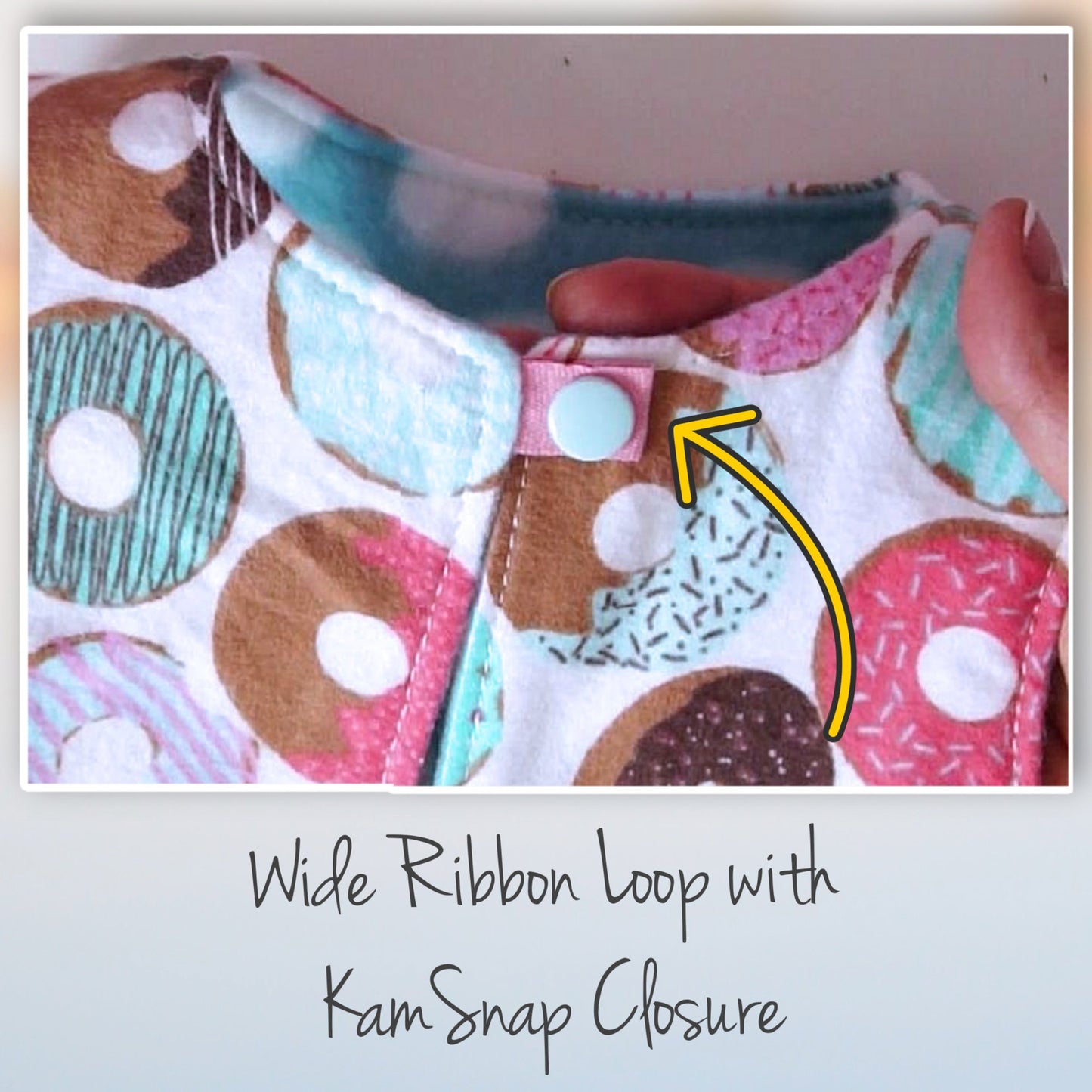
Hi everyone, this is Marina from Frocks and Frolics and I’m going to show you how to sew a classic vest. Here you can see it with a beautiful V-neck and shaggy fur, and your preteens will actually really, really like this. This pattern goes up to age 12 and starts at six months, and the example for that is here. It’s fully reversible and the closure is this beautiful little cam snap on top of a tab at the top. That’s how we fasten it. It’s super easy, very quickly made, and it will keep your toddler warm, and of course, your teen as well.
Now this here is made with a shaggy fur, and for that I’ve lined it again with some brushed cotton. At the end of the video, I’m going to show you a few tricks for that. Here you can see the beautiful clasp I’ve got, which is actually from Totally Buttons (Los Angeles), and the good news is they are online. I have got a link to this clasp in the video description.
One thing to remember when you’re doing shaggy fur on anything: you want to sellotape up the fur when you’re cutting out. I didn’t, and hence it looks a little bit like a bad haircut when you look closely. You can also just use a hook and eye to close it, of course.
Preparing the Pattern
Let’s get started with the little top. I’ve got a fleece here and a brushed cotton, and I think if you are a beginner sewer that is the ideal combination.
Of course, first of all, you want to print up your pattern. Make very sure you print it with Adobe Acrobat Reader. You can download that for free. In the instruction booklet it will have the link to that as well. The last page usually has an assembly plan so you can see how many pieces you need to put it together.
Make sure that your measurement is correct so you’ve got either an inch or five centimeters. Then, looking at the pattern, you can see that you have a slender and regular as well.
Cutting the Fabric
I think that when you’re cutting out, you want to make sure that you only fold over as much as you need to get out your pattern. If you haven’t got a direction of fabric, you can put them on like this, and you will use very little. In fact, you probably get two out.
So we need the back on the fold, and then we need the front twice in the lining and the shell fabric.
Sewing the Shoulder Seams
The first step for this is to put together the shoulder seams of the outer fabric, which is the shell, and the lining. Make sure that the right side is on the inside and the wrong side on the outside.
Then we’re going to close those shoulder seams. On the lining, it’s much easier to see here. You just flip it over, and I’m going to pin that as well. Then we’re taking it to the sewing machine, and we’re putting it together.
The seam allowance on my patterns is always one centimeter. When you’re sewing this, try to get into the habit of pushing the next part straight under it. It saves you a lot of thread in the long run, and if you’re using very expensive threads such as Gütermann, then you really don’t want to waste it.
Pressing and Attaching the Tab
Then you want to iron the seam apart to be addressed. Make sure it’s nice and flat. You could also top stitch at either side if you like.
When you take the tab, fold it over. You can either use your sewn tab or you use a little ribbon like I’ve done here. You put that onto the right side of your vest a little bit further than one centimeter over and in because that’s the seam allowance. I’m also going to fold it back a bit so I don’t accidentally catch it when I come along there and sew it all together.
Joining the Lining
Now you want to put the lining over the top. Make sure that the shoulder seams are on top of each other, so I’m going to use some pins to fix that. That will also keep the seam allowances from folding over.
In the front, we’re starting halfway down the front, and then we’ll sew all the way around. You want to pin that really well, so go all around here and finish halfway down the front. Then we’re going to close both armholes all the way around.
Sewing Curves and Corners
I haven’t used any stay tape for this, so the trick here is to push your fabric and never ever pull it. Push it towards the presser foot, and that way you don’t need stay tape.
If you are a beginner and likely to pull your fabric and have these horrendous armholes and stretched necklines, then please do use stay tape or stay stitch before you put it together.
Next, we’re doing the front here. We’re going halfway up from the front. Put your needle down as you get to the corner, that’s really important, lift the presser foot and turn all the way around. Do the same on the other side.
Clipping and Turning
Now we need to make sure that there’s no tension on all these seams because they’re coming in on themselves. So what you want to do is snip it. You could also cut the seam allowance back. I haven’t done that here. It’s not necessary.
If you’re using heavier fabric, you might want to cut it back in stages so you’ve got one seam allowance slightly shorter than the other.
Make sure you cut the seam allowance back here as well, so it’s nice and flat. That’s usually enough to get something like this right.
When it comes to the corner here, some people say just fold it over and turn it, but this would make it very thick. Because we’re going to have a cam snap there, you need to cut this back up really sharply, almost right to your seam, because otherwise it will interfere with your cam snap.
Turning the Vest
Then we’re pulling the front through the back, and I’m just going in with my fingers here. I grab the part of the front that’s farthest away, push that through with my fingers, and then I pull it.
For the smaller sizes, this is quite hard because obviously the shoulder isn’t very wide, so you need to give that a really good time, but it will come through.
Then we can give this all a good press.
Closing the Side Seams
The next step is to close your side seam. Put it in front of you, and the front goes up, and the back goes up. We’re closing this from one side to the other.
Again, the seam is pinned down so that it can’t fold over. It’s so simple. You’re really going to love making these. The second one shouldn’t take you much longer than about 30 to 40 minutes.
On one of the lining sides, I’m leaving a turning gap. If you’re topstitching it like me all the way around, you don’t really need to do that. You can leave the turning gap in the hem.
Closing the Hem
Then you also want to make sure that there’s no tension. We’re going to snip one of the seams and reduce the seam allowance here.
I had forgotten to iron the other side, so I had to iron that too. Then we’re going to iron it closed.
To do that, you want to put your thumb in there so none of the seam allowances can fold over. Then you hold it and take it to the ironing board and quickly press that.
Now all we have to do is close the hem. In order to do that, just start at the front. You need to poke it out a little bit again so that you can get in there better.
Topstitching
Now we’re going to top stitch the whole lot.
When you’re doing top stitching, it’s really important to extend your stitch length, especially if you’ve got a fairly basic machine which seems to be hammering in the same spot all the time. Make it quite long. Like 3.5 or even 4.
The distance from the edge of the vest to your stitching should also be a little bit wider. I think that looks really nice.
Then, when you’re coming around the curve, do a couple of stitches, lift the presser foot, and work your way around. Don’t try to do it in one go because it will not look as good.
Adding Cam Snaps
Next, we’re going to do the armholes and then put in our cam snaps.
First, you want to use your awl, and that goes all the way through. That’s the trick always.
Then we’re lifting off what we’re doing and putting our cam snaps in, and that way they will be in the correct position. Don’t be tempted to put one in and then try to put the other one in too much.
I’m actually using two colors, so it’s a contrast, which I think is also really nice.
Final Notes
A little word about the vest: if you make it with a V-neck and some furry fabric, if you want to make pom-poms, a pom-pom maker is certainly better than what I’m doing here. But if you want to do a braid like I did for it, then you need three pieces of wool hanging out there so that you can braid them together.
Make sure you put some sellotape over the end so it can’t come undone. That’s really important.
Well, I hope you enjoyed this video. This lovely vest is available from Frocks and Frolics, and if you’re wondering what the beautiful Magdalena is wearing underneath the vest, it’s of course, the Virginia tunic, which you can also get from Frocks and Frolics.
Thank you very much for watching. Bye for now.
All-In-One Video
Transcript for the video: Bobby Dazzler - All-in-One-Tutorial
Welcome and Overview
Welcome to the Bobby Dazzler dungarees.
I'm Marina from Frocks and Frolics and I'm going to teach you this course that hopefully you're going to enjoy very much.
You can make the dungarees in three lengths: full length, ankle length, and short length.
Let’s have a quick look at the details now.
We have the little side pockets here, and then the other pockets you have just on the right side of the back pants. They are really full pockets — I mean, you can't really put anything in there, but they look very, very cute.
We’ve got those, and then we’ve got the classic patch pockets as well.
Then we have a full zip here.
One thing I quickly wanted to do is show you how beautiful the contrast fabric looks on the inside as well.
I'm going to open this up and we’re going to have a look on the inside.
Use your contrast fabric for the bib, for the back, and also of course in here for your snap placket.
And then in here, just have a quick look at this fabulous closure.
We have a back placket, we’ve got a shorter front placket, and when this is all put together it’s just the best closure.
What I’ve done here is make sure that everything is on the same height.
Snap Placket Closure
Hidden Snaps and Professional Finish
Let’s get started by having a look at the placket closure with the trusty snaps.
We are working this so that we see none of the snaps on the front, which I think is really nice.
They only go through the snap placket facing.
To do that, we have to interface that really well, but it makes it look way more professional.
You can also leave that snap placket off — I’ve done that in this example.
This is the size 6–9 months and I’ve got the ankle length.
It’s really nice for rolling up; I think it looks so, so cute.
It’s absolutely gorgeous.
Sewing Pattern Overview
Test Square, Printing, Seam Allowances
We can now go on to having a look at the sewing pattern in detail in the next chapter.
The first thing to do before you put it together with sellotape is to check your test square.
If it’s 2.5 in either direction, you can get started.
What I’ve noticed when printing in Adobe is that if you set it to “portrait,” it actually shrinks it a tiny bit.
So go to “Auto” and print at 100% or “actual size.”
The pattern does not need seam allowance added — it’s already included, and it’s 1 cm.
Some pieces have dashed lines — these are attachment lines.
They make it easier to overlap the pattern pieces when assembling the PDF.
The last page is your assembly plan, and it’s different for every size — smaller sizes need fewer pages.
Both the front and back come in three lengths:
- full length (winter or rolled up)
- ankle length (spring/summer)
- shorts (warm weather)
Cutting Out
Fabric Layout and Interfacing
Get your pins and scissors ready — we’re going to cut out.
Look at your cutting‑out plan.
Don’t let the German plan confuse you — cut exactly as shown.
We want to work efficiently so we don’t waste fabric.
We need:
- the front piece
- the two plackets
- two back pockets
- two front pockets
These are cut once from the top layer.
Pin everything on, making sure the grainline arrow is parallel to the fabric edge.
It’s best to cut from the left side so your scissors sit next to the paper.
Sometimes you cut from the other side because of space, but generally left‑side cutting is tidier.
Finally, cut your interfacing.
You need one of the facings — you can remove the seam allowance if you like.
If you’re making the dungarees without the snap placket closure, you only need:
- the facing
- the pocket lining
- the bib lining
You can leave out the plackets.
Everything’s cut out — we can start sewing.
Patch Pockets
Serging, Templates, Pressing
First, we’re going to serge around the edges of our pockets.
For the bib pocket, we go all the way around.
I go down the sides, around, and back up, then do the top separately because the corner is sharp.
We’ve created templates for the back pocket and the bib.
Cut away the seam allowance along the dashed line — this gives you a brilliant pressing template.
Fold the edges over the template and press.
Use a tailor’s clapper if you have one — it makes the edges crisp.
Check that both pockets match.
Topstitching Patch Pockets
Distances and Secondary Stitch Lines
Now we’re ready to topstitch.
Distances:
- lower back pocket: 1.2 cm
- patch pockets: 2.5 cm (or slightly less to ensure you catch the fold)
You can add a secondary stitch line — I use a marking on my presser foot, but you can use foot width or half a foot.
Once all pockets are stitched, we can apply them.
Applying the Pockets
Bib Pocket, Back Pockets, Lower Pockets
On the bib, I added a little racing car patch I found in Los Angeles — perfect for my new grandchild.
Cut out the pocket placement on the pattern, place the pocket into the gap, pin, and it’s perfectly positioned.
Do the same for the back.
For the lower pockets:
- the upper pocket is not folded at the bottom
- it slots into the lower pocket
- align with the side seam
- fold both pockets in by 1 cm
- pin
The top part of the lower pocket disappears under the patch pocket.
Topstitch the lower pockets first, then the upper.
Topstitching Tips
Avoiding Stuck Stitches and Achieving Clean Lines
When topstitching, pull the threads at the beginning so the machine doesn’t get stuck.
Mine did — constantly — and I kept forgetting.
Distance from the edge should be about 3 mm for denim.
Not too close like on a silk blouse, but not too far either.
Add your secondary stitch line foot‑width from the first.
Secure the side of the pocket so it doesn’t shift.
Move the top pocket out of the way when stitching the lower one.
If it’s not perfect — don’t worry.
Once the garment is finished, you won’t see the tiny imperfections.
Store‑bought jeans are often far less perfect.
Side Pockets
Pocket Lining, Corner Snip, Turning and Pressing
Now we’re going to sew our pocket and pocket lining to the front legs.
Place the lining right sides together with the front leg.
Pin and sew.
Make sure you’ve changed your thread — we don’t want topstitching thread here.
At the corner, reduce your stitch length to 1.5 so the fabric won’t fray when we snip into it.
Snip right to the stitching line — not halfway.
Turn and press to create a clean pocket opening.
Roll the seam out with your fingers until it sits exactly in the edge.
Topstitch all the way down.
Pull your threads at the beginning so it doesn’t get stuck.
Add a second line foot‑width from the first.
Sewing the Pocket Bag
Aligning, Pinning, Sewing, Serging
Change back to standard thread.
Align the upper edge and side seam of the pocket bag under the opening.
Pin vertically so you can sew over the pins.
Sew around the pocket bag — foot‑width seam allowance is fine.
Serg the edge from the visible side — in this case, the underside of the pocket.
Press everything nicely.
Sewing the Front Center
Curved Seam, Snaps Area, Topstitching
Place the front legs right sides together and pin along the curved center front.
Pins follow the stitching line — this helps you see mistakes early.
You cannot pivot this curve without lifting the presser foot.
Lift, turn, continue.
Serg the seam — pull with the right hand, push with the left so everything feeds evenly.
Press the seam toward the right leg.
Topstitch:
- first line: 2.5 cm from center front
- second line: foot‑width from the first
- third line: 5 cm down (approx. pocket opening length)
If your fabric drags, place paper underneath and tear it away afterward.
Add the little bar‑tack tab at the end — makes it look like real jeans.
Sewing the Bib
Attaching Bib, Plackets, Lining, Corners
Place the bib on top of the front trouser.
It may look like there’s too much bib — that’s because of the curve.
At the seam line, it fits perfectly.
Fold the plackets lengthwise and press.
Serg one short edge.
Pin the plackets to the bib lining, right sides together, fold facing inward.
Sew with 1 cm seam allowance.
Sew the bib to the front trouser.
Use your left hand to control the fabric so it doesn’t creep upward.
Press the seam flat.
Cut back the seam allowances — bib slightly shorter.
Press the lining and fold up the seam allowance.
Place lining and shell right sides together.
Pin from the waistline up and around.
Snip seam allowances where needed so layers don’t stack.
Mark the little corner for the closure.
Reduce stitch length to 1.5 at the corner.
Sew around.
Cut into the corner.
Turn and shape the corner with your nails.
Roll the seam into the edge and press with lots of steam.
Topstitch the bib edge with stitch length 4.
Topstitch the waistline — same distance as all other topstitching.
Add the faux waistband stitching line 3 cm above the waist.
Buttonholes
Marking, Machine Issues, Solutions
Mark the buttonhole between the two topstitching lines.
The button should not sit over the edge.
The stem should sit about 1.3 cm from the edge.
Mark both sides and the center.
Test your buttonhole length — some machines make them too long.
Most buttonhole systems work backward.
I set everything up — and the machine didn’t move.
It hammered in place because the seam allowance underneath was too thick.
I tried flipping it — no luck.
Tried adding fabric under the plastic side — still stuck.
Added more — still stuck.
Finally, I put the “bumper” under the metal side of the foot — and it worked.
“Hallelujah!”
Cut open the buttonhole carefully — not all the way at once.
Sewing the Back
Center Back, Serging, Topstitching
Sew the center back with 1 cm seam allowance.
Try to sew the curve without lifting the presser foot — use your left hand to turn the fabric.
Serg from the top side — it looks nicer.
Press to the left side.
Topstitch:
- first line: 2–3 mm
- second line: foot‑width
Pull the fabric apart slightly so no folds form.
Back Facing
Interfacing, Serging, Curves
Interface the facing.
Serg the lower edge, armhole, and neckline.
Sew around the curves — try not to lift the presser foot.
Reduce stitch length to 1.5 in tight curves.
Cut back seam allowances to about 3 mm.
Do not cut triangles like old commercial patterns.
Turn the straps with a safety pin.
Press the edges by rolling the seam outward.
Back Placket
Closing the Upper Edge
Sew the little back placket closed across the top.
The lower edge is already serged.
You can also finish and then serge — either way works.
Back Placket
Closing the Upper Edge
And the final thing now is we are going to do the little placket for the back.
We’re going to close it just across the top.
The lower end is already serged.
You could of course finish this part and then serge it afterward — that would also work.
It doesn’t have to be done earlier.
Preparing the Facing
Interfacing, Serging, and Attaching
Next, we’re going to prepare the facing.
This needs to be interfaced because we want stability, especially when working with lighter cottons.
Iron the interfacing to the wrong side of the facing.
Then serge the lower edge, the armhole curve, and the neckline.
Place the facing right sides together with the back piece.
Pin all around the neckline and armholes.
Sew with a 1 cm seam allowance.
Try not to lift the presser foot when going around the curves — it gives a smoother, rounder stitching line.
At the tighter curves, reduce your stitch length to 1.5 so nothing frays when you clip into the seam allowance.
Trimming and Turning
Clean Curves and Crisp Edges
Trim the seam allowance back to about 3 mm.
Do not cut triangles like in old commercial patterns — it never looks good.
Clip only where the curve is very pronounced, such as the dip at the neckline.
Attach a safety pin to the top of the straps and pull them through to turn them right side out.
Roll the seam between your fingers until it sits right in the edge.
Press with lots of steam — denim can take the heat.
Attaching the Facing
Securing and Topstitching
Now we’re going to attach the facing to the back.
Pin the facing down along the edges.
Topstitch around the neckline and armholes with stitch length 4.
Pull the threads at the beginning so the machine doesn’t get stuck.
Make sure the distance from the edge matches the rest of your topstitching so everything looks even.
Hardware Installation
Buttons, Snaps, Sliders, and Buckles
Now we’re ready to install the hardware.
For the buttons, mark the placement carefully.
The button should not sit too close to the edge.
Measure 1.3 cm from the edge for the button stem.
Use an awl to open the fabric — don’t punch a hole, just spread the fibers.
Insert the tack from the back and place the button on top.
Hammer gently but firmly, keeping everything straight.
For the second button, repeat the process, making sure the height matches the first.
Next, we’re going to attach the sliders and buckles.
Thread the strap through the slider, then through the buckle, and back through the slider.
This can be fiddly, especially on small sizes.
Pull enough length through — at least 2 cm — so you can sew it securely.
Stitch back and forth several times.
This seam will never be seen, but it must hold.
Repeat for the second strap.
Final Assembly
Side Seams, Hemming, and Finishing Touches
Now we’re going to sew the side seams.
Place the front and back right sides together and sew with a 1 cm seam allowance.
Serg the seam and press it toward the back.
Hem the legs according to the length you chose:
- full length
- ankle length
- shorts
Turn up the hem, press, and stitch.
Final Press and Review
The Finished Bobby Dazzler
Give the entire dungaree a really good press.
Check all your topstitching, corners, and pockets.
Your Bobby Dazzler is now finished — and it looks absolutely gorgeous.
I hope you enjoyed sewing along with me.
If you want to learn more about sewing, patterns, and techniques, visit my website and the Nähakademie — all videos are free.
I hope you’ll join me again for the next project.

Introduction
Transcript for the video: Lollipop Romper - Introduction
Hi everyone, welcome to the romper course. I'm going to take you through everything you need to know to make a beautiful romper.
If you don't know me already, I'm Marina. I live in LA with my husband and my grown-up son. He also lives in LA but he's over in Burbank. I run this business and make patterns and videos and I absolutely love it.
This time with a romper, it was something that I didn't really think was for me, and now I'm absolutely excited. I've loved it. I've got many more in the pipeline, so let's get started.
This lovely romper has long sleeves and long legs. It's super comfy for your baby. We put cuffs on the ends of both of these, and I have a really nice crossover neckline.
Now, let's go through what you will need to know.
Fabric Requirements and What to Look For
So what kind of fabric will you need for this? That's the first question I want to address. We are also going to look at the snaps and which ones are suitable for making this lovely romper. Then we are going to talk about what fabric to use for the cuffs and for the neckline.
Is it ribbing? Which type of jersey can you use if you're using jersey or interlock? We are going to break this all apart.
First of all, we're starting with fabric.
When you buy any fabric, there are two main differences in all your jerseys. One is a four-way stretch, and the other one is a two-way stretch. A four-way stretch will stretch both ways, this way and this way. A two-way stretch will only stretch in one direction.
You can see that this fabric is only a two-way stretch. It will only stretch widthways and not lengthways.
Stretch, Recovery, and Fabric Quality
The other thing you need to look out for is the composition of the fibres used in the knit. Knit fabric is always nice and stretchy, but cotton is not a stretchy fibre. That means when you pull it, even if it is knit, it might not jump back into its original position. This is what we call recovery.
I just want to show you an example of the one I made for the film. If you have already watched some of this, you will recognise it.
This print has very solid printed areas. If I stretch this, you can see it literally stays stretched. It does not jump back. This does not bode very well.
I really liked this pattern and thought it would be beautiful, which is why I bought it. But I shudder to think what will happen when it is washed. I don't think it will last very well.
If you are getting a bargain from Joann, and it is cheap, you can try different things and not mind if it does not last. But generally speaking, make sure you have a stretch fibre in it.
You should aim for 3 to 5 percent lycra or spandex. We are looking for a stretch of about 25 percent for a romper like this. For other items it might be less or more, but here we go for 25 percent.
That means if you mark 10 centimetres, it should stretch to about 12.5 centimetres. It is quite easy to test.
In a shop, you can stretch it with your hands. If it stretches and recovers, that is fine. If it stretches and stays stretched, that is more like swimwear or sportswear.
If you can get organic bamboo, even better. It is a beautiful fabric and it lasts very well.
Jersey, Interlock, and Fabric Types
The main knit fabric you will use is jersey. When you pull it, it may curl slightly at the edges. The thicker the fabric, the easier it will be to work with.
In the fabric guide, you can check the weight of the fabric. If you are buying online, you can check this too.
For rompers, you want lightweight to medium weight fabric. You do not want very lightweight or very heavy fabric.
My favourite fabric for rompers is interlock. Interlock is when you have two layers of jersey knitted together. The needles go back and forth between the layers, creating a fabric that looks the same on both sides.
You can use both sides of interlock. This is especially nice if it has two colours, for example grey on one side and teal on the other.
It is more stable and usually stretches around 12.5 percent. If it has lycra in it, even better.
Ribbing, Cuffs, and Neckline Fabrics
For the neckline and cuffs, you can use ribbing or interlock. Ribbing stretches about 50 percent and jumps back into shape very well. I used it for the cuffs on the legs and on the top neckline.
The white fabric you can see is interlock with lycra. It also has good recovery. If you do not want thick ribbing, interlock is a great alternative. It is stable, stretchy, and works very well for cuffs and necklines.
Poppers, Snaps, and Closures
Now before we get started, let's talk about poppers. I ordered some from Amazon and they were very cheap. When they arrived, they were not great. I also tried Dritz tools and those worked much better.
I will show you in the section on poppers how to use the Dritz tool with standard poppers that you can get cheaply.
I also bought poppers from Joann originally. Each packet was about six dollars including tax, and I needed three packets for one romper. Two packets were not enough.
I would not recommend the Joann ones. They did not last well and they are expensive.The cheap ones from Amazon actually worked very well.
Another option is to use Kam Snaps. I am working on a summer romper where I used Kam Snaps all the way down the front. Many people prefer them and they work absolutely fine.
Next Step
Now we are going to look at the pattern in a little more detail. I will see you in the next section of this course.
As a beginner sewer I’ve loved sewing the baby collection and learned so much. The patterns are easy to follow and work really well. Coupled with Marina’s videos even a total beginner like me can produce great results.
I am so pleased with the baby collection. It has inspired me to learn to sew and explore new projects. The patterns in this collection are clear and true to size and paired with video instruction I feel confident to begin sewing! I am so proud of the way the dungies turned out on my son. Thank you!
I am a beginner at sewing children's clothes. I needed to learn how to successfully sew jersey ribbing, join necklines, sew plackets, overstitch etc. Basically how to put clothes together. FrocksandFrolics.com has been perfect for me, guiding me through all the stages. It means I can stop the step by step YouTube videos whilst I unpick my mistakes, rewind & try again! The items I've sewn so far are surprisingly good thanks to the baby bundle patterns.
I like F.& F. PDF patterns as there's not too many pieces to print off & stick together. The patterns work perfectly & are all very straightforward and easy to follow.
I am awaiting the arrival of a grandchild & I'm hoping that with Marina's help, I'll be an accomplished sewer by the time the child arrives! Fingers crossed!
I am improving garment by garment as you can see from my first attempts here: