SAFARI JACKET DOLL
SAFARI JACKET DOLL
Couldn't load pickup availability
Give your doll’s wardrobe a stylish upgrade with this beautifully detailed safari jacket! Designed to fit American Girl dolls, this sewing pattern features classic safari styling — flap pockets, a tie belt, and crisp topstitching that makes every tiny detail shine. Perfect for confident beginners and seasoned doll‑clothes makers who love creating miniature fashion with big personality.
Pattern Download Includes
- Instant Download
- DIN A4 & US Letter Size
- Detailed eBook
- Video Tutorials
Design Options
Design Options
- Pockets with flaps
- Long sleeves
- Stand up collar
- Front placket
- Waist tunnel with tie
- Front and back yoke
Fabric Requirements
Fabric Requirements
BEST MATERIAL CHOICES
- Linen fabrics
- Chino
- Denim
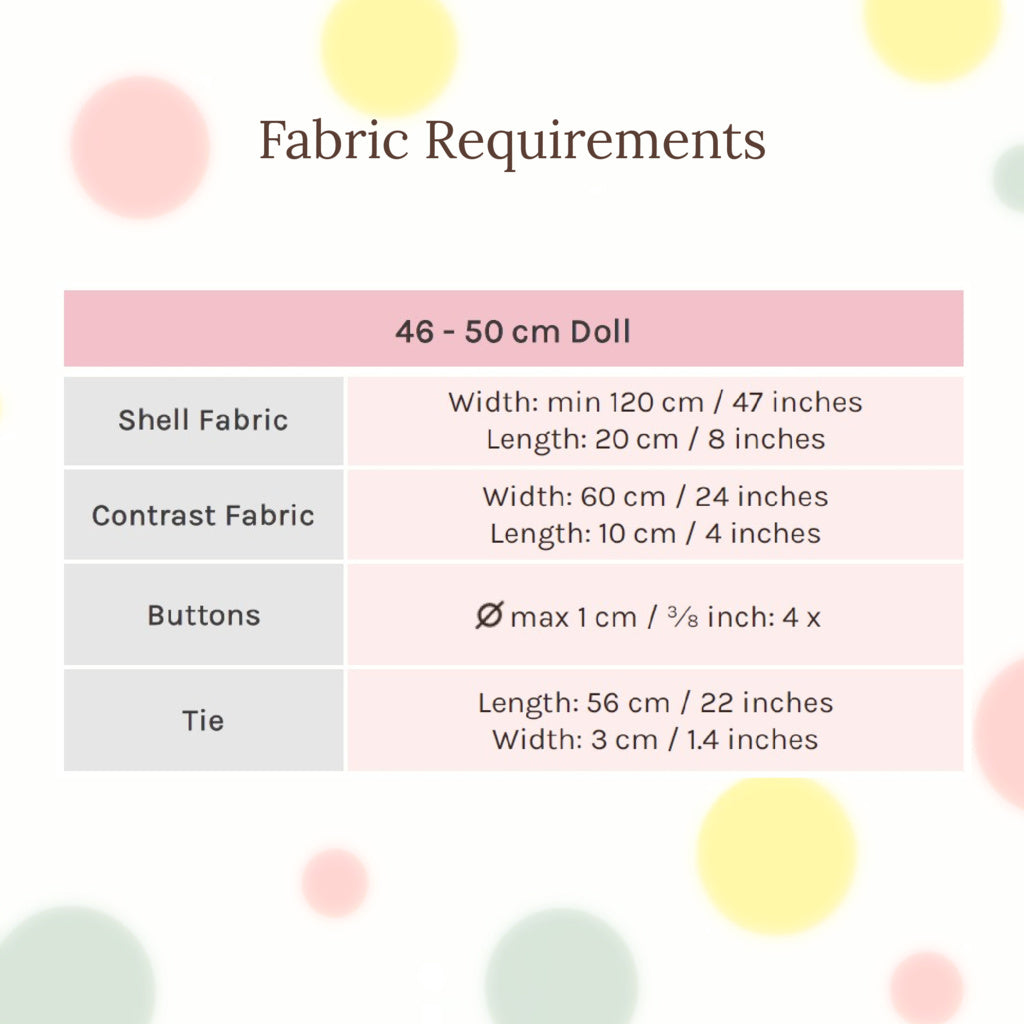
FABRIC REQUIREMENTS
- Shell Fabric:
Width: 47 inches (120 cm)
Length: 8 inches (20 cm)
- Contrast Fabric:
Width: 24 inches (60 cm)
Length: 1.4 inches (3 cm)
NOTIONS
- Buttons: max 1 cm
Available Sizes
Available Sizes
FITS 18" DOLLS PERFECTLY
Professionally designed to fit American Girl®, Truly Me, and My Generation dolls
• Chest: 11 inches (28 cm)
• Waist: 10.6 inches (27 cm)
• Shoulder to waist: 4 inches (10 cm)
Please Read
Please Read
- This is a digital pattern or PDF file, not a physical product. It will be delivered electronically via a download link delivered to the email used for the purchase.
- To ensure the pattern prints at its actual size, it's recommended that you use Adobe Acrobat Reader.
- The pattern creator, Frocks & Frolics, welcomes small-scale production using their patterns.
Customers are encouraged to tag Frocks & Frolics when sharing projects made using their patterns on social media.
@frocksandfrolics #frocksandfrolics
Share

STEP-BY-STEP VIDEO TUTORIALS
VIDEO TEXT
Safari Jacket for 18-Inch Dolls
Transcript for the video: The Safari Jacket - Project Introduction
Hello everyone. I’m back with another project for our American Girl dolls, or dolls measuring 18 inches (46 cm to 50 cm) in height. And this is a real stunner.
This is a safari jacket that has loads of details you can learn from. From little fake pockets to proper pockets with a box pleat, this project includes so many techniques. We’re also working with a front placket, a tunnel waist, and a collar. It’s really something you could make for a girl and it wouldn’t look out of place at all.
It really is absolutely fabulous, and I hope it doesn’t feel too scary because I think it’s glorious.
I’ve also made this jacket in a salmon pink version, and honestly, this has to be my favorite.
Now, I’m pairing this up with the Scarlet Skirt. So if you want to start sewing doll clothes with Frocks and Frolics and you don’t know where to begin, then get the Scarlet Skirt. It’s free, and you can also get it free for your girl.
I divide all these projects into two parts.
This is the first part where we:
- Look at the pattern
- Learn how to print it properly
- Go through what to watch out for
- Examine each individual pattern piece
- Review the cut-out pieces and markings
- Look through the instructions
This part is more theoretical.
In the second video, we sew the jacket together.
If you want to jump to the second video, you can find the link in the YouTube description. If you’re already on my website, just swipe over to the next video in the list.
If you’ve never been to Frocks and Frolics, go to the Doll Collection and find the Safari Jacket. Scroll down and you’ll find a tab with all the videos for this project.
You do not need to log in or sign up. You can watch everything for free and see if this style of sewing is for you.
I wouldn’t say this project is super easy, but if you want to learn how to make jackets and you feel a bit frightened about sewing for yourself or your daughter, this is a really good place to start. You learn a lot, and maybe afterward you’ll think, “Yeah, I can do this.”
So now we’re going to continue with all the main detail parts.
Ebook Overview
We’re going to start with the ebook and do a quick run-through.
First, you have the contents page so you can quickly find what you’re looking for.
The second page includes links to sewing courses you might be interested in, such as:
- Putting in sleeves
- Sewing zippers
Then we move on to the video links for this project.
After that, there are fabric recommendations. For this jacket, linen, chino, or denim work really well.
Next, you’ll find:
- Fabric requirements
- Printing instructions
- Information about adapting the pattern for different dolls
Then we look at each pattern piece individually.
The seam allowance is:
- 1 cm
- Already included in the pattern
Next, we have the layout plan.
We fold the fabric in a way that allows us to cut everything that needs to be cut twice. Then we use the remaining space for pieces that only need to be cut once.
There’s also a separate layout plan for the contrast fabric.
At the end of the photo guide, there’s a page with links to other projects you may enjoy.
Finally, there’s the Impressum page with:
- Amazon shop links
- Facebook group
- Email address
Printing the Pattern
Please measure first.
The test square should measure:
- 2.5 cm
- Or 1 inch
on all sides.
Usually, the pattern pieces do not fit onto a single sheet of paper, so there are little tabs to help with assembly.
You overlap the tabs to put the pieces together more easily.
The larger pieces include:
- The tie (A, B, C, and D)
- The tunnel (A and B)
On the last page, I always show exactly how everything fits together.
You’ll see:
- Tie = A, B, C, D
- Tunnel = A, B
Printing Tips
Use Adobe Acrobat Reader DC.
When printing:
- Print at “Actual Size”
- Set orientation to “Auto”
- Make sure “Fit to Page” is unticked
If you use Portrait orientation or fit-to-page settings, the pattern may shrink slightly, which means it won’t fit properly.
Printer Recommendation
If you print lots of sewing patterns and wonder which printer to use, I recommend the Epson EcoTank ET-3750.
I bought this printer around four or five years ago and I’m still using the same ink that came with it. I print loads of full-color patterns.
The printer itself is more expensive upfront, but the ink lasts an incredibly long time.
Pattern Assembly
Now we’re assembling the pattern.
I’ve got my tie pieces sorted into:
- A
- B
- C
- D
You’ll notice little diamond symbols that must line up. If the diamonds match correctly, you know the pieces belong together.
If the diamonds don’t align, those pieces are not supposed to connect.
Then we repeat the process for the tunnel pieces:
- A
- B
Again, line up the diamond shapes.
Pattern Pieces in Detail
Front Pieces
The front comes in:
- Lower front
- Front yoke
We also have the front placket.
The placket is longer because the collar is attached first, then the placket goes on afterward.
Pocket Flaps
The small pocket flaps are inserted into the seam, which makes construction easier.
You can make them:
- In the same fabric
- In denim or chino
- In contrast fabric
For this sample, I used contrast fabric.
Box Pleat Pocket
The pocket has a box pleat created by sewing along the dotted line.
To place the pocket correctly:
- Remove the pocket section from the pattern
- Mark the corners directly onto the fabric
- Use those dots for placement
This makes positioning much easier than measuring repeatedly from the edges.
Back Pieces
The back also comes in two sections:
- Back jacket
- Back yoke
There are center back markings that need to line up.
You’ll also see markings for the tunnel.
You mainly need to mark the lower edge so you know where the tunnel placement goes.
Sleeves
The sleeves are not symmetrical.
So you must:
- Mark the front of the sleeve
- Mark the sleeve head
This helps avoid attaching the sleeves incorrectly.
Tunnel and Tie
The tunnel wraps all the way around the jacket.
The best method is:
- Find the center back of the jacket
- Find the center of the tie
- Match them together
- Work toward the front from there
The tie threads through the tunnel and looks beautiful from the inside as well.
Collar Details
For the collar, I used contrast fabric.
So you’ll cut:
- One collar piece in contrast fabric
- One collar piece in main fabric
I also used the same contrast fabric on the pockets.
The whole jacket is unlined, which keeps it much simpler to sew.
Cutting Out the Fabric
I folded the fabric so all mirrored pieces could be cut efficiently.
That left enough space for:
- The back
- The tunnel
- One collar piece
The contrast fabric was used for:
- The other collar piece
- Pocket flaps
- Tie
Cutting Guide
Tie
- Cut once in contrast fabric
Tunnel
- Cut once in shell fabric
Pockets
- Cut twice
Pocket Flaps
- Cut twice in contrast fabric
- Cut twice in upper fabric
Back Yoke
- Cut once
Collar
- Cut once in contrast
- Cut once in upper fabric
Front
- Cut twice mirror image
- Don’t forget to cut out the pocket section
Back
- Cut once in upper fabric
Sleeves
- Cut twice mirror image
Placket
- Cut twice
Front Yoke
- Cut twice mirror image
Markings and Snips
Now we snip all the markings where needed.
Sleeve
Mark:
- Front
- Sleeve head
Back
Mark:
- Center back
Back Yoke
Mark:
- Center back
Line up your fabrics carefully before marking.
Final Thoughts
I really hope I encouraged you to sew this jacket with me in the next video.
Don’t forget:
- You can get the pattern from Frocks and Frolics Doll Collection
- There are loads of patterns to choose from
- The Scarlet Skirt is free, so it’s a great place to start
I also forgot to mention that underneath the jacket is the Virginia Blouse.
Everything was made in coordinated fabrics:
- The blouse collar
- The tie
- The skirt details
All use the same matching fabric combination.
I hope you enjoy this project, and I’ll see you in the second video where we can start sewing.
Bye for now.

How to sew a Safari Jacket for Dolls
Transcript for the Video: Sewing the Doll Safari Jacket
Welcome to the safari jacket for dolls. This is Marina from Frocks & Frolics, and I'm going to teach you how to make this absolutely stunningly beautiful jacket. You have landed in the second part, which shows you step by step how to sew this wonderful jacket.
If you want to know everything about the pattern, how it goes together, all the details you need before you get started — including cutting out — then please go and watch the first part, which is linked in the description. If you're watching on my website, it’s simply the video right before this one. You can find all the videos on foxenfolix.com, and if you scroll down on the listing for the jacket, you will find all the video content right underneath it. You don’t need to log in or sign up; you can watch everything before deciding whether this project is for you.
Just in case you haven’t watched the first video: we have four pockets with flaps, box pleats, a placket for the front, and a collar that ends before the placket, which makes it much easier to sew. It’s really cool. You’ve got a little tie, front and back yokes for that safari style, and a tunnel on the
back and front so you can tie it. I’ve made everything fabric‑coordinated, using the same fabric in the ties and collar.
You can also get the Scarlet Skirt for free on my website and make it for your doll or your girl — the videos are all there. I hope you enjoy this project immensely. Let’s get started with the sewing.
Preparing the Edges
The first thing we’re going to do is neaten all the edges. It’s basically all the shoulders, sides, and the hem of the sleeve. The serger I’m using is the Brother 1034D. I don’t think they produce it anymore, but you can sometimes find one second‑hand. It’s a really good, simple, inexpensive machine.
Working on the Pockets and Flaps
I’ve chosen a contrast fabric for all of this, which makes the pockets lighter and easier to work with. If you haven’t started yet, think about the thickness of your fabric and whether you want a coordinating or contrasting fabric underneath. My twill is quite stiff, so a lighter lining fabric helps
the flaps sit better.
Box Pleats
Fold the fabric with the wrong side inside. Mark 1.5 cm over where the pocket goes. Sew the pleat with a 2.5 stitch length, locking your stitches. Feed the next one straight after to save thread.
Open the pleat and iron it with lots of steam. Serge the pocket edges. Fold in the seam allowances: first the sides, then the lower edge. Leave the top edge as it is. Compare both pockets to ensure they match.
Flaps
My flaps have a beautiful printed cotton lining, which makes them easier to work with. The chino is heavy, so marking the tip helps. Find the center, mark a dot, and mark your 1 cm seam allowance. Do this for all flaps. You may also want to mark the corners.
Sew to the dot, needle down, lift the foot, and turn. This ensures all flaps are identical. Trim back the seam allowances because the pieces are small. Turn the corners carefully using a pin from the side, not the tip, so you don’t pull out fibers. Push back any over‑pulled corners with a needle.
Press all flaps neatly, rolling the seam slightly with your fingers. Top stitch with a 3–3.5 stitch length. Use the markings on your presser foot to keep the distance even. If you struggle, avoid contrast thread.
Attaching the Pockets and Flaps
Serge only the upper edge of the larger pocket. Mark the pocket placement using the pattern piece. Pin the pocket in place.
Place the flap on top, matching the serged edges tightly. Top stitch with a 3.5 stitch length. Turn at the corners with the needle down. Fold the flap down and press well. Use a tailor’s clapper if you have one. You do not need to sew across the top.
Adding the Yokes
We have a front and back yoke, both heavily top stitched. Always use a longer stitch length for top stitching — at least 3 or 3.5.
Place the pattern piece over the front so you can see the flap placement through the fabric. Pin the yoke on right sides together. Sew with a 1 cm seam allowance. Serge the edge. Press the seam upward into the yoke so the pretty serged side is visible.
Top stitch the seam, pulling the fabric slightly apart. Repeat for the back yoke. You can use one or two rows of top stitching.
Shoulder Seams
Lay all pieces right side up, flip the fronts over, and pin the shoulders so you don’t accidentally sew them the wrong way around. Sew the seams, iron them open, and top stitch both sides.
Preparing and Attaching the Collar
This collar is clever because it only attaches to the front; the placket comes later, making it easier to sew.
Sew only the top edge of the collar with a 1 cm seam allowance. Press the seam flat, then open. Roll the seam slightly so none of the underside shows.
Attach the collar from the inside out, matching center back first. The neckline is curved and the collar is straight, so it may feel like there’s too much collar, but there isn’t. Fit it in and sew with a consistent seam allowance.
Press the seam into the collar. Roll the collar edge under and top stitch all around. Normally you’d start at the back, but here the front is open, so starting at the front is fine.
Preparing and Attaching the Sleeves
Add a gathering stitch around the sleeve head using the longest stitch length. Before inserting the sleeve, turn up the hem 2 cm and top stitch through the serged line.
Pull the bobbin thread slightly and secure it with a figure‑eight around a pin. Steam the sleeve head to shrink the excess fabric so it curves nicely.
Match the sleeve marking to the shoulder. Ensure the sleeve and body side seams align perfectly. Sew directly on the gathering thread, keeping the underside flat and removing pins only when necessary.
Overlock the sleeve with the underside facing up so the seam doesn’t stand up.
Closing the Side Seams
For dolls, always sew the sleeve seam and body seam in one go. Pin from the hem upward. At the sleeve end, pin the sleeve 2 mm lower so the fabric pushes into alignment as you sew.
Sew with a 1 cm seam allowance. Iron seams open using a sleeve board. Iron the sleeve seam using the edge of the board to avoid creases.
For a couture finish, sew down the seam allowances so they lie perfectly flat. This is optional but looks beautiful.
Hemming the Jacket
Serge the hem. Turn it up 1.5 cm. You can pin or eyeball it if you’re experienced. Top stitch from the upper side so the stitching looks neat. Avoid sewing into the pocket.
Sewing the Placket
This method sews the placket to the underside first, then rolls it to the front and tucks it in. It’s easier for some, messier for others. Beginners may prefer sewing it to the front first and hand‑stitching the inside.
Place the right side of the placket against the underside of the jacket front. Leave 1 cm at the lower end. Sew up. Press the seam into the placket.
Turn up the inner fold. Align the crease slightly underneath the outer fold so the placket covers the stitching line perfectly. Sew across the top edge neatly, using the stitch plate markings for accuracy.
Trim back the seam allowances in layers so the placket lies flat. Turn the placket right side out, pushing out the corners gently. Check both sides are the same length.
Turn in the seam allowance and ensure it covers the stitching line. If this feels too fiddly, use the beginner method and hand stitch the inside.
Top stitch all around, starting in the center. Use your presser foot markings to keep the distance even.
Making and Turning the Tie
Use a loop turner. Fold the tie lengthwise, sew with a narrow seam, and turn it using the hook. Keep tension so the hook doesn’t slip. Press the tie, rolling the seam slightly.
Sewing the Tunnel
Mark only the lower tunnel line — that’s all you need. The distance from the front must match on both sides. Fold the tunnel ends inward so the safety pin won’t get stuck later.
Fold the seam allowances like bias binding (careful not to burn your fingers). Sew across both ends.
Mark 6 cm up from the hem all the way around. Mark the center of the tunnel and align it with the center back. Pin and top stitch the upper and lower edges.
Thread the tie through with a safety pin and knot both ends.
Finishing
Add buttons or cam snaps. And that’s it. I hope you enjoyed making this safari jacket. Don’t forget to get the pattern from frocksandfrolics.com and the free Scarlet Skirt to complete the outfit. Until the next project — goodbye for now.