
WESTERN BLOUSE
WESTERN BLOUSE
Couldn't load pickup availability
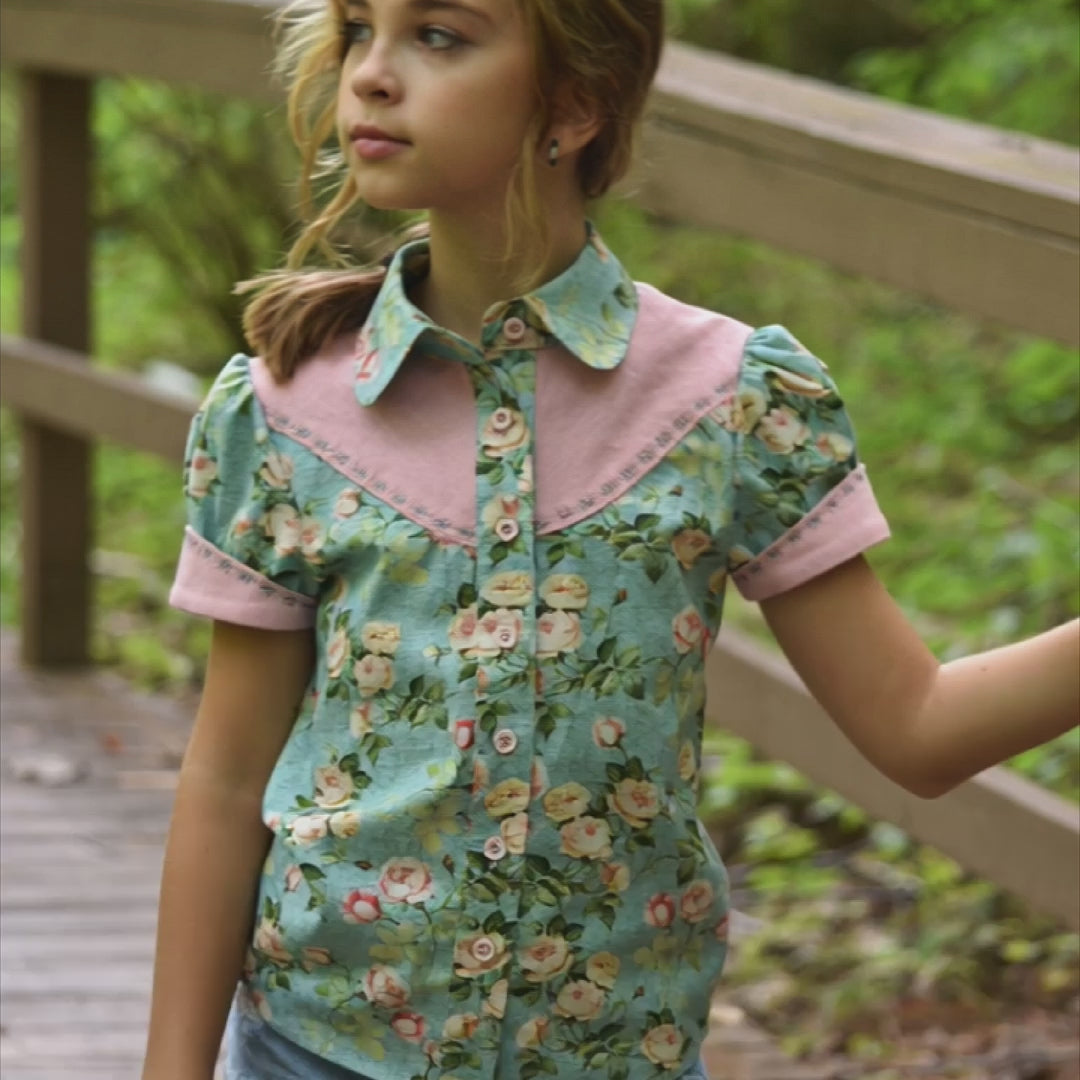
If you enjoy a touch of Rodeo style, you’ll love the subtle nods to tradition in this girls western blouse sewing pattern — from the shaped yoke to the button‑down closure, stand‑up collar the blouse has that sweet blend of heritage and handmade love.
Featuring long set‑in sleeves for a neat finish or a playful short puff sleeve with adorable turn‑up cuffs.
And because a little extra help is always a treat, you’ll get a full video tutorial too. It makes this digital pattern wonderfully easy to jump into—just scroll down and let the fun begin.
Pattern Download Includes
- Instant Download
- DIN A4 & US Letter Size
- Individual PDF Files for every Size
- All Sizes included
- Detailed eBook
- Video Tutorials
Design Options
Design Options
- Short Puff sleeve with cuff
- Optional piped cuff edges
- Long sleeve
- Lace detail cuffs (optional)
- Back darts (optional)
- Classic western yoke
- Stand up collar with round tips
- High - low hem finish
- Front button placket
- A doll version of the pattern is available in the shop
Fabric Requirements
Fabric Requirements
BEST MATERIAL CHOICE
• Lightweight cotton
• Lightweight linen
• Works beautifully in prints or solids
FABRIC REQUIREMENTS
- Shell: 1-1.7 yards (1-1.5m)
NOTIONS
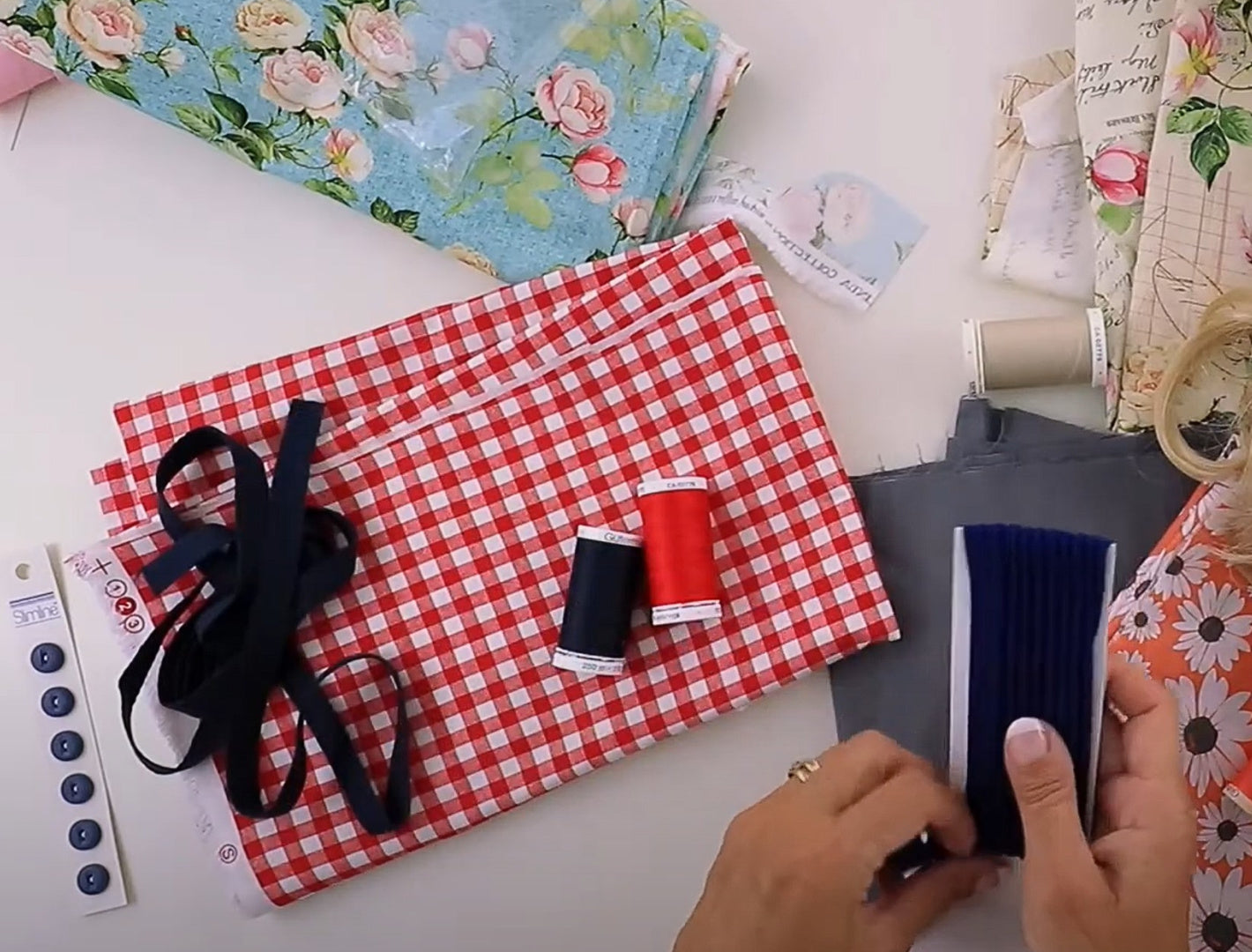
- Thread: 2 Reels
- Interfacing (H180): 8 inches (20cm)
- Buttons: 6-8
- Optional Piping for the yoke, cuffs and collar: 3 yards (2.5m)
Available Sizes
Available Sizes
Sizes: 1-12 years
Please Read
Please Read
- This is a digital pattern or PDF file, not a physical product. It will be delivered electronically via a download link delivered to the email used for the purchase.
- To ensure the pattern prints at its actual size, it's recommended that you use Adobe Acrobat Reader.
- The pattern creator, Frocks & Frolics, welcomes small-scale production using their patterns.
Customers are encouraged to tag Frocks & Frolics when sharing projects made using their patterns on social media.
@frocksandfrolics #frocksandfrolics
Share

STEP-BY-STEP VIDEO TUTORIALS
VIDEO TEXT
Transcript for the video: Western Blouse - Introduction
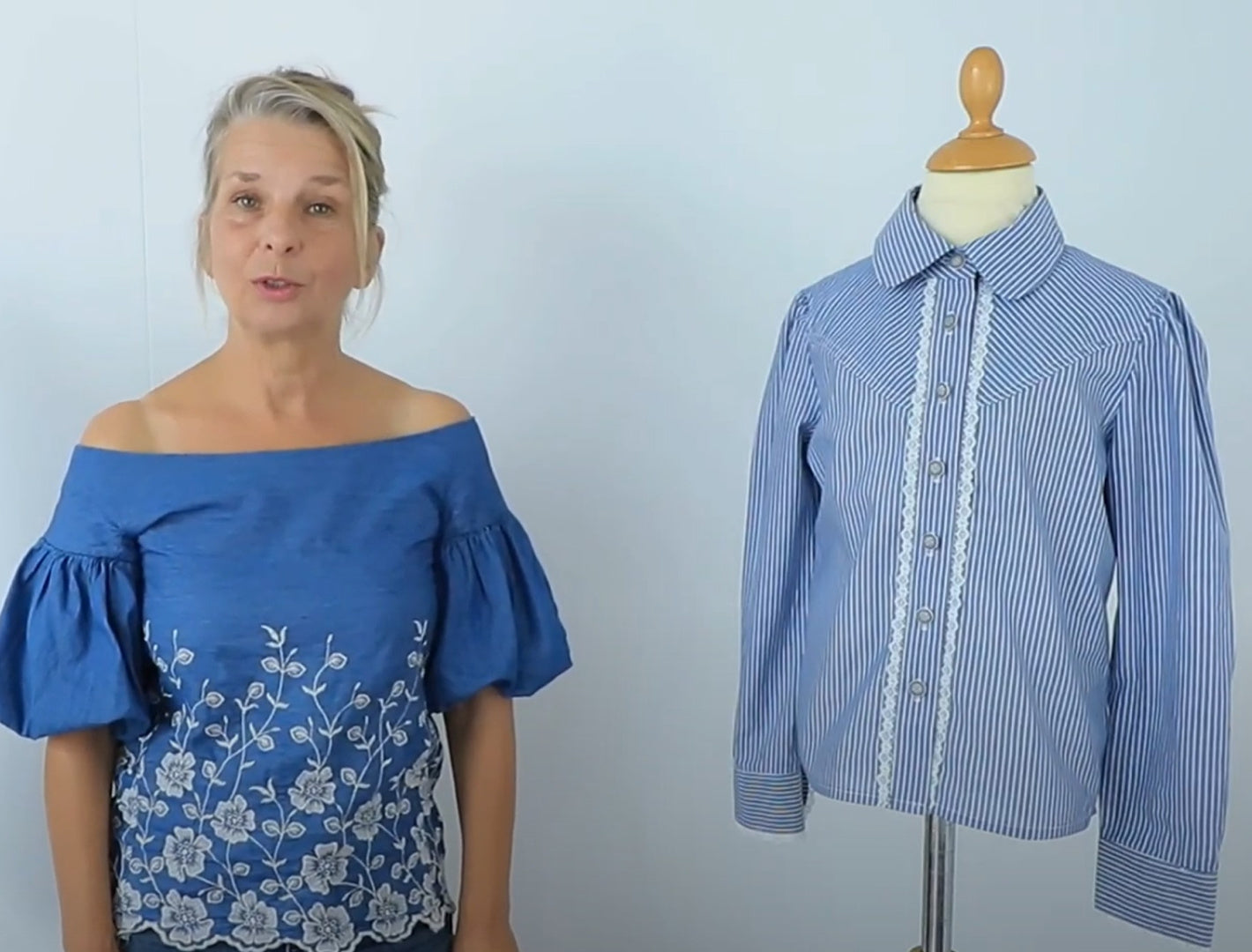
Welcome to the Western Blouse project with Frocks and Frolics. I am Marina, and I’m going to guide you through everything you need to know to create a beautiful Western blouse.
The Western blouse has been around for a long time. It is one of my earlier patterns, now updated to include sizes 1 to 12. Many of you have been waiting for this update, so I hope you enjoy the course.
Pattern Updates and Design Changes
A few things have changed from the original version. The older blouse included front patch pockets, but I removed them in the updated pattern.
The yoke has a rounded shape, and the straight pockets did not integrate well visually. If you already have the older pattern, you can still use the pockets, but they are not included in the updated version.
Course Materials and Bonus Content
This project includes both a video course and an ebook.
The ebook covers:
- Sizing
- Cutting layout
- Construction steps
It uses a photo-based guide for clarity.
There is also a sample blouse made for the course, shown as the standard version. The cuffs are sewn simply, with optional embroidery added for detail.
Hem and Bonus Tutorials
You will also learn how to create a clean hem finish. A dedicated video explains this technique in detail, available in the bonus section.
Additional bonus videos include:
- Hem construction method
- Yoke sandwich construction
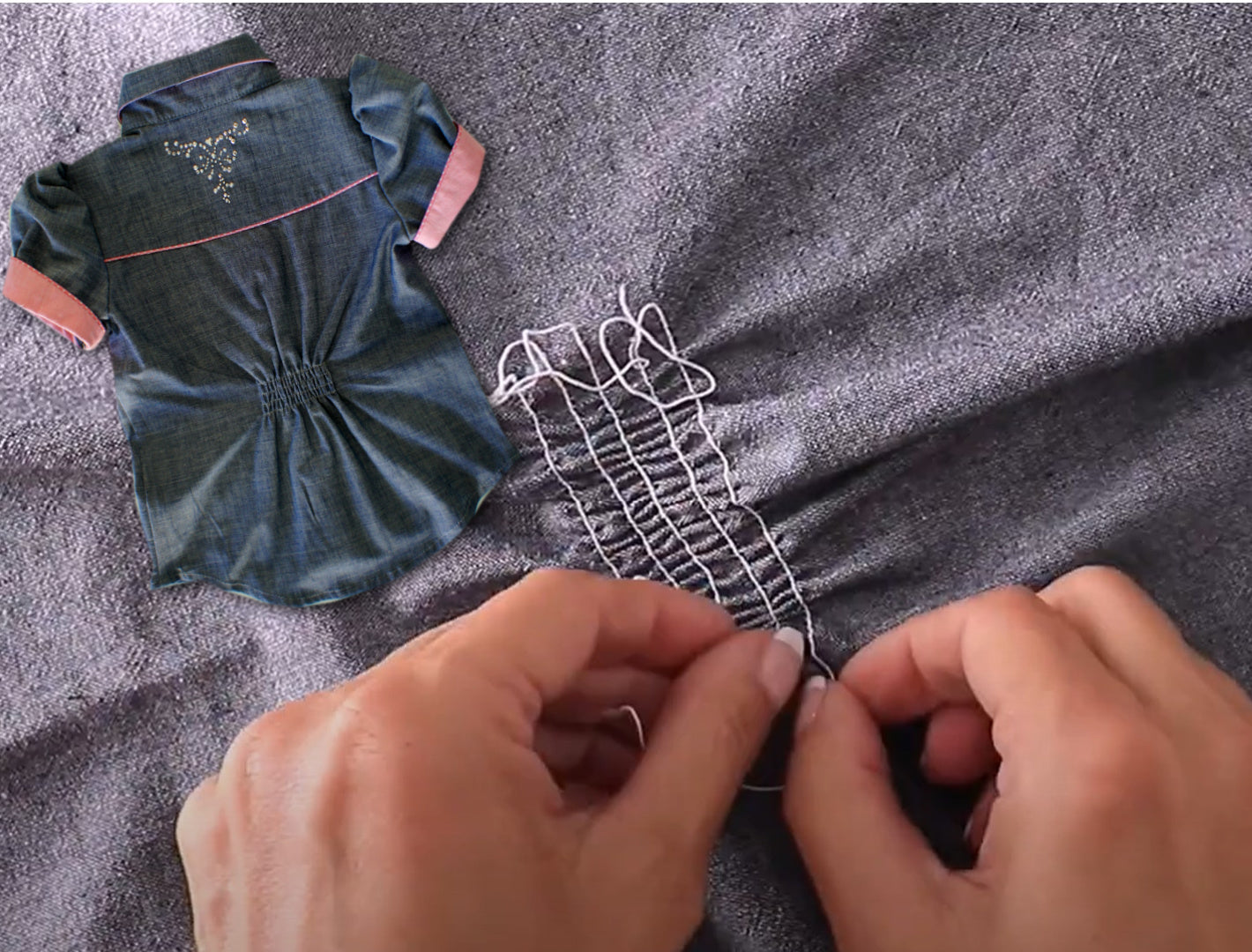
- Smocking at the back
These are not included in the main video but are available as extra learning resources.
Fabric Choice and Material Notes
The blouse is made using chambray fabric. Chambray resembles denim visually but is lighter in weight.
It is created using a thicker weft thread, giving it a denim-like appearance without the heaviness.
Design Enhancements and Variations
This updated version includes several enhancements:
- Optional piping for easier construction and cleaner shaping
- Piping along plackets for decorative detail
- A curved yoke construction method to simplify assembly
- A ribbon detail around the yoke for added structure and style
The ribbon also helps guide the curve more cleanly and may improve accuracy during sewing.
Back Design and Fit Adjustments
A new back design includes a pleat option.
This is useful for smaller or slimmer body types where additional ease is needed.
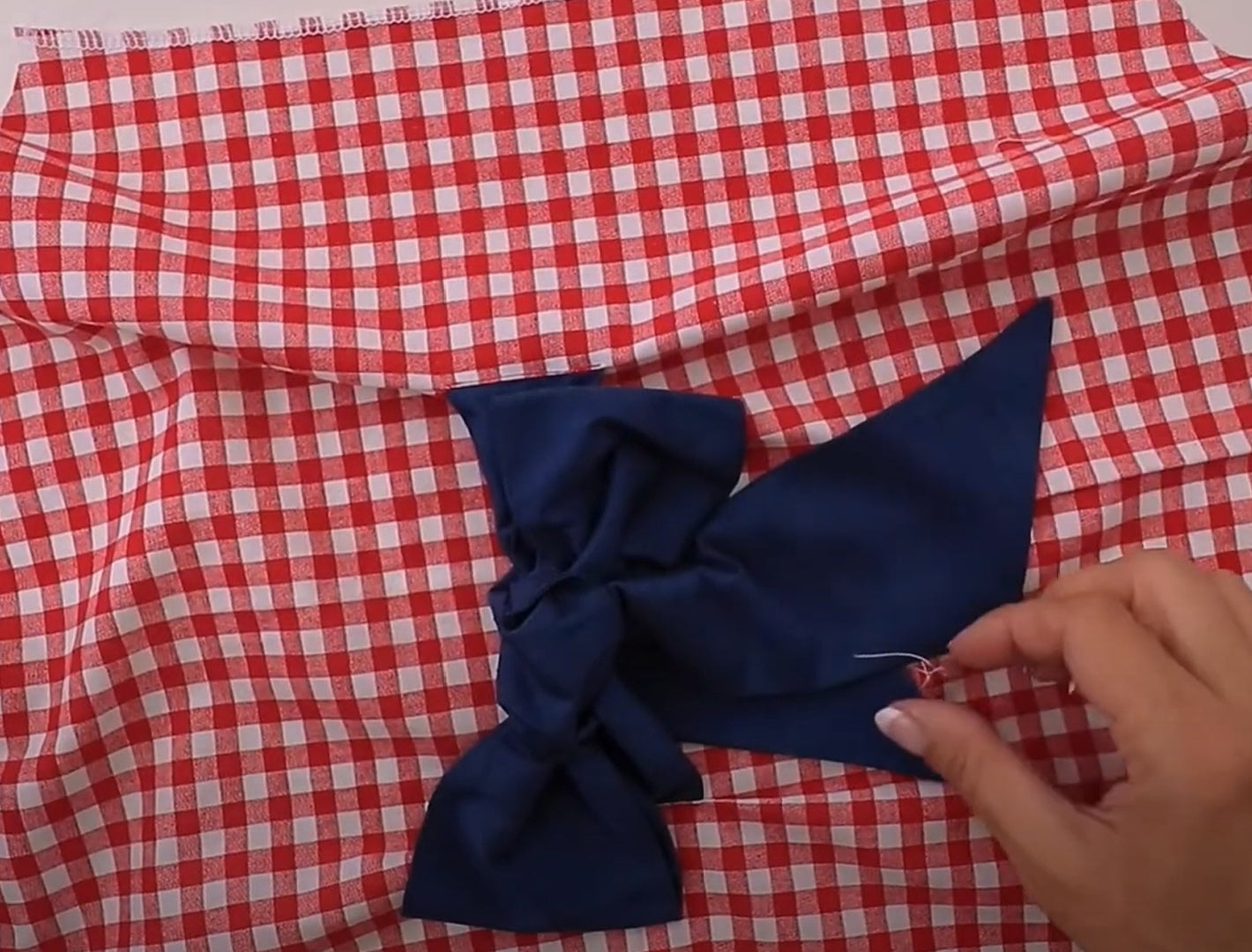
A bow detail is added at the back, shaped with a modified pattern piece rather than a simple straight strip. This creates a structured bow with more definition.
Buttons and Style Choices
Instead of traditional matching buttons, a wooden button is used.
This adds a Western or Bavarian-inspired aesthetic and softens the overall design.
Construction Techniques
The blouse can be constructed using:
- A zipper foot instead of a piping foot
- Adjustable needle positioning to simulate piping stitching
Not all machines allow full left-edge needle positioning, so testing your setup is important before starting.
Yoke Construction and Grain Direction
The yoke is cut as a single piece.
Because of its shape, parts of it fall on the bias, which helps the fabric drape more naturally.
The yoke is lined, which simplifies finishing and improves durability.
Alternative Construction Methods
If you do not have a serger, alternatives include:
- Bias binding for finishing edges
- French seams for clean internal construction
Both methods are covered in additional bonus tutorials.
Sleeve and Variant Options
The blouse includes both long and short sleeve variations.
Each version has dedicated bonus guidance for construction.
Learning Resources and Extras
Additional advanced techniques are included in older bonus materials, such as:
- Decorative rhinestone application
- Ruffle sleeve variations
- Advanced embellishment methods
These are optional but expand the design possibilities significantly.
Final Notes
You are encouraged to share finished projects and reviews on the website gallery section.
This course is designed to be flexible—allowing you to build a basic blouse or develop a highly detailed garment depending on your skill level.
Let’s begin the project.
Transcript for the video: Western Blouse - The Pattern
Hello everyone, welcome to the Sewing Workshop. This week we are going to look at how to construct a western blouse. I am Marina, and I am going to tell you everything you need to know in order to make a beautiful western blouse.
The western blouse has been around for a very long time. It is one of my earlier patterns, which I have now updated to include sizes 1 to 12. I know many of you have been waiting for this, so I hope you enjoy the course.
A few things have changed on the blouse. I used to include patch pockets on the front, but because of the yoke shape, I felt they did not suit the design as well, so I left them off. If you have the older pattern, you can still use them, but for the new version they are removed.
The course includes:
- Video lessons
- An ebook with sizing, cutting, and construction instructions
The ebook includes a photo guide using a standard blouse version. I added a little embroidery on the cuffs for detail. You will also learn how to create a clean hem finish, with an additional bonus video explaining this technique.
Bonus Content Overview
In the bonus section, you will find:
- Hem construction techniques
- Yoke sandwich construction and topstitching
- Smocking at the back
These are not included in the main video, but are important techniques depending on the version you choose to make.
The fabric used in the sample blouse is chambray, which resembles denim but is lighter because a thicker weft thread is used. It pairs very well with this design.
Design Variations and Construction Notes
For the main blouse project, I used a more advanced version:
- Added piping along the yoke and placket edges
- Optional wooden buttons for a rustic western style
- Ribbon trim along the yoke edge for structure and decoration
- Twin rows of topstitching for a reinforced look
- Optional back pleat instead of smocking for a simpler fit adjustment
- Feature bow at the back for shaping and design detail
The bow is not a simple straight strip. It has a shaped center section that creates a proper bow form when tied.
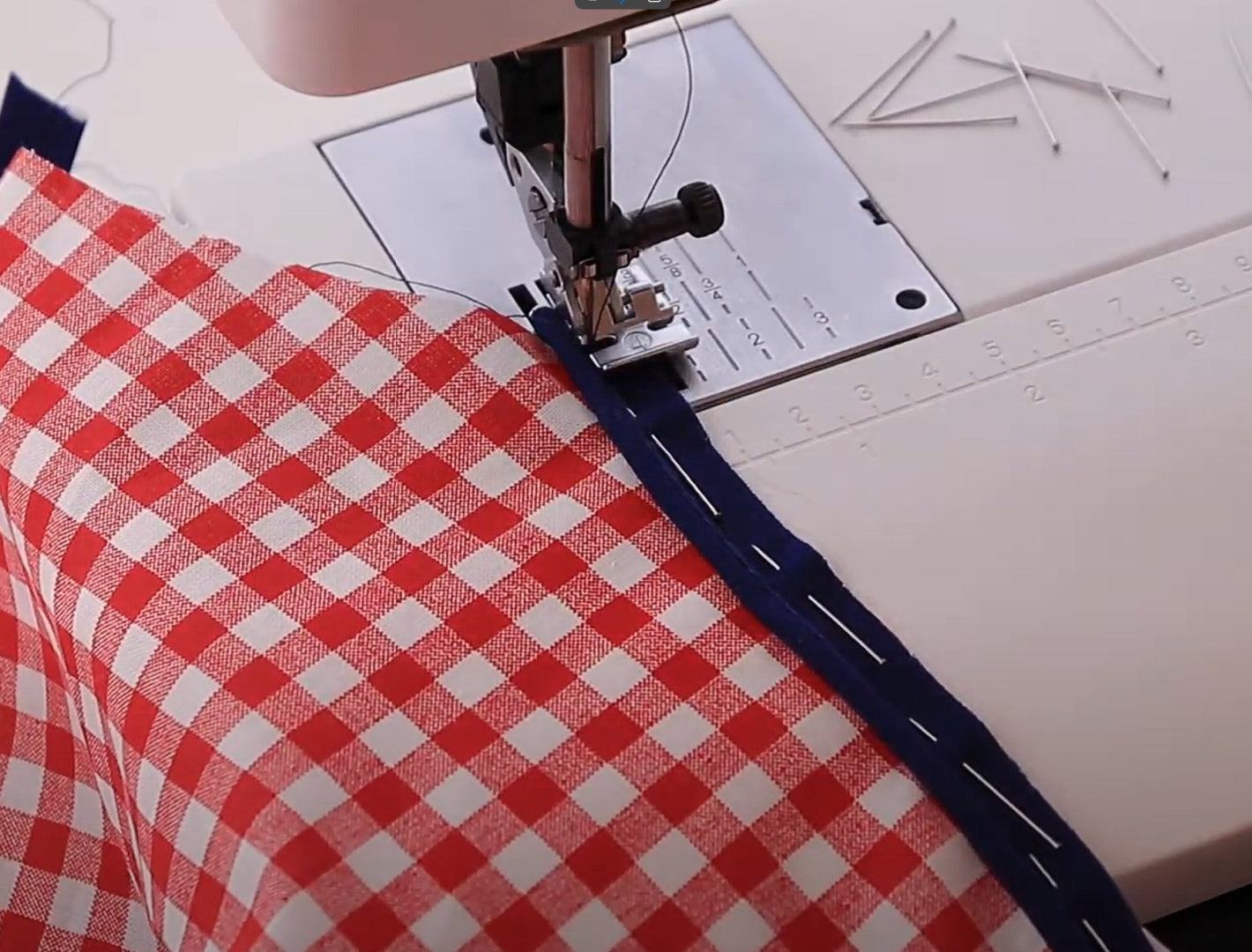
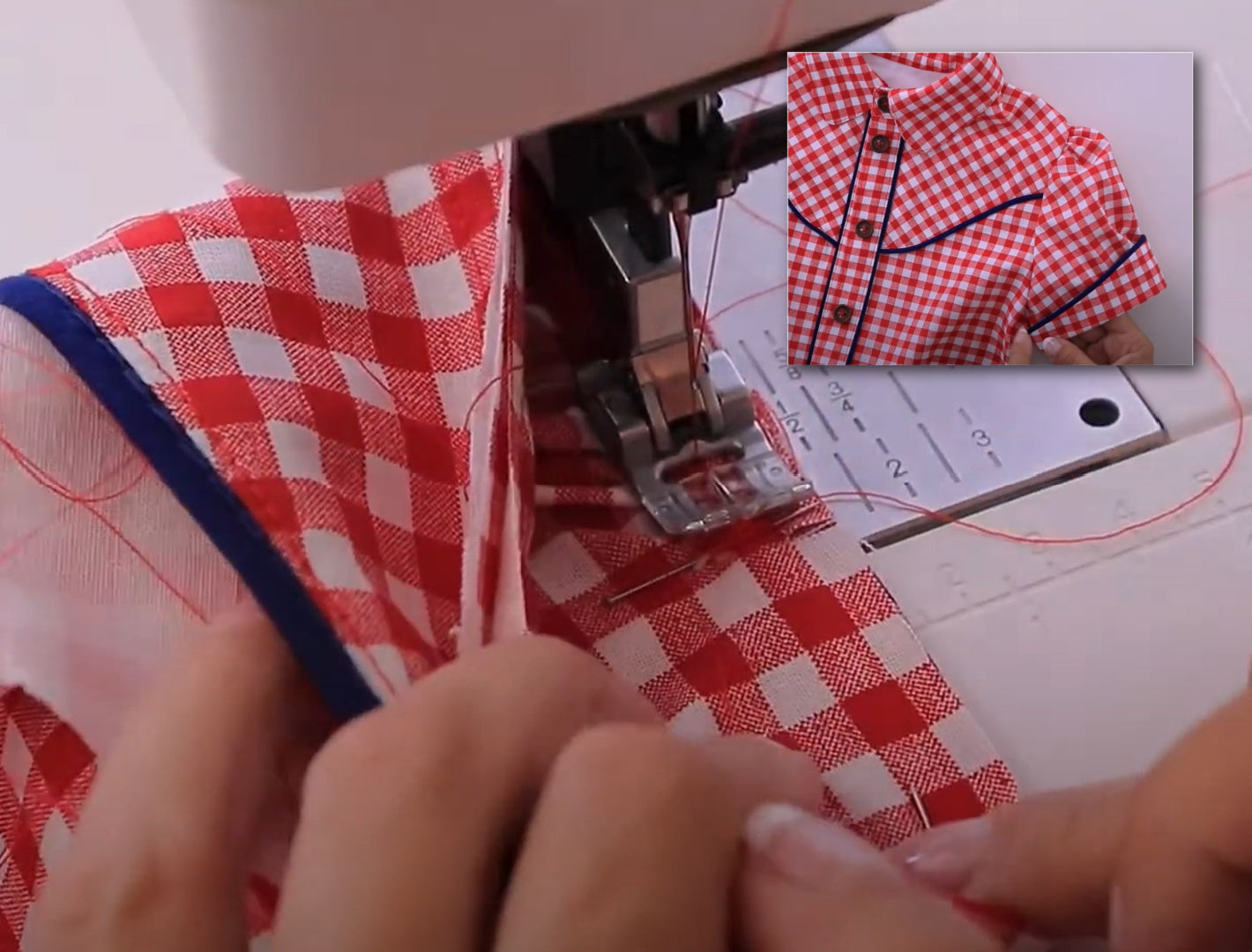
Piping is applied using a zipper foot. A dedicated piping foot is optional. The key is to adjust the needle position fully toward the edge of the foot. Always check your machine capability, as not all machines allow full adjustment.
Finished Blouse Overview
The finished blouse includes:
- Yoke construction without a shoulder seam
- Bias placement of fabric for visual effect (especially with checks or gingham)
- Lined yoke for clean interior finishing
- Armholes finished with serging or binding, depending on available tools
For beginners without a serger, you can use:
- French seams (recommended alternative)
- Bias binding around armholes
These alternatives are explained in the bonus material.
Pattern Overview and Printing
[Music] In this chapter, we will look at the pattern in detail so you understand every piece and how it fits together.
Each pattern includes a test square at the top. You must measure it in both directions:
- 2.5 cm or 1 inch
If it is correct, proceed with printing.
Patterns are layered by size. Print only the required size. Pages are arranged to fit either Letter or A4 paper.
Each pattern piece includes attachment lines to help align printed pages. This makes assembly easier compared to traditional patterns without guides.
The final page shows:
- All pattern pieces
- Color-coded symbols for identification (e.g., sleeves, front, back)
Smaller sizes will have fewer pieces.
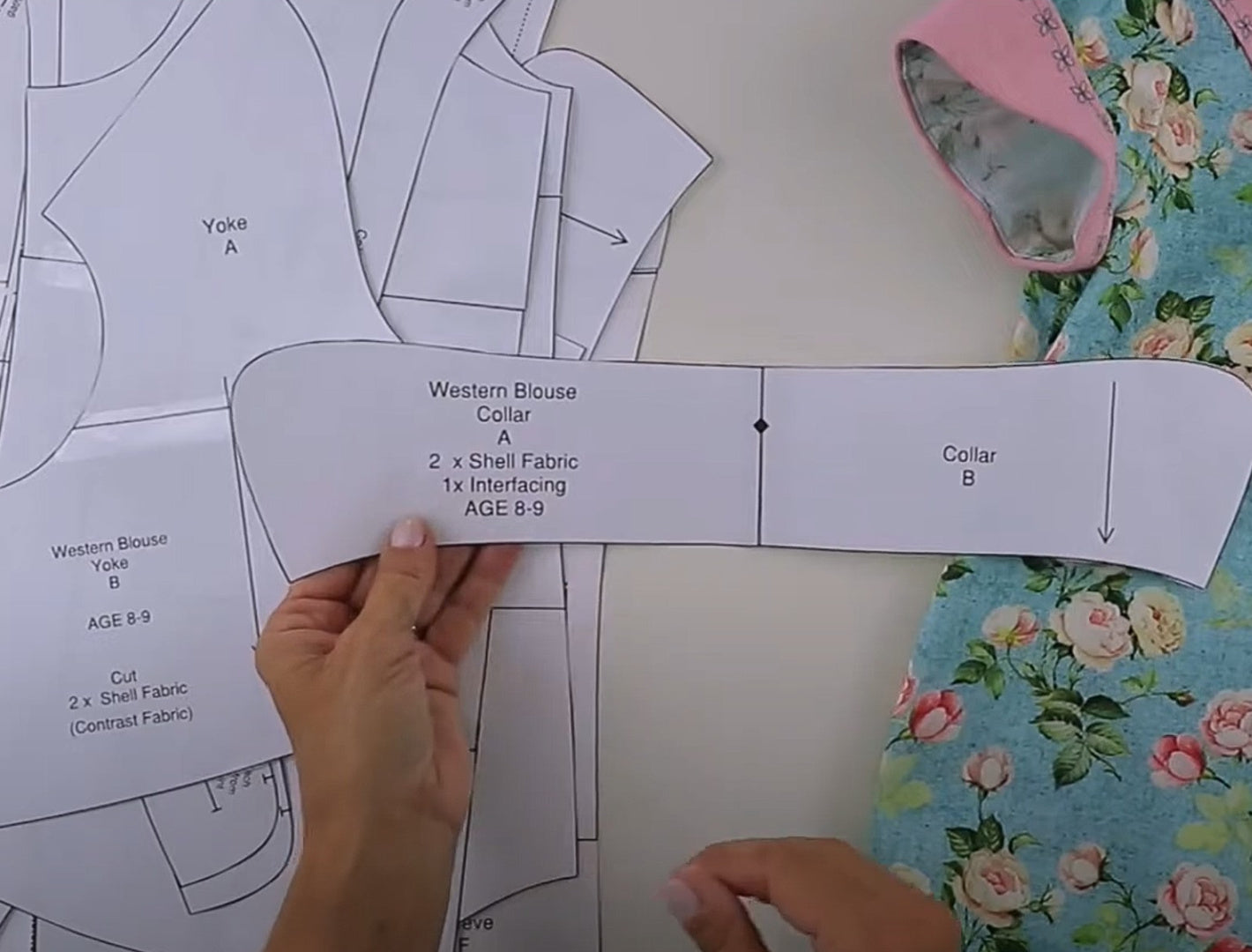
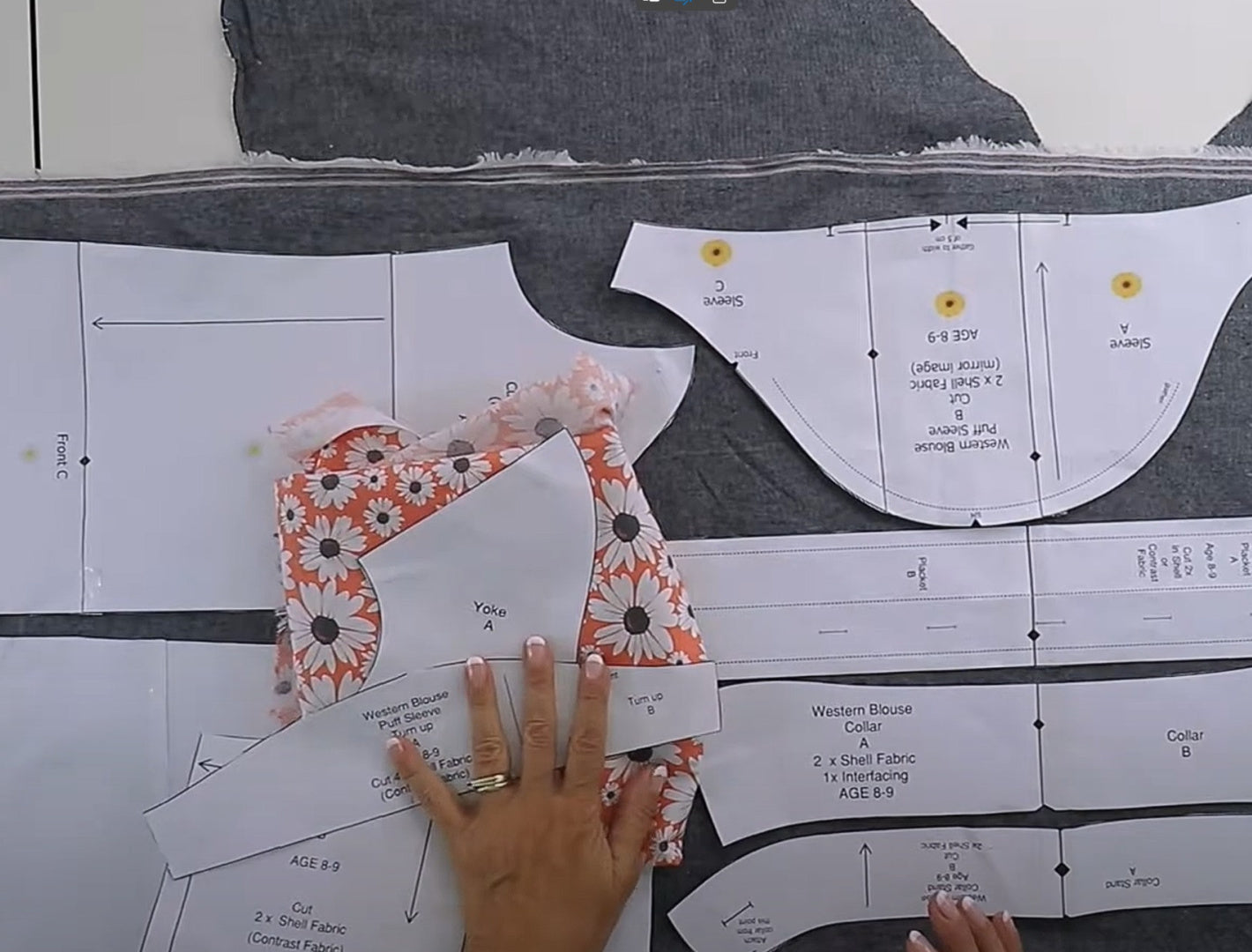
Collar, Yoke, and Stand Construction
The collar is cut:
- 2 times in shell fabric
- 1 time in interfacing
You may use contrasting fabrics for upper and under collar if desired.
The yoke is cut as a single continuous piece. This removes the shoulder seam, allowing the design to wrap smoothly across the shoulders. Because of its shape, parts of the yoke fall on the bias, which can enhance the appearance of checks or stripes.
Be careful not to stretch this area. A stay stitch can be added for stability.
The collar stand is cut twice:
- One piece retains seam allowance
- One piece is trimmed for use as a template for clean folding
Interfacing should also be applied once to the collar stand.
Front Placket Construction
The front placket requires interfacing applied only to the strip area, not the entire piece, to avoid bulk.
Interfacing can be applied as a continuous strip rather than cut pieces, which is more efficient and flexible.
The placket is folded in half and pressed before construction. Button placement is centered along this fold.
Front, Back, and Sleeve Pieces
The front pieces:
- Cut twice (mirror image left and right)
- Include bias areas near the yoke for shaping
The back:
- Cut on the fold
- Includes optional shaping for fit adjustment
You may use:
- Smocking lines for elasticity
- A pleat with a back tie for shaping
The back tie:
- Inserts into a pleat
- Forms a bow shape when tied
- Provides additional fit control for slimmer silhouettes
Sleeve Options
Two sleeve types are included:
- Short puff sleeve
- Long sleeve with placket
The puff sleeve:
- Gathers at the sleeve head
- Includes shaping toward the front
- Requires marking for front, back, and shoulder points
- Gathers must be evenly distributed to fit the armhole
The cuff detail:
- Cut 4 times in shell fabric
- Cut 2 times in interfacing
The long sleeve includes:
- Light gathering at the top
- A slit and placket construction
- Optional binding finish
Placket construction is simple:
- Attach strip
- Fold and topstitch
- Clean finish on both sides
Construction Notes and Alternatives
If you do not have a serger, you can:
- Use French seams for clean edges
- Use binding for armholes instead of overlocking
For lighter fabrics, lining the yoke improves stability and finish. For firmer fabrics, a single-layer yoke may be sufficient.
Closing Notes
This blouse is designed to be flexible. You can simplify or advance it depending on your skill level and fabric choice. The structure remains the same, but finishing methods can vary.
In the next chapter, we will look at fabric selection and begin cutting out the blouse.
Transcript for the video: Western Blouse - Fabric Choice
In this chapter, we focus on cutting out the check fabric and preparing everything for sewing, including interfacing.
There are a few important things to watch out for when working with checks. The goal is to ensure the pattern lines run straight, even if the fabric grain is slightly off. When working with directional fabrics, alignment matters, but with checks, visual alignment takes priority over perfect grain accuracy.
In this case, I’m working with limited fabric—about one yard—so layout efficiency is important. The yoke is cut twice, and fabric usage is tight, but careful placement allows everything to fit.
Pattern Placement and Cutting
The back is placed on the fold. Even though the fabric grain is slightly warped, I’m aligning everything to the check pattern to maintain visual consistency. This prevents any visible shifting down the front placket, which would be noticeable in a finished garment.
The collar and front pieces are aligned carefully so the checks match at key seams. Small adjustments are made where necessary, even if it means slightly reducing seam allowance by a few millimeters.
Underarm alignment is also checked to ensure consistency across panels.
The cuff pieces are cut twice, ensuring one left and one right piece (mirror image). Cutting is done carefully to avoid wasting fabric, especially when working with narrow widths (around 120 cm wide quilting cotton).
A key cutting principle here: if you are right-handed, it is often easier to cut from the left side, allowing your other hand to stabilize the fabric and improve control.
After cutting, only a small amount of fabric remains, though it may still be useful for small details like bows or trims.
Interfacing Preparation
Next, all interfacing pieces are prepared:
- Collar stand: cut and marked
- Collar: marked at center back
- Cuffs: interfacing applied to matching pairs
- Placket: prepared for folding and interfacing
For the collar stand, the center back is marked by folding and clipping. The same applies to the collar piece.
Interfacing is applied to one collar stand piece, one collar piece, and both cuffs.
The placket requires special attention. Instead of cutting an exact strip, interfacing is applied to a folded fabric piece, aligning with the center fold. This simplifies construction and improves stability.
Only the placket area (about 3 cm wide) is interfaced—not the entire piece—to avoid unnecessary stiffness.
Marking Pattern Pieces
Each piece is marked before sewing:
Yoke
- Shoulder point marked on both pieces
- Center back marked
- Cut on the fold to create a seamless yoke
Collar Stand
- Center back clipped
- Start and end points marked for collar attachment
Collar
- Center back marked
Cuffs
- Center back marked
- Noted as mirror image pairs (left and right cuffs)
Front and Sleeves
- No major markings needed on front pieces
- Sleeves require marking for: (1) Front orientation, (2) Shoulder alignment, (3) Gathering start and end points
For the sleeve, gathering must match specific sections and align precisely with the armhole. Accuracy here ensures the sleeve fits correctly into the garment.
Interfacing Application Process
Interfacing is applied using heat and steam:
- Fabric is placed with the adhesive (bumpy) side down
- Iron is pressed down without excessive movement
- Heat is applied in sections, counting roughly to eight before moving
This prevents shifting and ensures proper bonding.
A caution: low-quality interfacing may melt or stick to the iron if overheated. Using controlled pressure and steady placement prevents damage.
This process is repeated for:
- Collar
- Collar stand
- Placket (after folding in half)
Placket Preparation
The placket is folded in half and pressed carefully, ensuring check alignment remains consistent. Interfacing is then applied to stabilize the structure.
After pressing, the edge is folded and prepared for topstitching. This ensures a clean finish once attached to the garment.
Final Preparation
Cuffs are paired correctly (left and right). Incorrect pairing will be immediately noticeable during assembly.
All prepared components are placed into a sewing pile:
- Collar (paired)
- Collar stand (interfaced)
- Cuffs (paired and interfaced)
- Front and back pieces
- Sleeves (marked and ready)
At this point, all cutting, marking, and interfacing is complete, and the garment is fully prepared for construction.
Transcript for the video: Western Blouse - Cutting Out
In this section, I’m showing how to work with a contrast fabric for the yoke and cuffs. It’s a really effective design choice and gives a strong visual highlight when combined with the main fabric.
After that, we switch to a gray chambray for the rest of the blouse, which blends nicely with the contrast sections.
One important thing to watch for: when your fabric contains white areas, layering can change how it reads visually. If you double the fabric, the gray underneath can dull the brightness. A useful trick is to cut the same pattern piece once in white fabric underneath and once in the patterned fabric on top. This helps keep the contrast bright and clean.
Grain Direction and Layout Flexibility
The fabric is fairly similar in both directions, so you have some flexibility in layout.
There is slightly more stretch in one direction, but in most cases, it won’t be noticeable for this project.
For sleeves and smaller components, you can align pieces along either direction of the fabric as long as there is no obvious print direction.
However, for structural pieces, always respect the grain line:
- Front
- Back
- Placket
These areas need stability and should be cut along the grain for the best result.
Even so, if you are short on fabric, minor adjustments are possible. The placket, for example, can still be cut slightly differently without major issues as long as it is stabilized properly.
Placket Interfacing Method (Plain Fabric Adjustment)
Now I want to show a slightly different method for preparing the placket when you are not using a check fabric.
With checks, it is easy to follow the lines visually. With plain fabric, precision becomes more important.
Start the same way:
- Fold the placket fabric toward the center
- Press it firmly to establish the fold
Then add the interfacing strip.
Hand-cut interfacing strips are often slightly uneven, so alignment becomes critical. If the strip is not perfectly straight, use a reference measurement instead of trusting the edge.
For example:
- Target width is 3 cm
- If your strip is slightly smaller (e.g., 2.5 cm), align it using a ruler line rather than the fabric edge
You can align the interfacing along a consistent 3 cm guide and press it in place. This ensures a straight and controlled result even if the cut edge is imperfect.
Pressing and Alignment Control
Once positioned:
- Check that the strip has not shifted
- Confirm consistent spacing along the full length
- Press carefully without dragging the iron
After the first press:
- Fold the placket over again
- Press it sharply to set the structure
At this stage, you should see a clean, controlled fold line that will guide your stitching later.
Precision Check and Quality Control
Before moving on, always check:
- Distance from edge is consistent
- Interfacing is evenly placed
- Fold line is straight from top to bottom
You can physically feel the edge or visually compare spacing to confirm alignment.
Plackets are simple in construction, but they are precision-critical. Any small error will be visible in the finished garment, especially on the front.
Final Press and Result
Once everything is aligned:
- Press again to lock the shape
- Recheck measurements along the full length
If everything is consistent, you now have a clean, stable placket ready for sewing.
This completes the preparation for this variation. Everything else in the construction remains the same as in the main method.
Transcript for the video: Western Blouse - Joining The Front & The Yoke
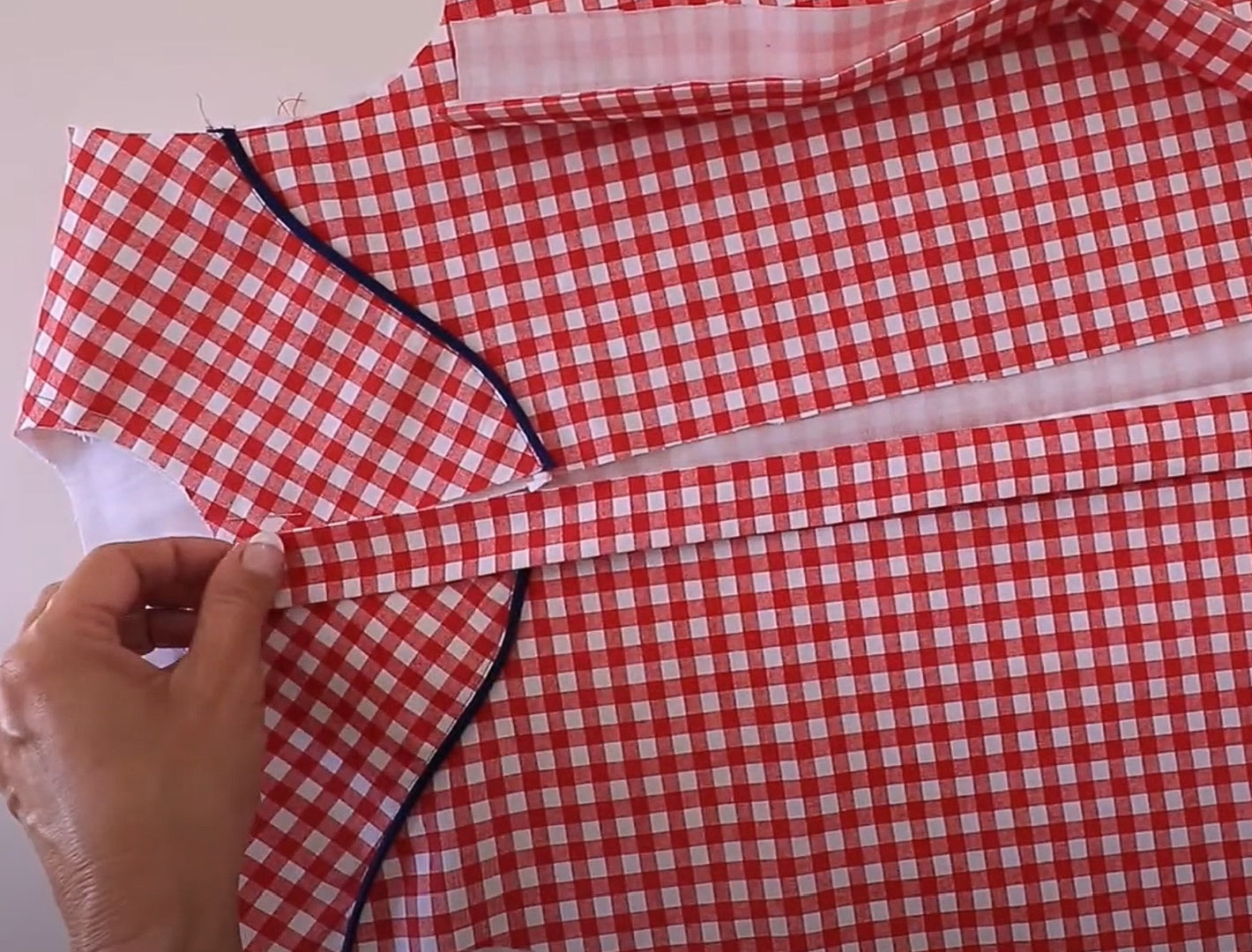
In this chapter, we attach the piping to the yoke and then sandwich the front and back pieces between the upper yoke and the lining yoke.
We begin with:
- Two front pieces
- One back piece
- Two yoke pieces
I also cut the lining in white to keep it bright. Using the same fabric for lining can make the inside look darker, so a lighter lining improves clarity and visibility.
Attaching the Front Yoke
The first step is sewing the front yoke to the front piece.
We want the seam to remain visible on the lining side underneath, while the upper layer sits neatly on top.
The seam allowance is 1 cm, so the raw edges must align precisely at that point. At certain sections, the fabric will naturally overshoot slightly, especially because of the curve.
At both ends:
- Ensure raw edges are aligned exactly
- Maintain a consistent 1 cm seam allowance
Do not stretch the fabric to fit. Instead, gently ease it into place by curving it. This prevents distortion, especially since the fabric is cut on the bias in some areas.
Work slowly along the curve:
- Keep edges aligned
- Avoid pulling or forcing the fabric
- Maintain even feeding into the presser foot
When done correctly, the front section will fit smoothly into the yoke without distortion.
Attaching the Back to the Yoke
The back is more straightforward because it is a straight seam.
Start by:
- Aligning the center back first
- Pinning outward from the center
- Ensuring raw edges match exactly along the seam line
Once pinned, sew carefully while:
- Maintaining seam allowance consistency
- Keeping fabric feeding straight into the machine
- Preventing any shifting or puckering
For control, the right hand supports the fabric while the left hand manages alignment and prevents folds underneath.
After sewing:
- Press seam allowances flat first (this helps control bulk)
- Then press the seam upward into the yoke
Adding Piping to the Yoke
Now we attach the piping along the curved yoke and across the back.
This step improves structure and also simplifies later assembly for beginners.
Key points:
- Keep raw edges aligned precisely
- Do not allow shifting during sewing
- Follow the piping closely while stitching
If available, use a piping foot. Otherwise, a zipper foot works by adjusting needle position.
Sew slowly along the curve:
- Maintain consistent pressure
- Follow the edge of the piping
- Keep fabric tension even but not stretched
Handling Curves and Securing the Seam
At curved sections:
- Slow down significantly
- Maintain alignment at all times
- Do not rush the feed through the machine
Once sewn:
- Trim seam allowances in stages for reduced bulk
- Cut carefully around curves
- Avoid cutting into stitching lines
Then press the seam over, allowing the piping to naturally define the curve. This creates a clean, structured western-style shape.
Repeat the same process for the back yoke piping.
Reducing Bulk in the Seam Allowance
To prevent thick seams:
- Pull out a small section of piping cord inside the seam allowance
- Trim the cord slightly shorter than 1 cm
- Allow the fabric casing to relax back into place
This reduces bulk significantly and helps the seam lie flatter when pressed.
Repeat this wherever piping is used.
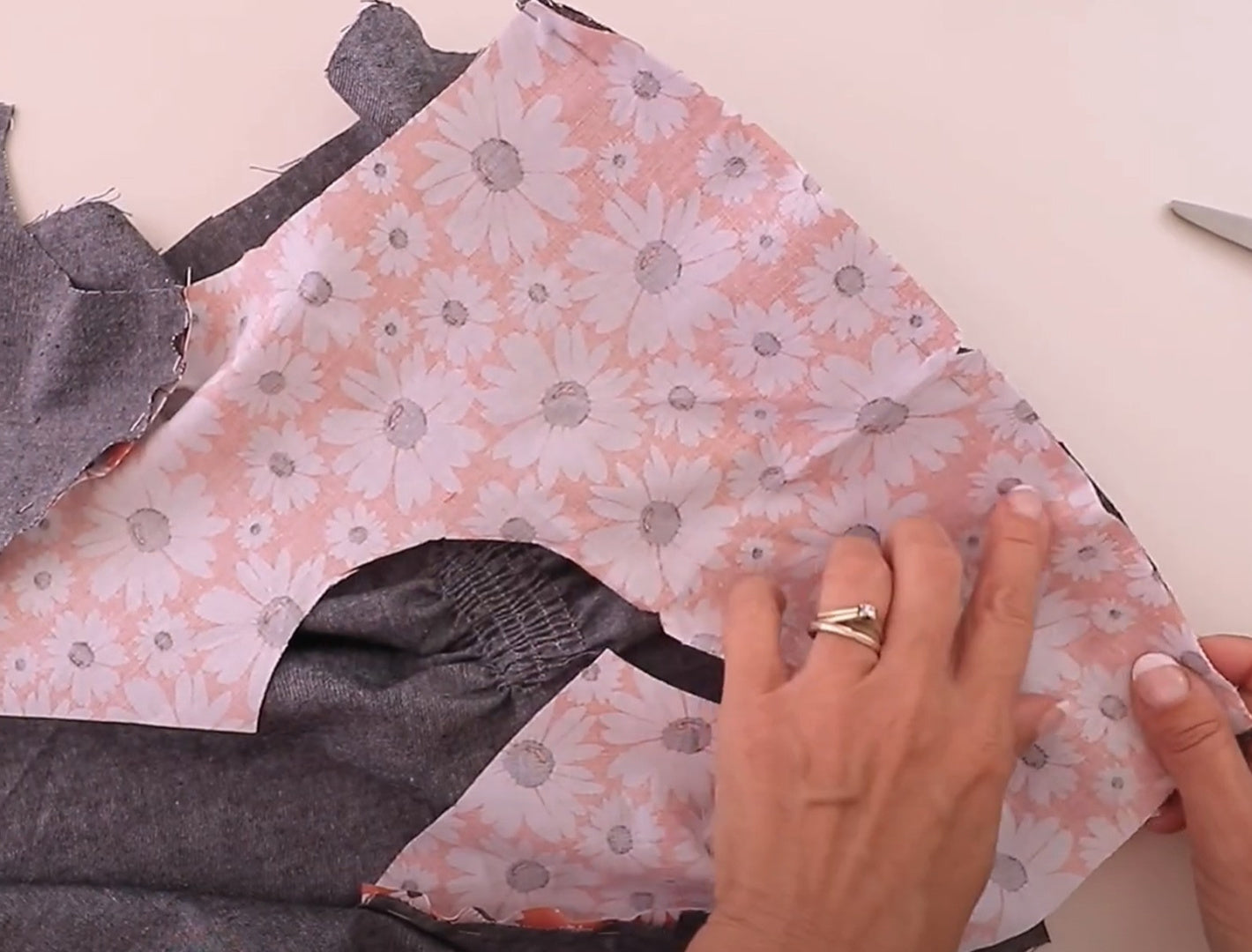
Joining the Yoke Assembly
Now place the assembled yoke over the front and back sections.
This is a forgiving step because:
- Minor alignment differences are hidden inside the seam
- The final topstitching will secure everything visually
Ensure:
- Neckline edges match
- Front and lining layers are aligned
- Back neckline is properly positioned
Pin to stabilize all layers before stitching.
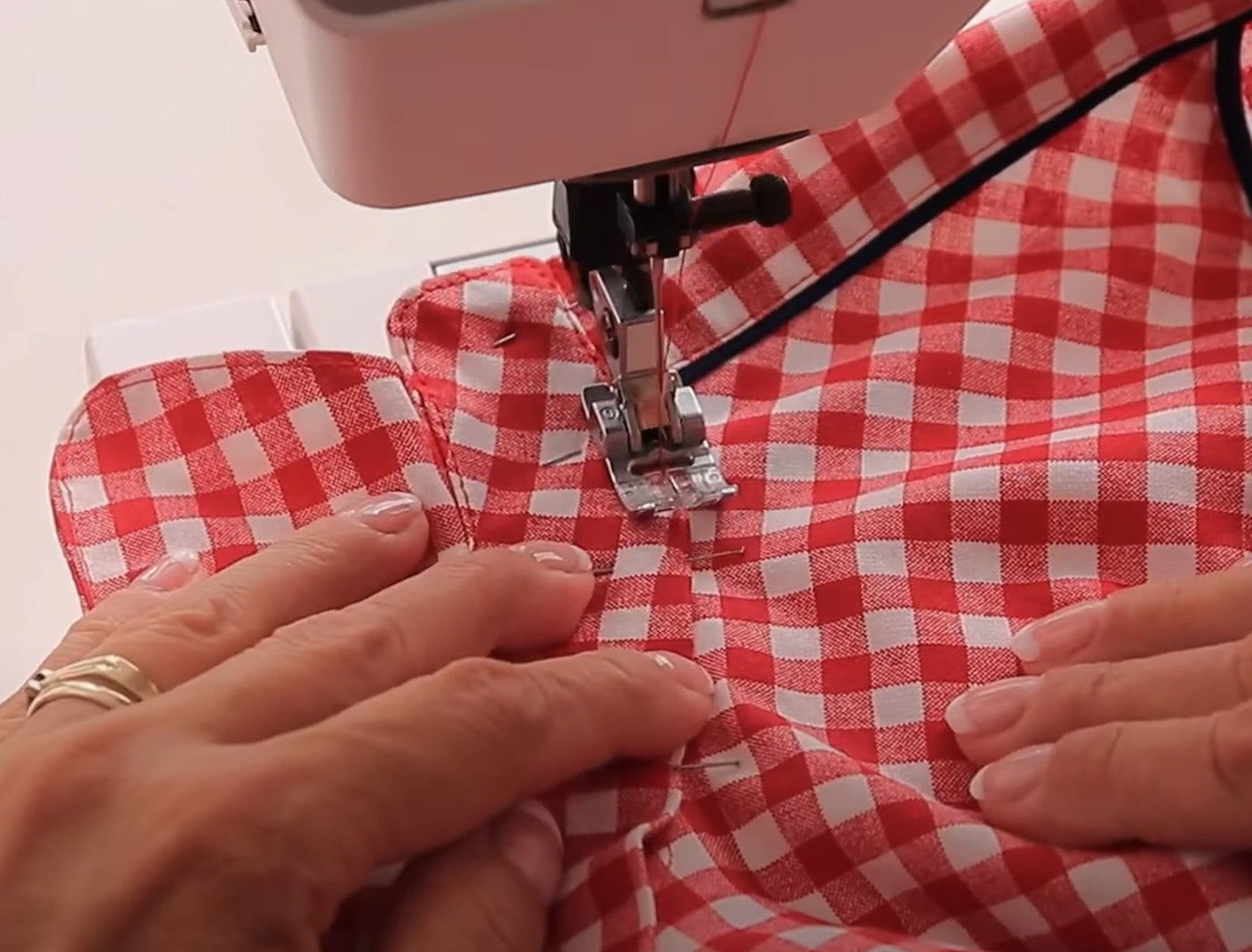
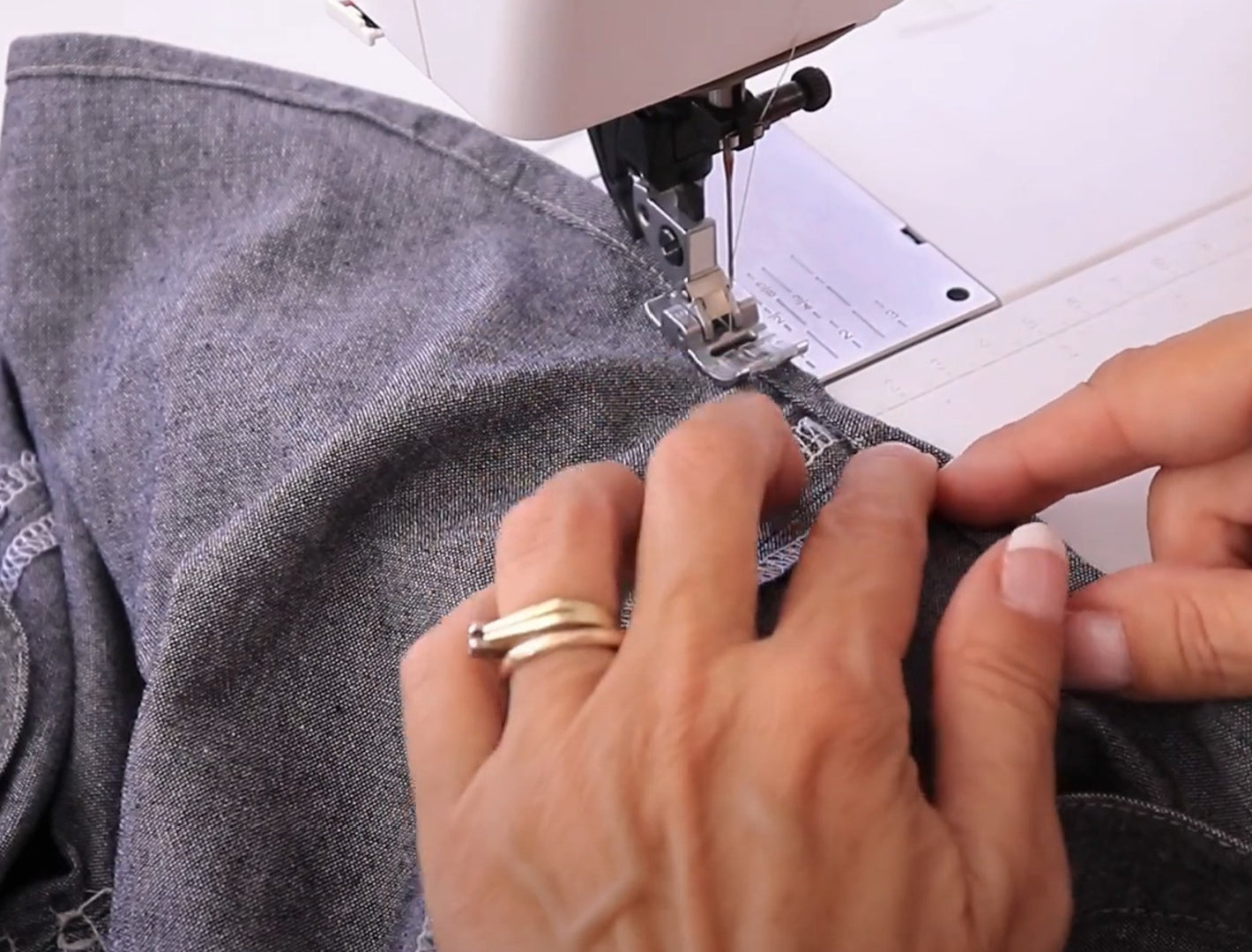
Topstitching the Yoke
Topstitch along the seam to secure the yoke in place.
Maintain:
- A consistent distance from the seam edge
- Steady machine speed
- Clear visual tracking of the stitching line
Focus on:
- The needle position
- The edge of the fabric as a guide
- Keeping an even margin throughout
Use slow, controlled movement, especially around curves. Straight sections are easier, but curved sections require attention to both needle position and fabric edge alignment.
Final Result
Once completed:
- The yoke is cleanly sandwiched
- Piping defines the curve
- Front and back are structurally integrated
- Seam allowances are reduced for a flatter finish
This creates a strong, professional yoke construction that will form the foundation of the blouse.
Attaching the Front Placket
Transcript for the video: Western Blouse - The Front Placket
Now we attach the placket to the front pieces. The construction method is:
- Sew it to the inside first
- Roll it to the outside
- Topstitch from the outside
This sequence is preferred because it reduces the risk of missing the edge during topstitching. If you rely only on topstitching from the outside without securing it first, it’s possible to miss the folded edge underneath. That would require hand stitching to fix, which is not ideal.
An alternative method exists—sewing it to the outside first and rolling it inward—but it carries more risk of uneven catching during topstitching unless you are very precise.
First Step: Sewing the Placket to the Inside
We begin by aligning:
- Right side of the placket
- Wrong side of the front piece
Match everything edge to edge and maintain a consistent 1 cm seam allowance.
Sew steadily along the length:
- Keep alignment consistent
- Follow your reference line (check or grain line if available)
- Avoid drifting in and out from the seam allowance
Even small deviations will be visible later once the placket is folded and topstitched.
Pressing and Setting the Placket
After sewing:
- Press the seam allowance toward the placket
- Reinforce the fold with a firm press
At this stage, structure is more important than speed. A clean press determines how accurately the placket will fold and sit during topstitching.
Optional Design Adjustment: Piping Integration
There is an optional design enhancement here: piping can be added into the placket area. However, in this case, the decision is made not to include piping inside the placket seam because it would add unnecessary bulk.
Instead:
- The piping cord inside previous seams is reduced
- This keeps the structure flatter and easier to manage
By removing excess cord bulk, the placket will lie more smoothly once finished.
Rolling and Securing the Placket
Now fold the placket over to the outside along the pre-pressed fold line.
At this point:
- The folded edge should naturally cover the stitching line underneath
- Align it carefully so the fold is consistent along the full length
If alignment is slightly imperfect, you can:
- Adjust it before stitching
- Use the fold to visually correct minor inaccuracies
You may also pin the folded edge underneath if needed to stabilize it before topstitching. This is especially useful if you want a very clean finish or are working with slippery fabric.
Topstitching the Placket
Now we secure everything with topstitching from the outside.
Key controls:
- Stitch length set to 3
- Maintain a consistent distance from the edge
- Keep fabric feeding evenly without stretching
Work slowly and deliberately:
- Follow the folded edge as your primary guide
- Keep your seam allowance visually consistent
- Adjust hand position frequently for control
Pins should ideally be placed in the direction of sewing, though careful removal as you go is acceptable if they are positioned differently.
Final Result and Design Notes
Once stitched:
- The placket is fully secured
- The outer edge is clean and structured
- The inside is enclosed without exposed raw edges
This method creates a stable and visually clean front closure.
As a design variation, you could also:
- Add lace inserts along the placket edge
- Incorporate decorative trim instead of piping
- Adjust contrast stitching for a more pronounced western aesthetic
The finished placket should be both functional and decorative, forming a strong visual line down the front of the blouse.
Transcript for the video: Western Blouse - The Collar
Now we're going to work on the collar. The collar is something that people are often frightened of. They think, "Oh no, a collar!" But I've had many people send me emails saying, "I never thought I could do this, and with your video I did it. I mean, I could do better, but I did it, and I'm really excited and proud of myself." So I want to encourage you—you can do this.
I am using one collar piece for both the under collar and the upper collar, and I'm going to show you a little trick so that the collar doesn't end up flipping up. The collar should always curve under, and if you know how to do that, you're golden.
Similarly to the placket, we're also sewing the collar on from the inside first. Then we're going to iron under this edge and topstitch all the way around from the top. That makes things much easier because it doesn't matter whether you catch it or not. As you can see here, I haven't caught it, and it doesn't matter because you've already sewn it on.
Let's get started.
Sewing the Collar
The collar stand is left open just like this. We're doing nothing to that at this stage.
We're going to sew around the collar with a 1 cm seam allowance. The right sides should be facing each other, and the lower edge remains open.
Place the edge of the fabric on the 1 cm seam allowance (3/8 inch) and move along very slowly.
When you get to the curved area, reduce your stitch length to 1.5 so that when you clip and trim the seam allowance later, it won't fray.
After the curve, increase the stitch length back to 2.5.
When turning corners, make sure the needle is in the fabric before lifting the presser foot. Move the fabric a little at a time and continue sewing.
Reduce the stitch length again for the second curve, then return it to 2.5 and sew to the end.
Trimming and Turning the Collar
Trim the seam allowance fairly closely, but don't cut too close or it may fray. Leave just under 1/2 cm, about 4 mm.
Grab the collar at the furthest corner and turn it right side out. Roll the collar between your fingers to work out all the curves.
Repeat on the other side. Place your fingers inside, thumbs on top, and roll the edges outward.
If something sticks out slightly, simply push it in with a pin. Nobody will know the difference.
Pressing the Collar
Now we're ready to iron.
Make sure the seam sits exactly in the center. Move the fabric back and forth so the seam settles correctly. You can also use two fingers and gently wiggle the seam into place.
Check that everything is even. If something is off, you can still fix it now. Once it's topstitched, adjustments become much harder.
Creating an Under Collar
Because we don't have separate upper and under collar pieces, we're going to create that effect ourselves.
In my case, the seam rolled slightly toward one side, so I am using that side as the upper collar.
Remove the collar and notice what happens when you shape it. It creates a difference between the two layers. This ensures the collar curves properly instead of flipping upward.
Place a few pins in the collar and trim the under collar slightly. This gives the upper collar more room and shortens the under collar.
I'm doing the same thing on this side, pushing right into the corner. The difference isn't huge, but it makes all the difference to how the collar falls.
You can already see that the collar naturally wants to curve.
Topstitching the Collar
Sew close to the edge to secure the collar shape.
Don't stitch too close to the edge if you're unsure of your accuracy. Moving in slightly farther will often look neater.
When turning corners, keep the needle in the fabric.
Pay special attention to the collar points and curves so the layers remain centered and don't shift.
Attaching the Collar to the Collar Stand
Now we're ready to finish the collar.
First, trim off any excess fabric.
The collar is looking beautiful now.
The collar stand piece without interfacing is the one that gets attached to the collar because it rolls to the outside.
Flip it over and attach the collar from one notch to the other. Pin it neatly all the way across with the raw edges aligned.
Before sewing, make sure both collar ends are exactly the same length. Mine wasn't, so I adjusted it slightly.
This final check is very important because it ensures both collar points will match perfectly.
Sewing the Collar to the Collar Stand
Sew the collar to the collar stand.
You can sew using the width of your presser foot if that helps maintain consistency.
Sometimes sewing too slowly actually creates a less tidy result. On longer sections, a steady pace often works better.
Check again after sewing to make sure everything remained aligned.
Pressing the Collar Seam
Press the seam allowance into the collar.
This step isn't strictly necessary, but it makes everything neater and easier to handle later.
A quick press now saves effort later.
Attaching the Collar to the Neckline
There are several ways to attach a collar.
I'm using the method from the original Western Blouse course, but you can also use the doll blouse method, where the collar stand is assembled first and then slipped onto the neckline. If you struggle with collars, that method works very well.
For this method, we're rolling everything to the outside again.
Position the collar stand on the neckline with the right side facing the underside of the blouse.
Secure one front edge first, making sure you have a 1 cm seam allowance extending beyond the edge.
Repeat on the opposite side.
Match the center back notches and pin.
Fitting the Collar Around the Neckline
At first, it may look like there is too much fabric around the neckline. There isn't.
The fabric needs to be rounded into the neckline because curved seams naturally consume fabric.
Round the fabric gently with your thumbs and work it into place.
Once one side is pinned, check the shape from the outside. You'll see that the collar lies beautifully and smoothly.
Repeat on the other side.
Preparing the Outer Collar Stand
Take your collar stand template and place it on top.
Turn up the seam allowance and press it all the way around with plenty of steam.
While doing this, check that both front ends remain symmetrical.
If something isn't quite right, now is the time to adjust it. Once everything is sewn and pressed, changes become much more difficult.
Sewing the Collar Stand
Make sure you're maintaining the full 1 cm seam allowance.
Remove pins only when you're about to sew over them.
Use your fingers to keep everything flat. If the fabric starts forming a pleat, reposition it immediately.
Guide the fabric so it feeds straight into the machine.
Finishing the Collar Stand
Now comes the magic.
Bring the outer collar stand over the seam and pin it at the center back.
At the front edges, fold it down so the pressed fold sits exactly on the stitching line. Pin each side.
You don't need a lot of pins.
Everything should fit perfectly.
Topstitching the Collar Stand
Sew carefully around the curved sections using a stitch length of 2.
Hold the fabric securely with your fingers.
This is similar to industrial sewing, where operators often use very few pins and rely on their hands to control the fabric.
Maintain firm pressure and guide the fabric smoothly around the curve.
Final Pressing and Inspection
Check both front edges to make sure they match.
If necessary, make small adjustments before pressing.
Trim the seam allowance slightly, but don't trim too aggressively.
Press the neckline seam into the collar so it lies perfectly flat.
Then turn the collar stand over, tuck in the seam allowance, and roll out the seam.
Repeat on the other side.
This takes a little time, but the neat finish is worth the effort.
Final Topstitching
Before topstitching, perform one last inspection.
If any seam allowances need to be tucked in slightly more, do it now.
Once you're happy with the shape, topstitch the collar stand, starting at the center back and sewing all the way around.
Hold the fabric firmly, especially around the curves, and remove pins as you reach them.
Because we created a true under collar, the finished collar naturally folds downward and sits beautifully without flipping up. This small detail makes a huge difference in the final appearance of the blouse.
Buttonholes and Button Placement
Transcript for the video: Western Blouse - The Buttonholes
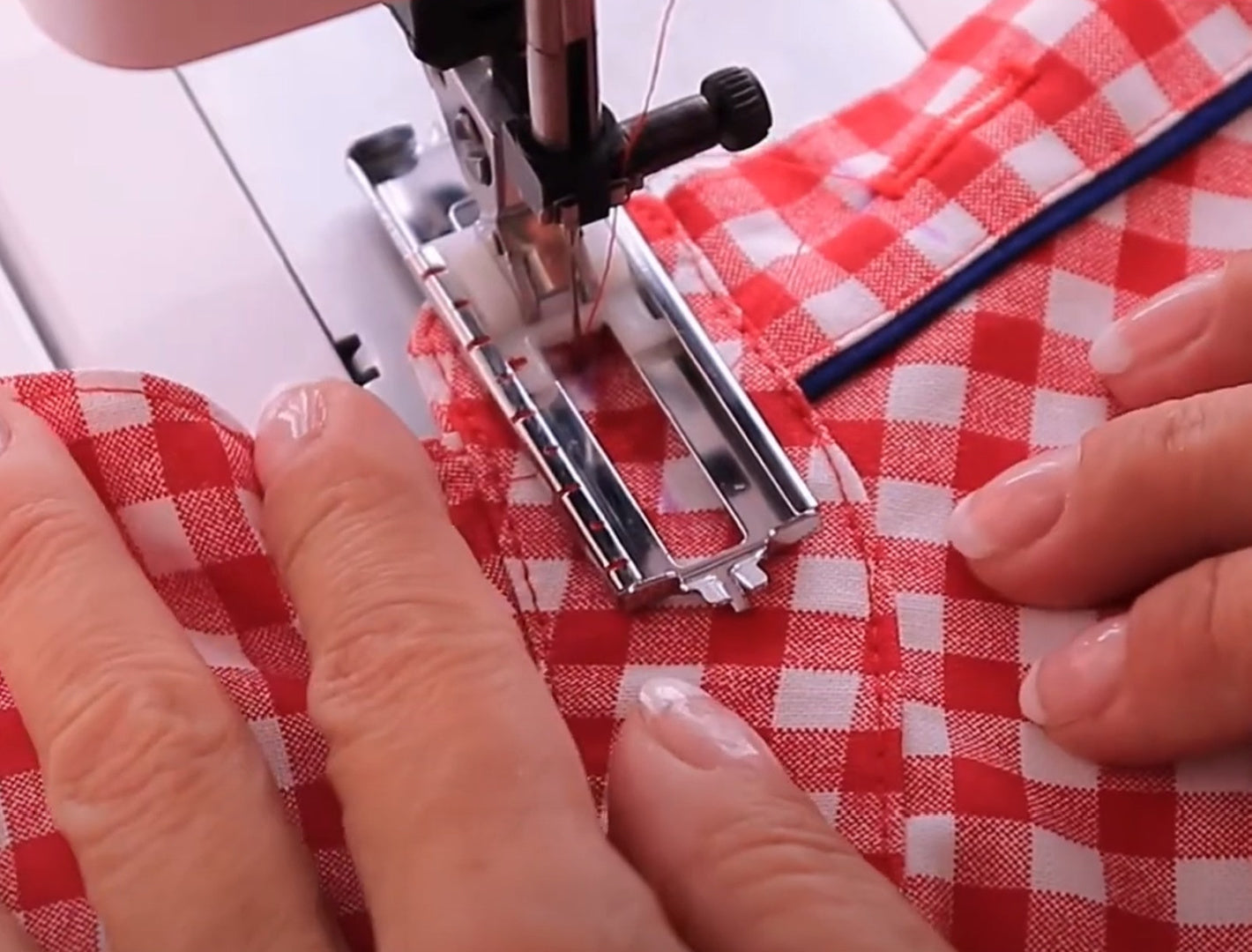
In this chapter, we're going to put in our buttonholes. I always like to do the buttonholes before I close the side seams and before I set in the sleeves, because it's much easier to handle at this stage.
Marking the Buttonholes
The buttonholes on the placket are placed vertically, while the top buttonhole is placed horizontally.
You need to make sure that the top buttonhole sits about 2 cm to 2.5 cm below the collar stand. The top button should not sit too close to the neck; otherwise, the blouse will open awkwardly.
This is usually marked on your pattern, but I adjust mine slightly depending on button size. In my case, I am using slightly larger buttons, so I reduced the number of buttonholes and adjusted spacing.
For the remaining buttonholes:
- The distance between each buttonhole is about 7 cm (2 3/4 inches)
- Start marking from your chosen top position
- Continue marking downward at equal intervals
Once you have your spacing, you can remove the button placeholders and transfer the marks to your placket.
Adjusting the Placket Position
The placket width here is about 3 cm. I make sure it is evenly folded so that it sits 1.5 cm on each side.
Because I folded it according to the check pattern earlier, it may be slightly offset, so I always measure from the actual fold line rather than the raw edge.
This ensures that your buttonholes are centered properly and not visually shifted.
Marking the Top Buttonhole
For the top buttonhole:
- Draw a vertical guideline first using a ruler
- Move slightly inward (about 1.5 cm from the edge)
- Mark the starting position of the buttonhole on this line
Do not place it right at the edge, because the placket will fold over and shift the visual alignment of the button.
Then mark the horizontal direction:
- Find the center of the placket (about 1.5 cm from either side if 3 cm total width)
- Draw the buttonhole direction line
- The buttonhole foot will determine the final length, so you do not need to fully mark the end
Machine Setup for Buttonholes
Before sewing:
- Set machine to buttonhole mode
- Reduce tension slightly (buttonhole setting if available)
- Set zigzag width around 5
- Insert buttonhole foot
- Set stitch length to low (as required for your machine)
Always do the lowest buttonhole first so you can test settings early.
Sewing the Buttonholes
Process for each buttonhole:
- Place the needle exactly at your marked cross point
- Lower presser foot and align with buttonhole foot guide
- Sew the first side in a straight zigzag line
- Form the bar tack at the end
- Sew back up the other side
- Finish with final bar tack
Hold the fabric firmly while sewing. If you are working with a check fabric, you can use the pattern lines as a guide to prevent drifting.
The key is consistency—maintain the same distance from the edge throughout.
Practical Notes on Sewing
- Keep seam allowances trimmed where possible to reduce bulk
- Thick areas (like collar junctions) can cause the machine to struggle
- Slow down only when necessary—on long straight sections, steady movement is better than hesitation
If the fabric shifts, stop and correct rather than forcing it through.
Cutting Open the Buttonholes
Before cutting:
- Insert a pin at the end of each buttonhole to prevent overcutting
Then:
- Use a seam ripper or small cutter
- Cut slowly until you reach the pin
- Check the opening with your button
- If needed, slightly widen from the center
Sewing on Buttons
To attach buttons:
- Bring thread up through fabric
- Wrap thread around needle to form a knot
- Pull through to secure
Positioning:
- Align buttons so they sit correctly with the placket edge
- For the top button, place it slightly higher to prevent gaping
When sewing:
- Leave a small “stem” (space between button and fabric)
- Wrap thread around base several times to create stability
- Secure with multiple passes
- Tie off underneath
This small spacing allows the button to sit properly without pulling the fabric tight.
Final Result
Once all buttonholes and buttons are complete, the placket should sit cleanly and the closure should align smoothly without distortion. The spacing consistency is what gives the garment its professional finish.
Transcript for the video: Western Blouse - The Bow
In this chapter, I'm going to show you how to sew the bow in and how to sew the bow as well. I hope you enjoy this. Look how very cute this is. It simply gets inserted here into that little seam.
How I'm going to do this: I always use the same techniques for everything. I'm just going to cut out my option to just cut it away. That's the same way I put pockets on as well; it makes your life a lot easier. You just cut it out there you go, and now it's easy to see where it needs to go.
So if I line this back up, I can exactly see where I need to mark my pleat. I'm just going to mark that side, and I'm going to mark that side, and mark that as well. If you want, you can go all the way around. I've marked it. It's actually so, so simple.
Marking and Preparing the Fabric
On the other side, you do exactly the same. Fold it over so it's neat, put it on the edges, and draw in your square.
I've chosen a dark blue silk fabric for my ties. I just have that line around; it's quite light. What I'm going to do is sew all the way around, then trim it back and iron it. Of course, the end here is left open, and we can then turn it through that. Also, that gets slotted in here, right into my back.
We're just going to sew all the way around. Leave that open; foot width is okay on this one. It doesn't have to be a centimeter, so you can just move it over a bit. Stitch length: two and a half.
When you come to a tip, it's always good to have a really small stitch length. So I've just turned that down a little bit—late, but better than not at all. There we go. Go to the tip, and here, very important, go to stitch length 1.5 so we can cut this back sharply. Then I go back up to stitch length two and a half and sew it back up.
On the other side, there we go, and then I'll do the other one exactly the same and just go away and turn it.
Turning and Trimming the Ties
Now we're ready to do the bow. I've already done one and turned it. So what we're going to do is cut back our tie pretty sharply. I'm just cutting straight across and right to it. That's why we use stitch length 1 or 1.5, so it doesn't fray.
Here we do the same. I've cut it back pretty sharply where we have a curve. When you have a straight edge, cutting back is not really that important, but here I don't want this to be tight in that area. That's where we need to cut it back.
Here I'll just leave it standing. It always makes it a little bit harder when we're sewing something in if the seam allowance is really tiny. So I'm going to go up here. Beautiful, very nice.
Turning the Fabric Right Side Out
Next step: take your thumb, open out the end, and with your thumb in here, just push it through. We don't really need a fabric turner.
Some people use little pokers to push out the edges or corners. I don't really use those—I just use my fingers. It works just as well, probably just as quick. Also, if there's any sharp point on those, you don't want them poking through.
So now I'm lifting this out from the side. Don't go straight in and accidentally rip it. That can happen. Always come in a little from the side.
When I first started sewing, I used to go right into the tip and try to force it out. Then you get too much pressure on it, you slip, and it rips out. I'm sure anyone working with tight corners has had that experience.
There we go. That's as good as it gets. If you have a little nose here, just push it back in so it's a nice smooth tip like that.
Now I'm just going to roll out my edges—do it right from the start so you don't have issues. Beautiful.
I'll do the same on the other one.
Inserting and Pinning the Ties
Now I can put my tie into the pleat, and I think that's going to be really, really nice. You want the ends here going in opposite directions.
So I'm just going to put them like this: I would do that, right? Put that this way, then flip it over and sew it on so it's correct.
I'm putting in a few pins vertical to the seam like this. Do the same on the other side. Flip it over, put it in, make sure it's in line with this one. With a check, that's really easy to do, and also really obvious if it's done wrong.
So I want to make sure you have it on the right check. If you're not sure you've done it right—yay, all good.
Sewing the Bow in Place
We're going to sew these on first, right next to the edge, then next to that again. Then we move this over and stitch it again down from there so they cannot rip out. Then we can tie them and they'll be absolutely beautiful.
All right, so we're going to do a few stitches right on the edge here. Move it straight back up and go right next to it. That's not going to go anywhere afterwards. Look at that.
Cut these threads off so they're not in the way; it's nice and neat. Take out your pins.
Now we're going to put it back under and just sew along that line. That makes it look good. I'm just going to put a pin back in so it doesn't go anywhere.
Very good. There we are.
Turn it around, and now I'm going to topstitch very close to the edge over this. That is my little pleat. Whoops—that was perfect.
Lock in your stitches and all the way down. Beautiful.
Now my tie is inserted. Great. I just have to do the same on the other side, and that's it. We can go on to the next step.
Closing the Side Seams
Transcript for the video: Western Blouse - The Side Seams
In this chapter, we're going to close the side seams here.
I just want to say again for everyone that doesn't have a serger at home: you could use a French seam. Just go down to the bonus feature, you'll find the video on how to do a French seam, and then you could just do that instead. Everything else, including the armhole, we could bind—that way you can make this super neat on the inside regardless of having a serger or overlocker.
Before we close the side seams, we now need to serge or overlock the edges. You could also do this at the start, of course, but it doesn't matter if you do it a little bit later like I'm doing here.
Sewing the Side Seams
Now we're going to close our side seams again. It's a one-centimeter seam allowance. Do the same on the other side.
Now we're going to sew them together there and there.
All right, lock in your stitches. One-centimeter seam allowance, stitch length 2.5. Off we go.
Make sure you have the edges on top of each other.
Oh, ran out of thread anyway. I'll finish that off, and then we go to the ironing board.
Pressing the Seams
As per usual, we want to iron our seams flat before we iron them apart. It's just a really nice way of working, and it depends on what materials you're working with. The thicker the material, the more that makes sense.
Here it's not necessarily required, but it's not a bad habit to get into.
Iron your seams apart. Lovely.
Preparing and Sewing the Sleeve and Cuff
Transcript for the video: Western Blouse - Sewing the Puff Sleeves
Now we're going to prepare and sew both the sleeve and the cuff. It’s important from the start that the front of the sleeve and the front of the cuff are aligned with the front of the blouse, because this is where mistakes usually happen. The front piece is always cut away slightly more than the back, which helps identify orientation. If you haven’t snipped the front yet, do it now on both sleeve and cuff so they don’t get mixed up.
Adding Gathering Threads
Start by adding gathering threads at the top of the sleeve. Sew one line fairly low down close to the edge, then a second line about a foot width next to it. Repeat the same at the lower edge of the sleeve. The reason for starting lower down is so you can gather without needing to pin everything—just leave the threads hanging and adjust later.
Finishing Edges and Closing Sleeve Seams
Before assembly, finish raw edges using a serger or French seam if you don’t have one. Then sew the sleeve seam with a one-centimeter allowance, preferably both sleeves in sequence. Press seams open afterward.
Preparing Turn-Up and Optional Piping
Make sure you’re working with matched pairs—interfacing should only be on one side before splitting. If not using piping, sew directly. If using piping, attach it to the interfaced side first, following the curved edge and trimming excess once confirmed. Avoid straight shortcuts—keep everything aligned to the natural edge.
Sewing Piping
Place the open edge to the left on the machine. Sew close to the piping while gently pulling from the back thread at the start to prevent jamming. Keep the stitch tight along the piping.
Constructing the Turn-Up
Without piping, place pieces right sides together and pin raw edges. Sew again with a one-centimeter seam allowance, ensuring alignment.
Trimming, Turning, and Pressing
Remove threads and trim seam allowances in layers to reduce bulk, especially at curves. Turn right side out carefully using fingers, not tools. Roll edges cleanly and press well.
Understitching the Turn-Up
Understitch the seam allowance toward the lining using stitch length 3, keeping fabric pulled apart so the seam stays inside. This locks the edge and prevents rolling.
Closing the Turn-Up Seam
Place ends right sides together and sew with a one-centimeter seam allowance. Trim minor mismatches if needed—this is normal, especially with piping. Ensure piping cord is trimmed slightly past the seam allowance so it lies flat before stitching.
Finishing the Turn-Up
Press the seam open, then turn and press again from the outside. Optionally topstitch around the edge for stability and cleaner structure.
Matching Cuff and Sleeve
Match each cuff to its corresponding sleeve carefully—do not mix them. Align centers and check the cut-away curves to ensure correct pairing. The deeper curve corresponds to the correct sleeve side.
Understanding Structure
The outer visible side is the one without stitching; understitching sits inside. When assembled correctly, the cuff forms a clean internal seam and structured outer edge.
Gathering Sleeve into Cuff
Remove threads and gather sleeve fabric to fit the cuff. Use snips as guides and distribute gathers evenly. Pin vertically into the seam and secure thread around pins.
Sewing Cuff to Sleeve
Sew with a one-centimeter seam allowance from the inside using stitch length 2.5. Work slowly around curves while keeping gathers evenly distributed.
Finishing Seams
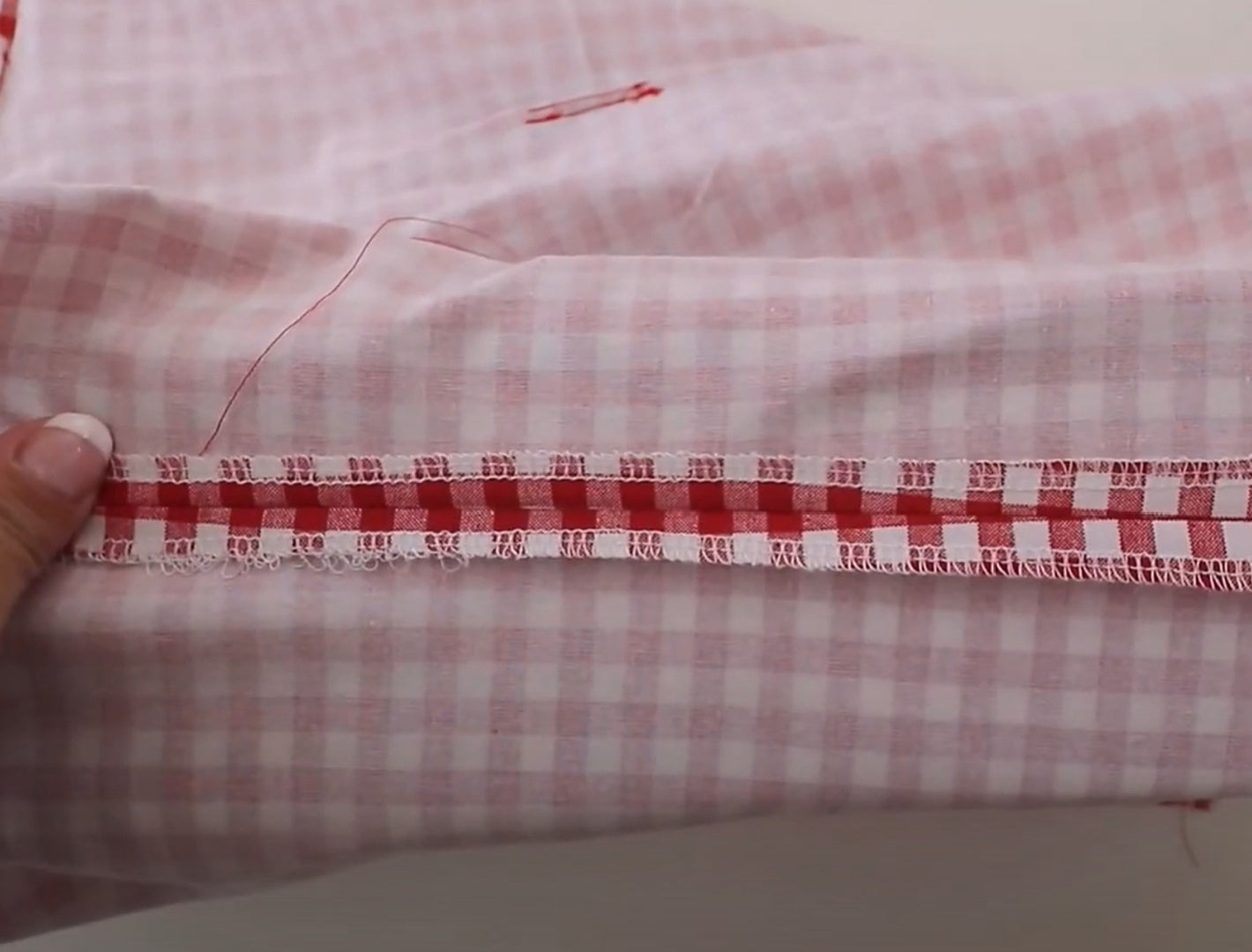
Finish raw edges with a serger, zigzag, or overcast stitch to prevent fraying and stabilize the seam.
Understitching
Understitch the seam allowance onto the sleeve so it lies flat. Keep tension consistent so the edge doesn’t roll.
Final Preparation
Clean up all loose threads. Leave the sleeve assembly as-is for now; final insertion into the garment comes next, and final securing will be done later through stitching in the ditch.
Transcript for the video: Western Blouse - Inserting the Puff Sleeves
Setting in the Sleeve
Now we're going to set the sleeve in. Make sure you’re putting the correct sleeve into the correct armhole. The way you confirm this is by checking the snip—this snip must face the front. That tells you this sleeve belongs on this side.
Start by working from the inside. First, align the underarm seams and pin them together so they sit directly on top of each other.
Next, find the shoulder snip on the sleeve and match it to the shoulder point of the armhole. This is your main reference point.
Distributing the Sleeve
After securing the shoulder, pin the lower section of the sleeve in place. Keep it flat at first—not stretched—just naturally shaped with your fingers so it sits smoothly in the armhole.
Then take the bobbin (gather) threads and gently pull them until the sleeve fits the armhole. Adjust gradually—don’t over-tighten. Once it fits, you can start pinning the rest of the sleeve up toward the shoulder.
Repeat the same process on the other side. If needed, adjust the gathering threads again until everything distributes evenly.
If the top section doesn’t gather enough, lightly tug the upper thread and redistribute. This helps even out tension.
Checking the Fit
Before sewing, measure and check the distribution from the snip outward. The gathers should be balanced on both sides of the shoulder point. If one side is uneven, adjust by easing fabric or releasing a bit of tension.
Always double-check from the outside as well. This is where mistakes become visible.
If something looks off, don’t ignore it—unpin and correct it. Even experienced sewing work requires adjustment at this stage.
Final Pinning and Sewing Preparation
Once the gathers are evenly distributed, repin securely. Keep checking as you go so nothing shifts.
Work from the inside when sewing. Start on a flat section first—do not begin directly on gathers or at a seam.
Keep the seam allowance consistent and guide the fabric slowly through the machine. As you reach gathered sections, gently control the fabric so it feeds evenly.
This is also the moment to make micro-adjustments—smooth the gathers as you sew and ensure they don’t bunch unevenly.
Pressing the Sleeve
After sewing, press the seam flat with steam.
Only press the seam area—do not flatten the puff of the sleeve. The goal is to set the seam without destroying the sleeve shape.
Use steam, lift, and reposition rather than pressing heavily.
Finishing the Cuff
Now finish the cuff.
Turn it up so only a small portion extends beyond the edge. Secure it temporarily with a pin.
Avoid folding it all the way to the edge. Instead, keep it slightly lower (around 1 cm down). This gives a cleaner internal finish and prevents the inside seam from being too exposed.
Lightly press this fold so it holds its shape.
Final Securing (Stitch in the Ditch)
To finish, turn the blouse inside out.
Stitch in the ditch along the seam line so the stitching becomes invisible. This locks the sleeve and cuff in place without visible topstitching.
Work carefully along the seam line and keep the fabric aligned so the stitch stays hidden inside the fold.
The sleeve is now fully set and secured.
Adding the Decorative Ribbon
Transcript for the video: Western Blouse - The Ribbon Hem
In this chapter, I'm going to show you how to add the little ribbon. It’s a houndstooth pattern, and it has a bit of stretch, which makes it easy to steam into place. It also gives the garment a more commercial finish rather than a handmade look.
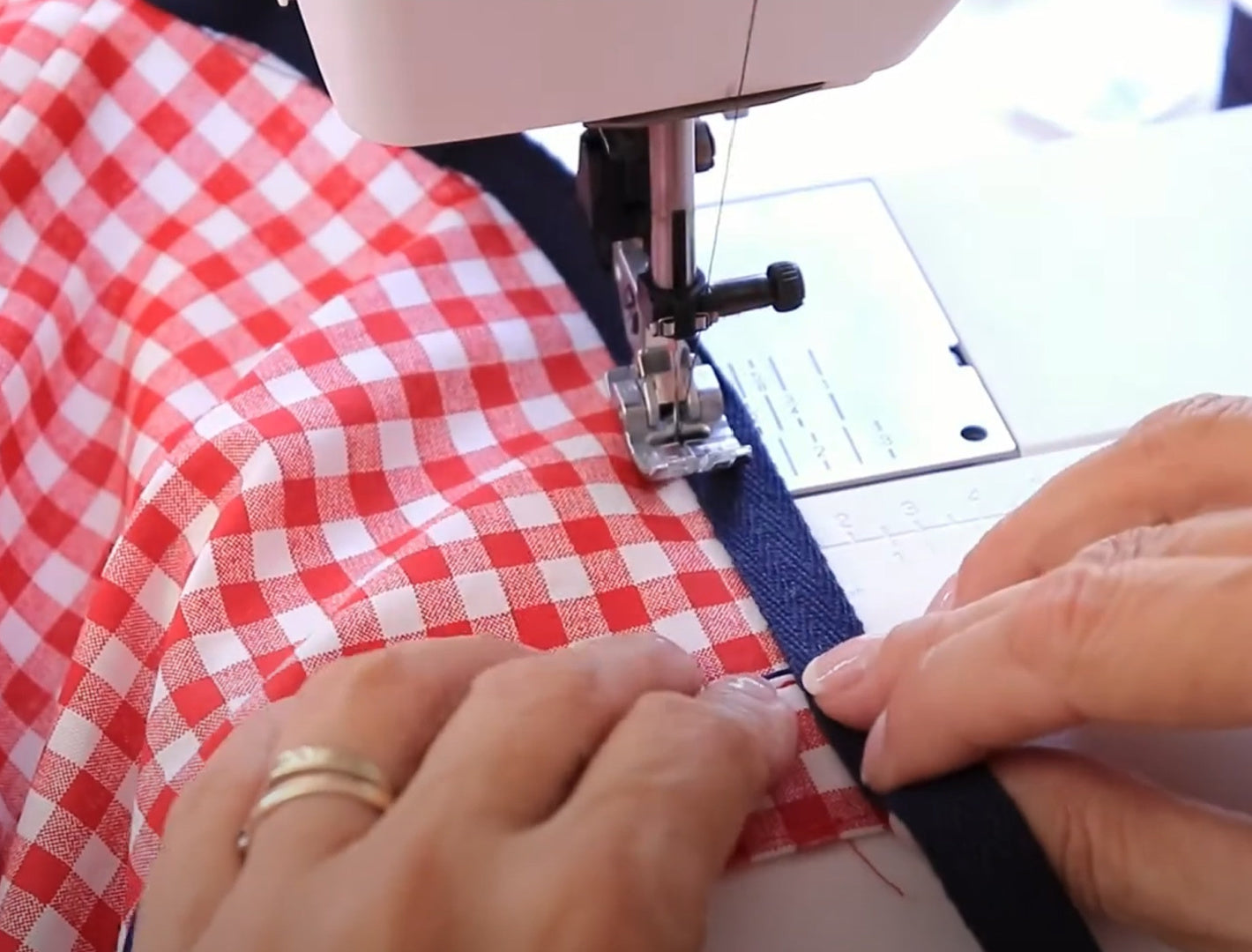
Attaching the Ribbon
Start by stitching the ribbon along the edge. Place it so it slightly overlaps the fabric—about 5 mm is enough. Sew close to the edge while keeping it aligned along the entire length.
As you sew, lift and guide the ribbon so it stays evenly positioned, then stitch it down securely along the edge.
Once attached, turn the ribbon upward along the edge.
Pressing the Ribbon
Now press the ribbon in place with an iron. This material responds well to steam, so you can easily shape it into position. Work along the edge and steam it gradually until it sits flat and clean.
Stitching and Thread Experiment
After pressing, sew it down to secure it.
You can experiment with thread colors—for example, blue on the bobbin and red on top. This can create a subtle contrast effect depending on the viewing angle.
If the threads interlock slightly or shift during stitching, adjust as needed, but proceed and test the result.
Finishing the Stitching
Continue sewing all the way around.
If needed, switch thread placement (for example, red on the bobbin and blue on top) and sew from the underside to balance the appearance.
The result can create a two-tone effect that changes depending on the side being viewed.
Final Result and Cleanup
The finished ribbon sits cleanly and gives the garment a more refined, boutique-style look. It can resemble a western or Bavarian-inspired detail, depending on the fabric choice.
Remove all loose threads and inspect the edge work. The final result should look clean, structured, and professionally finished rather than handmade.
Transcript for the video: Western Blouse - Bonus Lined Yoke
Hi, this is Marina from Frocks and Frolics, and I'm going to show you how to sandwich the front and back of a blouse or shirt into a yoke.
Preparing the Pieces
The easiest way to attach the yoke is to lay everything out exactly as it will be sewn so you don’t get confused. The lining (the white fabric) is not needed yet, so set it aside for now.
Place the yoke on top of the front piece that it will be sewn to. Then flip the edge so the pieces sit right sides together, making sure you start on one side and align the seam allowances carefully.
Aligning the Front Yoke
Make sure the seam allowances are directly on top of each other—this is critical for a clean, straight front edge, especially where the placket will go.
On the curved section, the fabric will feel tight. You can make small snips to release tension, even two if needed. Do not cut beyond the seam allowance.
Then gently curve the yoke into the front piece so it sits smoothly.
Checking Straightness
The front must remain very straight. This is important because it determines how clean the placket area will look later.
Now repeat the same process on the other side: flip the fabric, align seam allowances exactly, and ensure both edges match. You can pin first, flip it over, and check if everything sits straight before committing.
If the front piece extends slightly, that is expected. Adjust with small snips if needed, then ease the curve in.
Attaching the Back Piece
Now take the back piece and place it right sides together with the yoke.
Again, ensure seam allowances align precisely at the corner points. The back may shift slightly, so adjust it until both sides match correctly.
If the back is not perfectly aligned, it is less critical than the front, but still aim for accuracy.
Sewing the Yoke Seams
Sew using a narrow seam allowance (foot width). This allows the lining stitching later to cover it cleanly with a one-centimeter seam.
Go slowly around curves, especially where you have snipped to release tension. These snips make the curve easier to shape.
Before continuing, check that the front remains straight and everything aligns properly.
Preparing the Lining
Now flip the front so the wrong side is facing up.
Place the lining on top with the right side facing up.
You are now pinning right side to wrong side.
Start by pinning one side, then flip and continue pinning from the stitched side for better control.
Sewing the Lining
Sew with a one-centimeter seam allowance. Stay slightly to the left of the previous stitching line so it gets fully enclosed later.
Keep everything flat as you sew and continue matching seam allowances carefully.
You can add small snips in curved areas again if needed, but do not cut past the seam allowance depth.
Checking the Work
After sewing, check your seams carefully before trimming anything. It is much easier to correct issues now than after pressing.
Trim seam allowances in stages so they sit flatter and reduce bulk.
Turning the Yoke (Key Technique)
Now for the important trick:
Instead of overlocking or serging, take the lining and flip it so the right side folds inside naturally. Then pull the fabric through.
This will look twisted at first—that is correct.
Keep pulling until the shape forms properly and everything aligns cleanly.
Once positioned, pin it all the way across.
Finishing the Yoke
Sew with a one-centimeter seam allowance.
Then pull the fabric through to reveal a clean enclosed finish.
Press everything carefully and optionally topstitch for a professional finish. A twin-needle topstitch gives a clean, commercial look.
Repeat the same process for the back.
Final Result
Once pressed and topstitched, the yoke is fully enclosed and finished with a clean interior and exterior.
This completes the yoke construction with lining.
Transcript for the video: Western Blouse - Bonus How to Shirr Fabrics
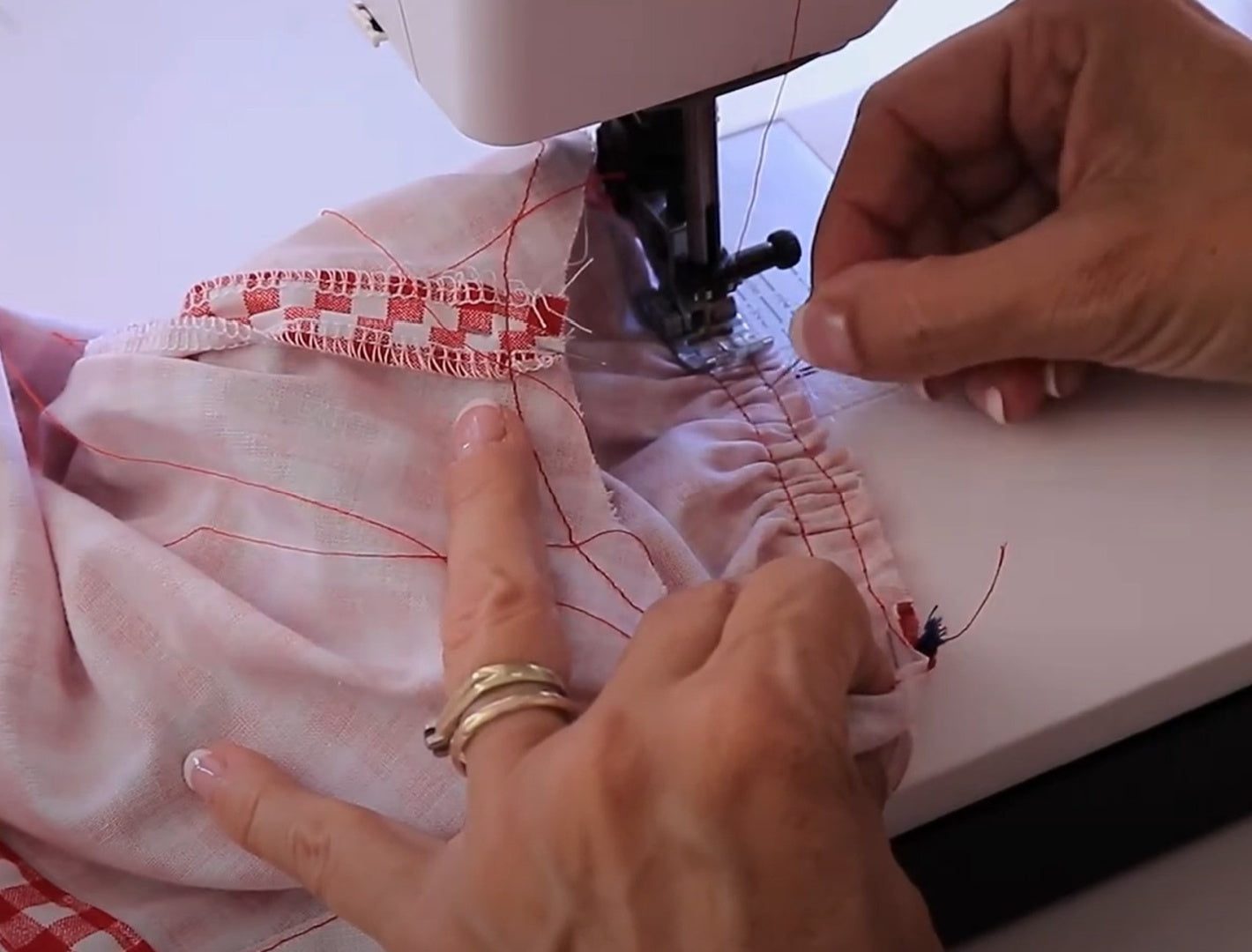
Hi, this is Marina from Frocks and Frolics, and I'm going to show you how to do smocking on my western blouse. This creates a beautiful fitted waistline effect.
Marking the Smocking Lines
To start, you need elastic thread and your bobbin case.
Take your pattern piece and use your existing markings from the pleat as a guide. Since the square has already been cut out, you can see where the pleat was placed and reuse that reference for smocking lines.
Draw one line at the bottom and one at the top. That’s enough—you don’t need to mark every single line. You will go down in foot-width spacing as you sew.
Before continuing, align the underarm seams, place a pin at the top mark, and check both sides. If it’s not perfectly aligned, adjust and redraw using a ruler so the line is straight all the way across.
Preparing the Bobbin with Elastic
Wrap elastic thread evenly around your bobbin. The tighter you wind it, the stronger the smocking will be. Leave the thread tails long so you can adjust tension later if needed.
Insert the bobbin into the bobbin case.
To bring up the elastic thread, hold the top thread with your left hand and slowly turn the hand wheel toward yourself until a loop appears. Pull the elastic through.
Set the machine tension to a buttonhole setting or low tension appropriate for elastic work.
Sewing the Smocking Lines
Start sewing directly on your marked line.
Do not backstitch—leave thread tails hanging so you can adjust tension later if needed.
After the first line, move down about a foot width and sew the next line parallel to it. Repeat for additional rows depending on how much smocking you want.
You will see the fabric start to gather and form the smocked effect immediately.
Adjusting the Smocking
Once sewn, check the tension. You can gently pull the elastic threads to adjust the fullness and even out the gathers.
If needed, redistribute tension so everything sits evenly across the panel.
Securing the Threads
Tie off the elastic threads securely. If you want finer control, you can leave them longer and adjust tension before final securing.
For more durable smocking (commonly used in dresses or panels), you can sew over both ends with a small stitch length (around 1.5). This helps lock the elastic in place so it won’t loosen over time.
Finishing the Smocking
Use an embroidery needle with a sharp tip to secure and tidy thread ends.
This process can take some time, especially if used on larger panels like dress backs.
For this western blouse, the smocking sits at the center back and gives shaping without needing a pleat. You can also skip smocking entirely if you prefer a looser, more casual shirt.
Final Notes
Smocking is a simple but powerful technique once you understand tension control. The key is consistent elastic tension and even spacing between rows.
Once you get comfortable with it, it becomes a very reliable method for shaping garments.
That’s it for smocking.
Creating a Clean Hem for a Shirt or Blouse
Transcript for the video: Western Blouse - Bonus Curved Hem
Hi, this is Marina from Frocks and Frolics, and in this video I'm going to show you a simple trick to create a clean, professional-looking hem on any shirt or blouse.
Initial Topstitching
Start by topstitching along the edge, about 4–5 mm from the raw edge (just under half a presser foot). Keep your stitch straight and consistent as you work across the fabric.
This line will act as a guide for the fold and helps control the hem later.
First Fold and Press
Once the stitching line is complete, fold the fabric up along that stitched line and press it firmly with an iron.
Use plenty of steam while pressing. This step helps set the fold and makes the hem much more accurate and stable.
Second Fold and Shaping
After pressing the first fold, turn the hem up again to the desired depth and press it once more.
This double-fold method creates a clean and even hem. It’s especially helpful around curves, where controlling the fabric is usually more difficult.
The initial stitch line makes shaping much easier and prevents the hem from distorting.
Final Topstitching
Return to the sewing machine and topstitch close to the folded edge.
Use a stitch length of 3 and sew slowly and evenly around the hem. Keep the fold aligned as you go, adjusting slightly if needed.
The guide stitch helps maintain the curve and prevents the hem from rolling or losing shape.
Final Result
Once finished, the hem should sit cleanly, evenly, and hold its shape without puckering. The double fold combined with the guide stitch creates a professional finish that works especially well on curved hems.
That’s it—you now have a simple but very effective hemming technique.
Transcript for the video: Western Blouse - Bonus The Long Sleeve with Cuff
Hi, this is Marina from Frocks and Frolics, and in this video I’m going to show you how to work a long sleeve for the Western blouse. It’s recently had an update and now goes from 9 to 12 months all the way up to 12 years. I hope you really enjoy this. Let’s get started.
For the cuff on the Western blouse, you will need the cuff piece four times and two times in interfacing. Use iron-on interfacing because that’s easiest.
On the sleeve, you will see a marked opening for the slit. You can work this slit in two ways: you can add a placket like a boys’ shirt or gentleman’s cuff (there’s a separate video for that), or you can gather it, which is what I’m doing here.
Preparing the Bias Binding and Sleeve Slit
For this version, I’m using bias binding without cutting on the bias because I have a stripe, and stripes are easier to handle. First, iron the bias binding lengthwise in half. Then fold each side toward the center, but don’t press exactly on the center line—shift slightly so one folded edge ends up a bit longer than the other. That longer side will go underneath when sewing, so you catch it more easily when topstitching.
Now place the bias binding onto one side of the sleeve slit. Stitch it down first along one edge. At the tip, only catch a very small amount—just a millimeter or two—so it stays neat. Start with a full seam allowance, then taper into the tip, then return to full seam allowance on the other side.
Once stitched, fold the bias binding over and topstitch it down. Keep the underside slightly wider so it gets caught properly. Hold it steady as you sew, especially around the tip. Secure your stitches at the end.
Remove any basting threads if you used them, then press the bias binding flat.
Securing the Slit and Adding Gathers
Turn the bias binding inward so it sits cleanly. Stitch across the small triangle at the top to secure it so it doesn’t shift.
Now add gathers or pleats to the sleeve opening. In this version, I’m using gathering. Sew two parallel lines of stitching (about 10 cm long) with a long stitch length, then gently gather. Secure the threads if needed.
Interfacing and Cuff Preparation
Next, apply interfacing to the underside of the cuff pieces. If you’re using lace or decorative trim, place it carefully on the cuff piece with allowance for seam width. Around curves, add a small pleat in the lace so it doesn’t pull tight when turned.
Stitch the lace in place with a small seam allowance—just a few millimeters where needed. Continue carefully around the cuff, adding small pleats where required for shaping.
Once attached, place the second cuff piece (non-interfaced) on top and stitch around the same edge.
Trim seam allowances in stages to reduce bulk, then press well with steam.
Sleeve Gathering and Attaching Cuff
Add gathering threads to the sleeve head: one line close to the edge and a second line a foot-width away, using the longest stitch setting.
Attach the sleeve to the bodice: match the sleeve snip to the front, align shoulder points, and pin underarm seams. Distribute gathers evenly—about 4 cm on each side of the shoulder point (adjust depending on size).
Check distribution visually from the outside before stitching.
Sew with a 1 cm seam allowance, keeping everything flat. Then finish the seam with a serger or overlock stitch.
Press the seam flat (do not flatten the sleeve cap completely—just shape it with steam so it stays rounded).
Closing the Sleeve and Side Seam
Now close the sleeve and side seam in one continuous seam. Match underarm seams and pin carefully. Stitch with a 1 cm seam allowance.
Finish edges with a serger or zigzag stitch, then press the seam toward the back.
Attaching the Cuff
Turn the cuff so the bias-bound edge is folded correctly. Attach the interfaced side (with lace or decoration) to the sleeve, right sides together.
Ensure the gathered sleeve fits evenly into the cuff. Keep a few small gathers for a softer, more feminine finish rather than sharp pleats.
Sew around the cuff edge with a 1 cm seam allowance, stopping cleanly at the edges without catching the lace.
Remove gathering threads, then press the seam allowance into the cuff.
Fold the lining inside, carefully shaping the lace along the edge. Pin so it just covers the seam line.
Topstitching and Finishing
Topstitch from the outside using stitch length 3 (or longer for larger sizes). Start in an inconspicuous area and sew evenly around the cuff, removing pins as you go.
Press again once complete.
Buttonholes
Mark buttonhole positions evenly, usually about 1.2–1.3 cm from the edge. Ensure spacing is consistent.
Important: place buttonholes only on the side where the bias binding is turned in. Misplacing them will require unpicking.
Sew buttonholes using a buttonhole foot or manual machine control for precision. Choose button length carefully based on your buttons.
Finally, sew on your chosen buttons—metal buttons work especially well for this design.
Final Result
And that completes the long sleeve for the Western blouse. Thank you for watching, and I hope to see you again for the next project.
I made two blouses for my granddaughters. They both turned out well but I have the placket around the wrong way on both. I am misreading the instructions. I didn't watch the video as I was sure I was right. Next time I will and there will certainly be a next time.
Easy to follow the video tutorials
Love the pattern. I haven't made the actual one yet, but I love it when items arrive timely and exactly as stated. Thank you!
Easy to follow, good fit