
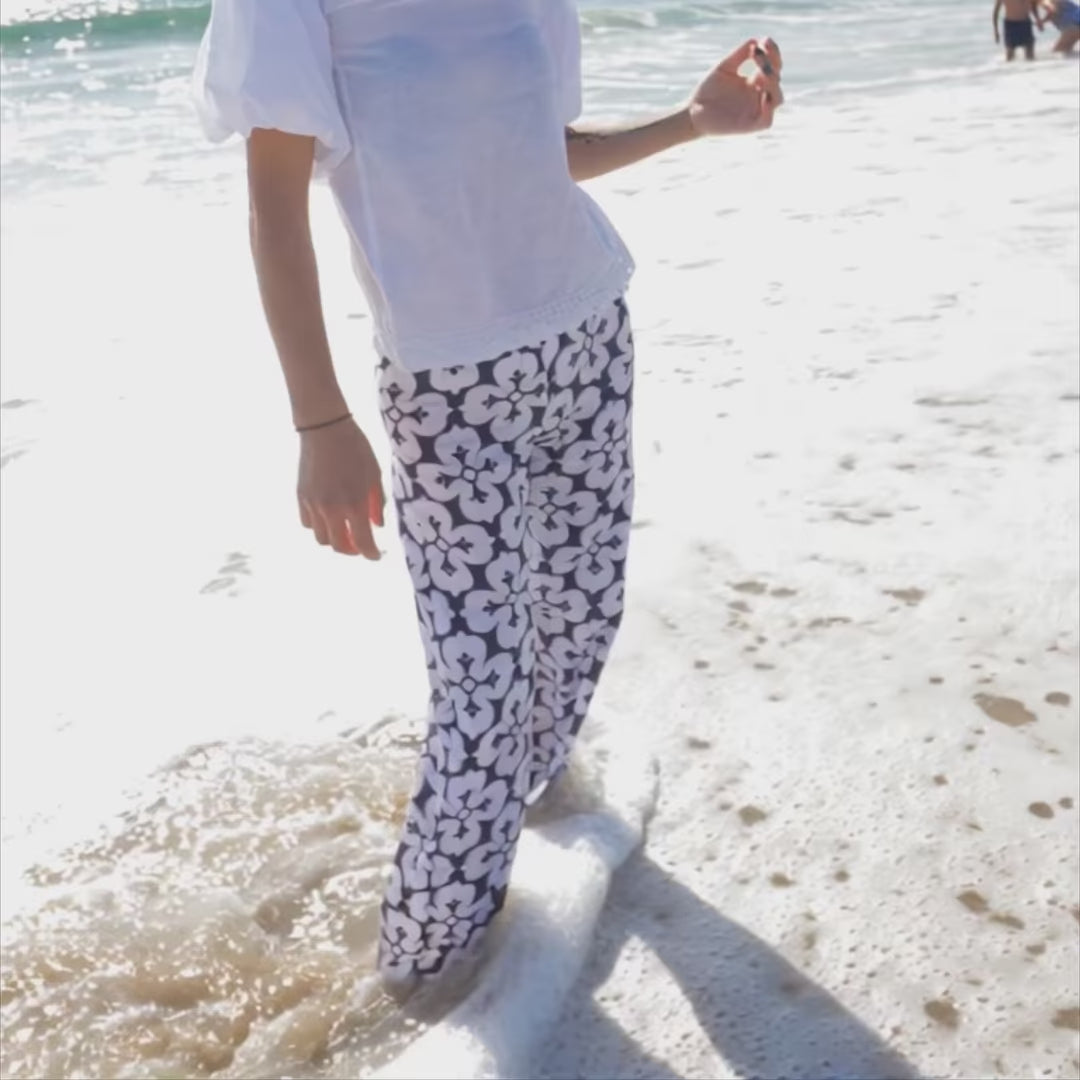
DEVON PANTS
DEVON PANTS
Couldn't load pickup availability
Devon is a breezy, elegant trouser sewing pattern designed for anyone who loves the effortless flow of straight wide pant legs and the relaxed charm of a low waist. She blends the ease of relaxed‑fit pants with the soft swish of festival‑style wide‑legs, making her a dreamy choice for warm days, slow mornings, and cottagecore wanderings.
Perfect for beginners, our detailed sewing course walks you through every step to ensure a polished, professional‑looking finish, scroll down a wee bit to the video tutorials and get started.
Pattern Download Includes
- Instant Download
- DIN A4 & US Letter Size
- Multi-Size Pattern
- A0 Copy Shop
- Detailed eBook
- Video Tutorials
Design Options
Design Options
- Low waist
- Waistline facing
- Concealed zipper
- Option of slender fit and wider legs
- Full length, 3/4 length
Fabric Requirements
Fabric Requirements
BEST FABRIC CHOICE
Lightweight woven fabrics in linen, silk or cotton.
FABRIC REQUIREMENTS
- Age 12 to Ladies Size 0: 1 Yard (1.10m)
- Ladies Size (US) 2-14: 2.2 Yards (2m)
- Ladies Size (US) 16-22: 2.5 Yards (2.3m)
NOTIONS
- Matching Thread: One Reel
- Sewing Needle: Standard 80
- Iron on Interfacing (H180): 12 inches (30 cm)
- Concealed Zipper: 9 inches (21 cm)
Available Sizes
Available Sizes
- 0-22 (US) + Teen Age 12,14,16
- 2-24 (UK) + Teen Age 12,14,16
- 32-52 (DE) + Teen 152-176
Please Read
Please Read
- This is a digital pattern or PDF file, not a physical product. It will be delivered electronically via a download link delivered to the email used for the purchase.
- To ensure the pattern prints at its actual size, it's recommended that you use Adobe Acrobat Reader.
- The pattern creator, Frocks & Frolics, welcomes small-scale production using their patterns.
Customers are encouraged to tag Frocks & Frolics when sharing projects made using their patterns on social media.
@frocksandfrolics #frocksandfrolics
Share

STEP-BY-STEP VIDEO TUTORIALS
VIDEO TEXT
Introduction to the Project
Transcript for the video: The Devon Pant - Project Introduction
Welcome to the Hipsters! I want to take you quickly through this course so you know exactly what to expect.
We’re going to make a pair of trousers with a concealed zipper closure. It’s not difficult once you understand the method, and I’ll show you every step so it becomes second nature.
These trousers have no darts. They sit about 4 cm below your natural waist. If you look at mine, this is where my waist would be, and the trousers sit just a little lower. This makes the construction much easier because we don’t need darts — and that means faster sewing.
We’ll also be doing some understitching to create a beautifully firm, clean edge at the top of the trousers. Maybe you’ve done it before, maybe not — either way, you’ll learn it here.
After that, we’ll simply put the trousers together. It’s a very straightforward project that even beginners can sew confidently.
The course is divided into six chapters:
- You’ll learn everything about the trousers and the pattern
- How to adjust the pattern if you have a special figure type
- How to cut out your fabric without issues
- And then we’ll go through the construction step by step
- Until we reach the hem and finish the trousers completely
I hope you’re going to enjoy this course.
So without further ado — jump right into Chapter One!
The Sewing Pattern explained
Transcript for the video: Devon Pants - The Sewing Pattern
You’ll need a nice, sturdy medium‑weight fabric. I used linen, but denim works just as well. A fabric with a bit of stretch, like sateen (not satin — satin drapes softly, sateen has body and structure), is also a great choice if you want that beautiful wide leg.
You’ll also need an invisible zipper. The length doesn’t really matter — mine is far too long, but that’s fine, we’ll just trim it later. The only important thing is: good quality, because cheap invisible zippers break easily.
Then, of course, you need the pattern. You can print it in A0, A4, or Letter. You’ll also need some fusible interfacing for the facings. You can use the narrow roll‑type interfacing too. For very heavy fabrics, it’s enough to reinforce only the top edge (as shown in the e‑book), but generally I recommend interfacing the entire facing.
And that’s it — a very simple, very quick pattern.
Checking and assembling the pattern
Before you cut anything, check the test square. I always print just the first page — if the square measures 5 cm or 1 inch, everything is correct.
The pattern is super easy to assemble. It’s arranged alphabetically — A, B, C, D — just like you’ve done countless times before. The two facings are cut on the fold, which is why 1 cm is missing at the front and back center — that’s already included in the pattern.
You need two front pieces and two back pieces. Make sure to cut a pair — mirrored — so you don’t end up with two left or two right legs.
Finding the right size
The most important measurement is the hip circumference. The waistband can be adjusted easily later.
The chart also includes the finished hip and finished mid‑hip measurements. This is super helpful: if you have a pair of pants that fits you well, simply measure the hip. If your pants measure, for example, 107 cm and the finished measurement in the pattern is also 107 cm, you know: that’s your size.
The mid‑hip is where the pants sit — a low rise. This measurement is hard to judge because everyone measures in a slightly different spot. So the rule is: adjust at the waist, because that automatically matches the hip curve.
You’ll also see teen sizes (12, 14, 16). Many of my customers from Asia are very slim and struggle to find pants that fit — children’s sizes are too short. These teen sizes solve that problem. The length is the same for all sizes, so for teenagers you’ll need to shorten the legs.
All pattern pieces have a lengthen/shorten line. You can adjust there — but honestly: the leg is so straight that you can easily shorten it at the hem.
Quick fit adjustments (without complicated theory)
Every bum is different — here’s the quick method without diving deep into pattern theory.
If you need more room for the bum
- Follow your size line to the crotch seam.
- Then go one size up (or two) along the back crotch seam.
- Don’t add width at the side seam — that creates unnecessary darts.
- You’re only adding length and shape where the bum needs it.
If you have a very flat bum
- Remove a little at the back crotch seam.
- Go one size smaller there, then blend back to your size.
If you have wide hips and a flat bum
- One size smaller at the crotch seam,
- follow that line down,
- and blend back to your hip size at the top.
If you have an apple shape (like me!)
- If your waist is fuller, go one size up at the waist,
- then blend back to your hip size.
- You don’t want extra width at the hip — only at the top.
If you have a long rise
- The pants will pull down at the back.
- Go one or two sizes up at the back crotch seam,
- and blend back to your size if your bum is small,
- or stay on the larger line if your bum is fuller.
If you have a round tummy
- Go one or two sizes up at the front waist,
- and blend back to your size below the hip.
If you want to learn the full theory
In the course you’ll find a chapter with Alexandria’s videos. She explains:
• adjustments for a full bum
• flat bum
• long or short rise
• hip variations
• tummy shapes
There’s also a practice pattern so you can try everything out.
Ready to cut
Now you know your size and any adjustments you need.
In the next step, we’ll cut the fabric.
Let’s go!
Cutting Out the Trousers
Transcript for the video: Devon Pants - Cutting out the Fabric
Now we’re ready to cut out our trousers, and I’ve already laid the pieces out here. There are really three different ways you can cut your trousers:
- Side‑by‑side layout — perfect for smaller sizes,
like the one I’m using here. Both legs fit next to each other without
overlap. - Offset layout — one leg is placed slightly
lower than the other so everything fits on the fabric. - Double‑length layout — for larger sizes (size 16, 18
and up), you will need twice the length of the trouser leg you want
to make.
Before buying fabric, you can even measure your finished pattern pieces to estimate how much fabric you’ll need.
I’ve also placed the back facings here, but I’m not cutting them out yet. Instead, I’ll cut them after the trouser legs, so I can use leftover fabric more efficiently. There’s usually a nice long strip left over, and I might even squeeze a little top out of it — not for me, but for a child.
Cutting the Facings From Leftover Fabric
Now everything is cut out except the facings. I want to cut these from leftover fabric, so I’m using the long strip that was left between my two trouser legs. No need to waste more fabric.
Pin the facings carefully — this fabric can shift quite a bit.
The pattern says “cut on fold,” so make sure the fold is straight.
Cut them out, and remember to snip the center front or center back notches.
I’ll cut the first facing, then slide the pattern over a little and cut the second one. I always have loads of interfacing at home, yet somehow I still run out. For this one, I’m shifting the pattern slightly so I don’t waste fabric.
Cut out the second facing — and that’s it.
Preparing the Pieces
Now we’re ready to prepare all the pieces.
- Overlock/serge
- Overlock everything
except the waistline and the hem. - Also overlock the lower edge of the facings.
- Iron on the interfacing
- Place the fabric with the wrong side up.
- Place the interfacing with the glue side down.
- Press with the iron and count to eight —
one… two… three… four… five… six… seven… eight.
That’s the rule I learned as an apprentice. - Linen is very forgiving — it doesn’t scorch easily — so you can leave the iron on a bit longer if
needed.
Move the iron across the entire facing until everything is fused nicely.
In the next chapter we are looking at inserting the concealed zip. Hope to see you there.
Inserting the Concealed Zipper
Transcript for the video: Devon Pants - Inserting a concealed Zipper
Now we’re going to insert the concealed zipper. It goes on the left-hand side, just like mine here. When it’s sewn in properly, you can hardly see it. We insert the zipper first and then close the side seam afterward.
Start by measuring the length of your zipper — 16 cm — and mark that length directly onto your fabric. Make sure the zipper opening is on the left side of the body. If your front piece is lying in front of you, the center front should point away from you.
Mark the 16 cm on both sides.
Concealed zippers are often a bit longer than needed. You only need about 1 cm plus a little extra for a hook and eye. Mine is slightly too long, so I’m trimming it. Just make sure you trim both sides evenly, leaving about 1 cm plus a bit of allowance.
Next, mark the zipper itself. I simply laid it down and marked the point where it needs to end. This ensures both sides are sewn in at exactly the same height — otherwise you get a little pleat at the bottom, which we don’t want.
Now you know exactly where the zipper will sit. Place a pin there so you can’t get it wrong.
Pinning the Concealed Zipper
Place the zipper with the teeth facing up and pin the first side along your marked line. Start at the top and work your way down. It’s not difficult — the important part is that both the zipper and the fabric are marked correctly.
Now pin the second side. To avoid twisting the zipper, simply flip it under the fabric and lay the front piece over it. Add one pin to hold it in place — we’ll pin properly from the other side in a moment.
Open the zipper completely and pin the second side neatly. Make sure the bottom markings line up exactly. Pin close to the edge so you maintain your 1 cm seam allowance.
Close the zipper once to check that nothing is twisted. Always check — everyone has sewn in a twisted zipper at least once.
Sewing the Concealed Zipper
For concealed zippers, it’s best to use a concealed zipper foot. This foot rolls the zipper teeth open so you can stitch right next to them, making the zipper disappear completely.
Before sewing it in permanently, we add a holding stitch. This keeps the zipper from shifting — in industry, this is always done.
Open the zipper and sew a narrow line (2–3 mm from the edge) along both sides.
Now sew the zipper in properly. Roll the teeth open slightly so they stand up, guide them into the groove of the foot, and stitch the first side. Repeat for the second side.
Make sure the point of the foot sits neatly in the groove — that’s what makes the zipper invisible.
Checking the Result
Close the zipper and look at it from the outside. You’ll see how cleanly both sides match. In my example, the pattern even lines up — that was pure coincidence, not planning.
If your zipper was too long and you trimmed it, sew across the bottom once more to secure it. Cut off the excess teeth with paper scissors, not your fabric scissors.
Closing the Side Seam
Lay the side seam flat and pin it all the way up. Switch back to your regular presser foot and sew up to the point where the zipper begins.
Then switch back to the concealed zipper foot, move the needle all the way to the left, and sew from that point upward, right next to the zipper, going just a tiny bit past the point where the zipper is attached. Secure your stitches.
Pressing and Finishing
Open the trousers and look at the zipper — it should sit perfectly. Press the seam allowances open, first from the inside, then from the outside. The result is a beautifully inserted concealed zipper.
Now that the zipper is in and the seam is pressed, we can move on to the next chapter, where we’ll finish the remaining seams.
The Seams
Transcript for the video: Devon Pants - The Seams
Now we're going to pin the seams. I’ve already pinned one leg together, so we’ll work on the leg we haven’t touched yet. Place the two pieces on top of each other and pin from the top down to the lower end.
Make sure the lower part of the leg lies completely flat. At the top, you’ll notice there is a little bit of extra fabric — about 1 cm — on the back leg. Do not trim this off. This small amount of ease helps the trousers fit better, so we want to keep it. Hold it in place as you pin.
Then flip the leg over and pin the other side as well. Now we can take it to the sewing machine and sew the seam.
Once the seam is sewn, press the seam allowances open. A sleeve ironing board works wonderfully here — you can slide the trouser leg over it and press with plenty of steam.
Turning One Leg Inside Out and Sewing the Crotch
Next step: turn one trouser leg inside out. Then slide it into the other leg. This allows us to sew the crotch seam in one continuous line. It’s very easy once you’ve done it once.
Pin the front crotch together, then the back crotch, and continue pinning all the way around.
Now sew the entire crotch seam in one go. You can start at the front or the back — whichever you prefer. Always sew from the inside so your pins are on the side you’re stitching, and you can move the trousers around easily.
Pressing the Crotch Seam
Once the crotch seam is sewn, press the seam allowances open again. You won’t be able to press all the way down the leg, but you can press the upper part at the front and back. That’s all you need.
Ready for the Facings
And now we’re finally ready to attach the facings.
I’ll see you in the next chapter, where I’ll show you exactly how that works.
Attaching the Facing and Finishing the Waistband
Transcript for the video: Devon Pants - The Facing
Now we're going to work on the facings. One side is still open, so imagine the facing lying inside your front piece with that open edge aligned. This helps you see clearly which sides need to be sewn together. Pin the correct sides — it's very easy to mix them up — and then close the seam
with a 1 cm seam allowance.
After that, serge or overlock the lower edge of the facing.
Attaching the Facing to the Zip and Waist Edge
Next, I’ll show you how to attach the facing to the zipper and to the top edge of the pants. The first time you do this, it may feel confusing, but once you've done it once, it all clicks into place.
Start by placing the facing onto the side seam you just closed — this is the side opposite the zipper. Pin it in place. Once the facing is aligned with the center front and center back, you’ll notice it needs to be shortened slightly. Reduce the length by about 0.5 cm so it sits
neatly next to the zipper.
Now we sew the facing to the zipper — but only halfway across the zipper tape. You can see this clearly when you fold it open. Sew it on, then move to the next step.
Folding and Securing the Facing
Fold the zipper inward so the firm edge of the zipper tape sits neatly inside the facing. Fold the facing over it and sew across. This gives you a clean, professional finish.
Once sewn, open it out — it should look tidy and smooth. If this is your first time, it may feel strange, but it becomes very logical once you’ve done it.
Place a vertical pin to keep the zipper in position, then pin the rest of the facing. Before stitching everything together, repeat the same process on the other side.
On the second side, align center back to center back. If you haven’t shortened the facing yet, trim it by about 0.5 cm so it lies flat. Sew it in place.
Sewing the Facing All Around
Turn the facing inwards, place a vertical pin to secure it, add another pin at the top edge, and now you can sew all the way around with a 1 cm seam allowance.
Remove pins as you go and keep the fabric edges aligned.
Checking the Top Edge
Turn the pants right side out and check whether the top edge is even. If there’s a small dent or uneven spot, simply place it back under the sewing machine and correct that tiny section. Once fixed, the top edge should look smooth and straight.
Understitching the Facing
To make the facing sit beautifully and prevent it from rolling outward, we understitch. This means stitching the seam allowance onto the facing.
Place the facing under the sewing machine. You can’t start right at the very edge because that part is already enclosed, so begin a little further in. Stitch about 2 mm from the seam, all the way around.
You’ll see a second line of stitching on the underside — this is correct. The facing will now roll inward perfectly.
If you accidentally caught a seam allowance somewhere, just snip it free.
Securing the Facing
To prevent the facing from riding up, attach it to the side seam. You can stitch in the ditch or use a few small hand stitches. I’m using hand stitches here — just catch the seam allowance, not the outside fabric. A few stitches are enough to keep it secure.
Trim the thread.
Final Notes
Your facings are now beautifully attached. You could add a hook and eye at the top if you like, but it’s not essential. The pants are finished except for the hem, which we’ll complete in the next chapter.
THE HEM
Transcript for the video: Devon Pants - The Hem
We’re almost finished now. All we have to do is serge or overlock the ends of both trouser legs, and then we’re going to turn them up. If you’re making the shorter version, you can trim away the curve that’s built into the hem. If you’re making the longer version, leave the curve as it is. I’m making
the long version, so I’m turning up my hem.
I’m turning the trousers to the left side, the wrong side of the fabric. You don’t actually have to do that — I didn’t do it in the German version — but let’s do it a little differently here. Pin up the hem on one side, then on the other side. The hem allowance is 3 cm. Don’t forget to pin the center as
well.
Check everything… yes, that looks good. Now turn your trousers back to the right side, because it’s actually easier to sew from the inside. You could press the hem first, but honestly, I don’t think it’s necessary.
Now we’re just going to sew all the way around with a 3 cm seam allowance.
And that’s it — your trousers are done! I’m quite excited now. I’m just going to give the hem a quick press, and it looks fantastic. I’m really happy with these pants. Well done — you are finished!
I hope you share everything you’ve made on Facebook, Instagram, and all the other places I don’t even know about. And don’t forget to hashtag your creations with #frocksandfrolics.
The Indian Summer Collection has a few more items for you, so make sure you check them out. We’ve got a skirt, a top, the beautiful Grace Blouse, and of course these fantastic trousers.
I hope to see you again soon with another course. Bye for now!
I have made these trousers and they are the best fitting trousers ever. A brilliant pattern. Thank you!